The Temple of Horus's darkened ceiling
Gaze upward in the initial hypostyle hall and observe a distinct blackening on the ceiling.
Full story unlocks in the tour
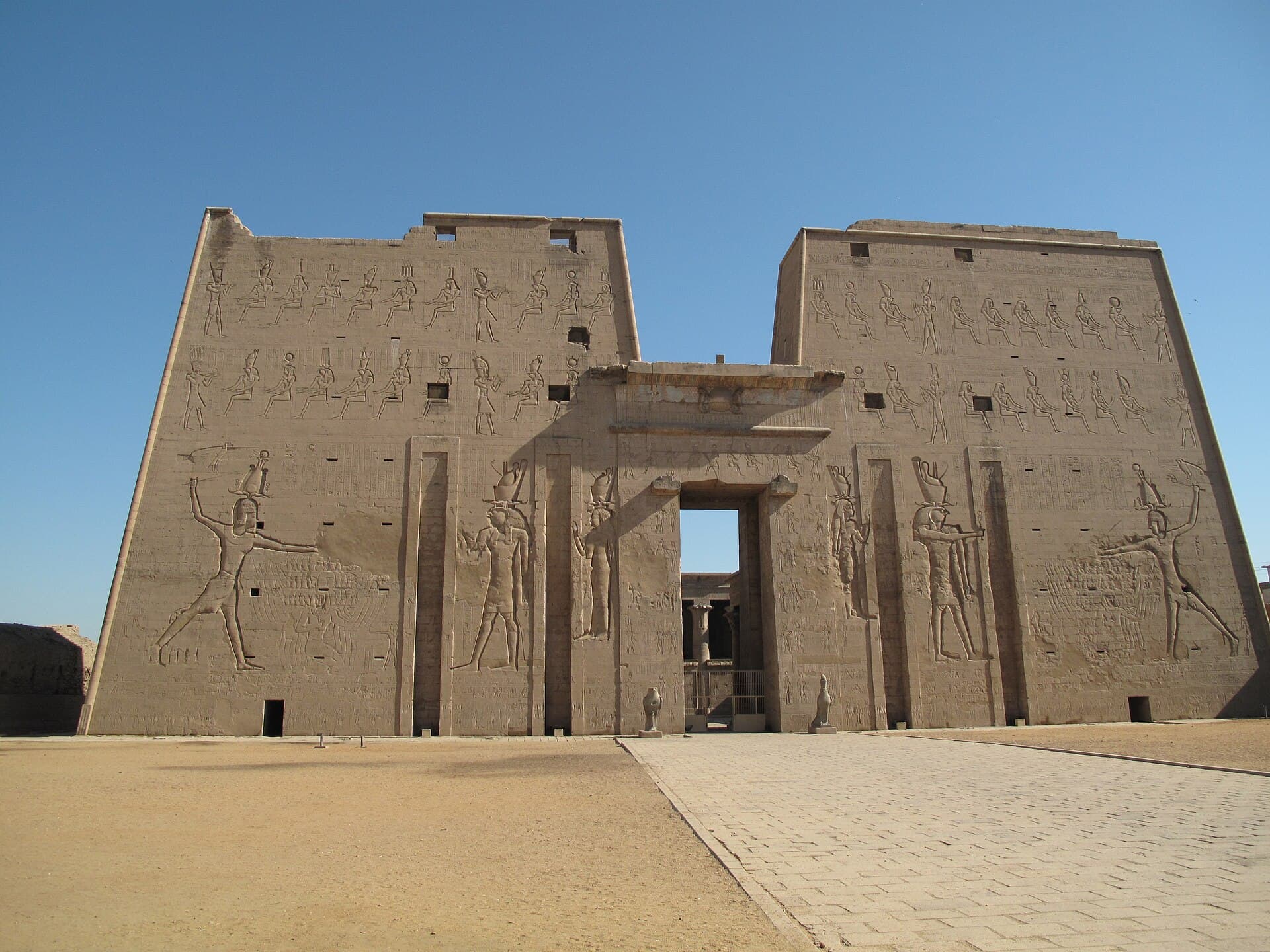 Patrick.reb / CC BY-SA 3.0, via Wikimedia Commons
“Edfu: Where ancient myths, etched in stone, continue to breathe.”
Not the postcards. The stories even locals don't know — whispered in your ear, right where they happened.
Gaze upward in the initial hypostyle hall and observe a distinct blackening on the ceiling.
The Temple of Horus appears as a singular, magnificent structure, yet it rests upon something far older.
The remarkable preservation of the Temple of Horus owes itself to an unexpected 'architect'.
Discover every secret of Edfou
Every address, every reveal in full — in your ear, right where it happened.
You pick your stops. You walk. The voice reveals what the others miss.
No tours available yet. Check back soon — we're preparing them.
Edfu, an ancient city upon the Nile's western bank, finds its renown in the magnificent Temple of Horus. This colossal sandstone edifice stands as one of Egypt's most carefully preserved shrines, offering an unparalleled window into Ptolemaic-era Egyptian religious practices and architectural splendor. Positioned almost equidistant between Luxor and Aswan, Edfu is a frequent and significant pause for those navigating the Nile, providing a tangible connection to a civilization that shaped much of the ancient world.
Unlike many other ancient Egyptian sites that exist largely as remnants, the Temple of Horus at Edfu remains remarkably whole, with its towering pylons, intricate reliefs, and even its original roof largely intact. This exceptional state of preservation permits visitors to experience the temple's deliberate progression from bright, open courtyards to increasingly sacred and shadowed inner sanctuaries, much as ancient worshippers would have.
The Temple of Horus at Edfu stands as a testament to the Ptolemaic Kingdom's dedication to traditional Egyptian religious architecture, even as Greek rulers governed Egypt. Construction commenced on August 23, 237 BC, under Ptolemy III Euergetes, and it required an extraordinary 180 years to complete, finally concluding in 57 BC during the reign of Ptolemy XII Auletes, Cleopatra VII's father. This extensive building period, spanning multiple generations of rulers, mirrors the prosperity of the era and the dynasty's aspiration to legitimize their authority by honoring native Egyptian customs and deities.
The temple was consecrated to Horus, the falcon-headed god of kingship, protection, and the sky, often identified with the Greek god Apollo. Edfu was considered a pivotal site in Egyptian mythology, believed to be the location of the epic confrontation between Horus and his uncle Set, a cosmic struggle representing the triumph of order over disarray. This foundational myth is extensively depicted throughout the temple's reliefs, serving as both a place of worship and a ceremonial venue for reenacting these crucial events.
Over the centuries, following the decline of ancient Egyptian civilization and the emergence of Christianity, the temple fell into disuse. In 391 AD, when non-Christian worship was outlawed, many of the temple's carved reliefs were defaced, and evidence of fires, potentially set by early Christians, can still be observed on the hypostyle hall's ceiling. Subsequently, the temple became interred beneath layers of desert sand and Nile silt, reaching a depth of approximately 12 meters (39 feet). This burial, while accidental, proved to be its salvation, safeguarding its architectural and decorative elements from the ravages of time and human interference. It was not until 1860 that French Egyptologist Auguste Mariette began the extensive work of excavating and restoring the temple, reintroducing this remarkably preserved ancient wonder to the world.
The Temple of Horus offers a journey through ancient Egyptian cosmology and architecture. Your visit commences at the monumental pylon, standing 36 meters (118 feet) high and adorned with colossal reliefs of Ptolemy XII striking his adversaries before Horus. Guarding the entrance are two grand granite statues of the falcon-headed god Horus. Passing through the pylon, you enter a vast, open peristyle court, lined with columns featuring intricate floral capitals. This area, once accessible to the public, displays reliefs depicting offerings and hymns.
Beyond the court lies the first hypostyle hall, a dimly illuminated space supported by 12 towering columns, their ceiling painted with astronomical scenes. A second, smaller hypostyle hall leads to the inner sanctuary, the holiest part of the temple, which once cradled a sacred statue of Horus on a bark-shaped pedestal within a granite naos (shrine). Encircling the sanctuary are nine chapels and an ambulatory corridor, where religious texts and ceremonial objects were kept. Be sure to observe the Nilometer, a well used to measure the Nile's water levels, and the mammisi (birth house), celebrating the divine birth of Horus.
The most favorable period to visit Edfu falls during the cooler winter months, from October to April. During this time, daytime temperatures remain mild and pleasant, ranging from 20°C to 25°C (68°F to 77°F), making it comfortable for exploring the outdoor temple complex. Summers, from May to September, are marked by intense heat, often exceeding 40°C (104°F), which can make extended outdoor excursions challenging. Arriving early in the morning or late in the afternoon helps avoid larger groups and provides optimal lighting for photography.
Edfu is conveniently situated between Luxor and Aswan, making it a standard stop on most Nile River cruises. Many cruise ships anchor at Edfu's riverside, and visitors often take a brief horse-drawn carriage ride (hantoor) to the temple entrance. Alternatively, Edfu is reachable by road or rail from nearby cities. The temple generally welcomes visitors daily from 7:00 AM to 5:00 PM, with entrance fees typically ranging between 160 and 220 EGP. While exploring, wear comfortable walking shoes, a hat, sunglasses, and high-SPF sunscreen, especially during the day. Carrying bottled water is also advisable. Consider engaging a licensed guide to fully appreciate the intricate symbolism and historical narratives etched into the temple's walls.