Dwarkadhish Temple
The grand flag atop the Dwarkadhish Temple is changed several times a day, a lively spectacle visible from afar.
Full story unlocks in the tour
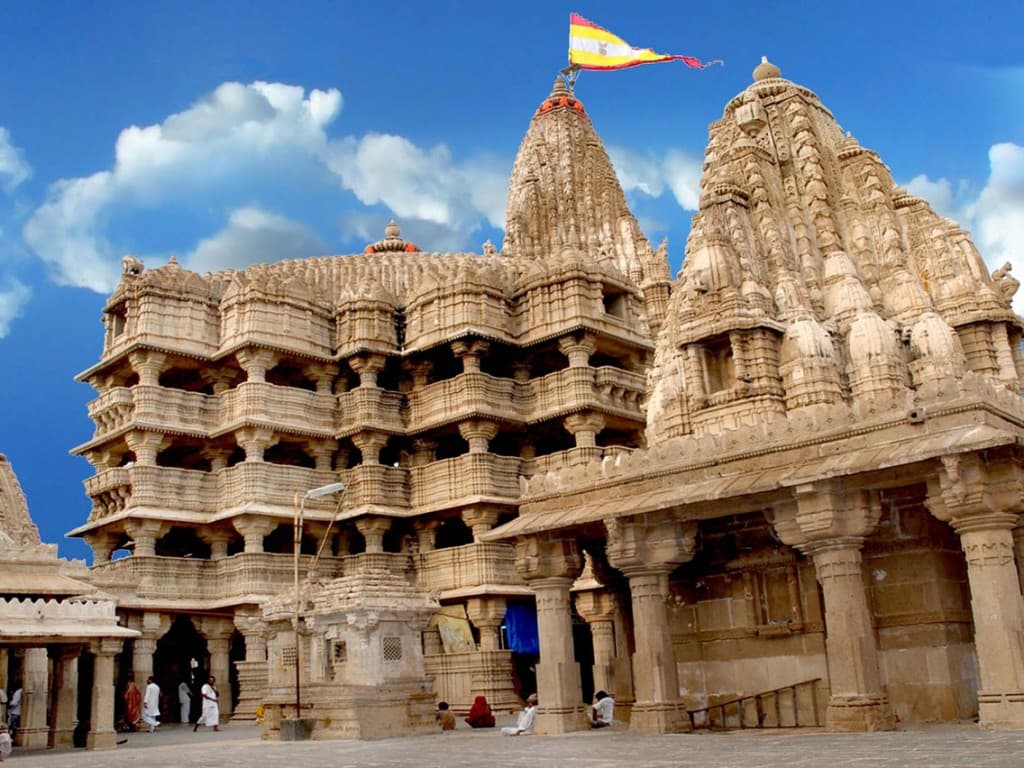 Vishnupranay.k / CC BY-SA 4.0, via Wikimedia Commons
“Where myth meets the tide, and history sleeps beneath the waves.”
Not the postcards. The stories even locals don't know — whispered in your ear, right where they happened.
The grand flag atop the Dwarkadhish Temple is changed several times a day, a lively spectacle visible from afar.
Despite being Krishna's chief consort, Rukmini's temple stands noticeably apart from the main Dwarkadhish Temple.
This island, believed to be Lord Krishna's residential palace, holds a surprising connection to a childhood friendship.
Discover every secret of Dwarka
Every address, every reveal in full — in your ear, right where it happened.
You pick your stops. You walk. The voice reveals what the others miss.
No tours available yet. Check back soon — we're preparing them.
Dwarka, a coastal town on the western shore of Gujarat, is a city of profound spiritual significance and ancient lore. Revered as one of the seven most ancient religious cities in India and a vital part of the Char Dham pilgrimage circuit, Dwarka draws devotees and history enthusiasts alike. Its name, translating to "gateway to heaven" in Sanskrit, hints at its sacred status. The city is intrinsically linked with Lord Krishna, who is believed to have established his kingdom here after leaving Mathura.
Beyond its spiritual magnetism, Dwarka offers a tangible connection to a storied past. Marine archaeological expeditions in the Arabian Sea, both offshore and onshore, have unearthed evidence of ancient settlements, including stone structures, anchors, and pottery, lending credence to the legends of a submerged city. This blend of mythological narratives and archaeological findings makes Dwarka a captivating destination, where the line between legend and history often blurs, inviting visitors to ponder the mysteries that lie beneath the waves.
## The Legendary City of Krishna Dwarka's origins are deeply intertwined with Hindu mythology, primarily as the fabled kingdom of Lord Krishna. According to ancient texts like the Mahabharata and the Puranas, Krishna founded Dwarka after relocating from Mathura to escape the incessant attacks of Jarasandha, Kansa's father-in-law. Legend states that Krishna, with the aid of the divine architect Vishwakarma, reclaimed 12 yojanas (approximately 96 square kilometers) of land from the sea to build this magnificent city. This ancient city, sometimes referred to as 'Suvarna Dwarka' due to its purported opulence of gold and jewels, was described as having grand palaces, well-planned sectors, and a bustling harbor.
## Submergence and Archaeological Discoveries The most compelling aspect of Dwarka's history is the legend of its submergence. It is believed that after Lord Krishna's departure from his mortal body, the city was swallowed by the sea, marking the end of the Dvapara Yuga. For centuries, this remained a powerful myth, but modern archaeological investigations have brought fascinating insights. Starting in the 1960s, and particularly with extensive underwater explorations by the National Institute of Oceanography (NIO) in the 1980s, significant findings have emerged. These discoveries include submerged stone structures, fortification walls, a stone jetty, and triangular three-holed stone anchors, similar to those found in Late Bronze Age sites in Ugarit and Kition. Pottery from the Late Harappan period and seals suggesting trade activity have also been found, with some artifacts carbon-dated to between 1900 BCE and 1300 BCE. These archaeological findings provide compelling evidence for the existence of an ancient, thriving port city, lending a scientific dimension to the age-old legends.
## Later History and Rebuilding While the ancient city may lie beneath the waves, the spiritual significance of Dwarka endured. The present-day Dwarkadhish Temple, a prominent landmark, is believed to have been originally established by Vajranabha, Lord Krishna's great-grandson, over 2,500 years ago. However, the current structure of the temple largely dates back to the 15th-16th century, after it was damaged and subsequently rebuilt following invasions. Throughout its history, Dwarka has been referred to by various names, including Mokshapuri, Dwarkamati, and Dwarkavati, all reflecting its sacred importance. It has remained a continuous center of pilgrimage, adapting and rebuilding through the centuries, ensuring its legacy as a spiritual beacon on India's western coast.
Dwarka offers an array of spiritual and historical sites. The Dwarkadhish Temple, also known as Jagat Mandir, is the city's focal point, a five-story edifice supported by 72 pillars, dedicated to Lord Krishna. Its intricate carvings and the daily flag-changing ceremony are notable. A short distance away is the Rukmini Devi Temple, dedicated to Lord Krishna's chief queen, known for its elegant architecture and intricate carvings of gods and goddesses. The tradition of jal daan, or offering water, is unique here, stemming from a legend involving a sage's curse.
For a different spiritual experience, take a ferry to Bet Dwarka, an island believed to be Lord Krishna's original residence. This island is also an important archaeological site, with findings from the Late Harappan period. On the mainland, the Nageshwar Jyotirlinga Temple, one of the 12 Jyotirlingas dedicated to Lord Shiva, is a significant pilgrimage site. The Gomti Ghat provides a serene setting for rituals and offers views of the Gomti River meeting the Arabian Sea. You can also visit Dwarka Beach and the Dwarka Lighthouse for panoramic views.
The most pleasant time to visit Dwarka is during the winter months, from October to March. During this period, the weather is cool and comfortable, with temperatures ranging from approximately 10°C to 25°C, making it ideal for sightseeing and temple visits. The peak season for tourists falls between November and February. If you wish to experience the Janmashtami festival, celebrating Lord Krishna's birthday, consider visiting in August or September.
Dwarka is well-connected and accessible. The nearest airport is Jamnagar Airport (JGA), approximately 130 km away, with Rajkot (225 km) and Ahmedabad (450 km) also serving as major air hubs. Dwarka has its own railway station, connecting it to major Indian cities. The city is also reachable by road via national and state highways. Within Dwarka, auto-rickshaws are a convenient mode of transport for local sightseeing. For travel to Bet Dwarka, ferries are available from Okha port. It is advisable to book accommodations in advance, especially during peak pilgrimage seasons, as popular hotels near the Dwarkadhish Temple fill up quickly. Dress modestly when visiting temples and be prepared for crowds, particularly during festivals.