Durham Cathedral's North Door
Before modern justice, sanctuary offered a different kind of protection.
Full story unlocks in the tour
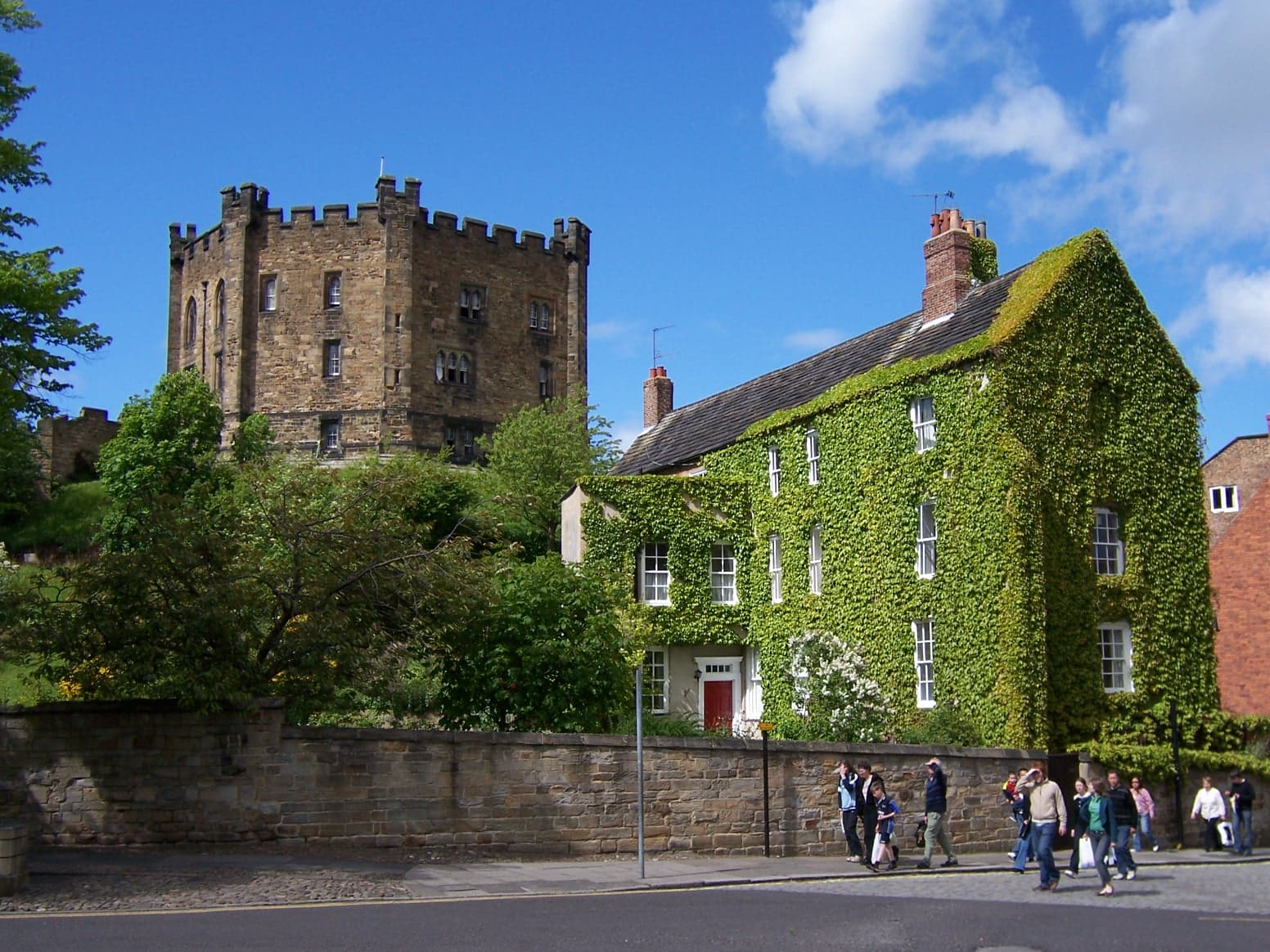 No machine-readable author provided. Jungpionier assumed (based on copyright claims). / CC BY-SA 3.0, via Wikimedia Commons
“Ancient stones speak of saints and scholars, where a river bends through time.”
Not the postcards. The stories even locals don't know — whispered in your ear, right where they happened.
Before modern justice, sanctuary offered a different kind of protection.
Imagine a medieval feast, with an unexpected seating arrangement for royalty.
Local lore suggests the city's very location was divinely guided by a cow.
Discover every secret of Durham
Every address, every reveal in full — in your ear, right where it happened.
You pick your stops. You walk. The voice reveals what the others miss.
No tours available yet. Check back soon — we're preparing them.
Durham, a city in northeastern England, finds its form within a dramatic peninsula, shaped by a horseshoe bend of the River Wear. At its core stand the grand Durham Cathedral and Durham Castle, together recognized as a UNESCO World Heritage Site since 1986. These imposing Norman structures define the skyline, embodying centuries of religious and political authority. The city's winding streets and historic buildings reflect its medieval origins, while the presence of Durham University infuses a lively, youthful energy.
Beyond the iconic cathedral and castle, Durham presents a compelling blend of ancient heritage and contemporary life. The city's compact center invites exploration on foot, revealing independent shops, cafes, and riverside walks. Durham's strategic location, historically important for defense against northern invasions, continues to shape its character, offering visitors a tangible connection to England's past.
Durham's beginnings are deeply rooted in the Anglo-Saxon period, specifically with the journey of St. Cuthbert's relics. In 995 AD, Anglo-Saxon monks, seeking refuge from Viking raids, searched for a safe haven for the saint's remains. They eventually settled on the defensible peninsula formed by the River Wear, establishing a wooden church, which was later replaced by a stone structure.
Following the Norman Conquest, William the Conqueror recognized Durham's strategic importance in controlling the rebellious north and defending against Scottish incursions. In 1072, he ordered the construction of Durham Castle. The castle, initially a motte-and-bailey design, evolved into a symbol of Norman military architecture and later, the residence of the powerful Prince-Bishops of Durham. These Prince-Bishops held semi-independent authority from the 1070s until 1836, governing a 'buffer state' between England and Scotland, with the right to raise armies, mint coins, and levy taxes.
Construction of the present Durham Cathedral, a masterpiece of Romanesque architecture, began in 1093 and was largely finished by 1133. It was built to house the shrine of St. Cuthbert and later, the Venerable Bede. The cathedral's innovative use of pointed ribbed vaults anticipated Gothic architecture. Throughout the medieval period, Durham became a significant pilgrimage destination.
The castle remained the Bishops' home for over 750 years until 1832, when it was donated to the newly formed Durham University in 1837, becoming its first college. Durham University, founded in 1832, was the first recognized university to open in England in over 600 years after Oxford and Cambridge. Today, the castle continues to house university students, blending centuries of history with an active academic community.
Begin your exploration at the UNESCO World Heritage Site encompassing Durham Cathedral and Durham Castle. The Cathedral, a testament to Norman architecture, invites visitors to marvel at its massive pillars and vaulted ceilings, and to visit the shrines of St. Cuthbert and the Venerable Bede. You can ascend the central tower for expansive views of the city. Durham Castle, now part of Durham University, can be explored through guided tours, offering a glimpse into its Norman origins and its evolution as a princely residence and student accommodation.
Between the Cathedral and Castle lies Palace Green, an open space that once hosted grand processions. Wander through Durham's medieval streets, where historic buildings now house shops and cafes. Take a stroll along the River Wear, which encircles the city center, offering scenic walking paths and opportunities for boat trips. For a taste of local life, visit the Durham Indoor Market, a historic hall with independent traders selling everything from artisan food to crafts. The Oriental Museum, part of Durham University, offers compelling collections from Asia and the Middle East.
Durham offers a compelling experience year-round, but late spring (May-June) and early autumn (September-October) provide mild weather and fewer crowds. Temperatures in autumn range from 9°C to 15°C, creating ideal conditions for exploration. Summer (June-August) brings warmer temperatures, averaging 15°C to 20°C, perfect for river cruises and outdoor markets, though it is the busiest season. Annual events like the Durham Miners' Gala in July and the Durham Book Festival in October add to the city's appeal.
Durham is readily accessible by train via the East Coast Main Line, with direct services from London and Edinburgh. Durham train station is a short walk from the city center. For those arriving by car, three Park and Ride schemes (Belmont, Sniperley, Howlands) operate Monday to Saturday, with buses running every 10-15 minutes into the city center. The city center is compact and best explored on foot, but a Cathedral Bus links the train station, market place, and the Cathedral and Castle, and is wheelchair accessible. Shopmobility services are available for wheelchair and scooter hire at the Prince Bishops car park.