The Castalian Spring
Before seeking the Oracle's wisdom, every visitor, from common pilgrims to those with blood on their hands, performed a crucial ritual.
Full story unlocks in the tour
 tamara semina / CC BY-SA 3.0, via Wikimedia Commons
“Where myths were made and destinies foretold.”
Not the postcards. The stories even locals don't know — whispered in your ear, right where they happened.
Before seeking the Oracle's wisdom, every visitor, from common pilgrims to those with blood on their hands, performed a crucial ritual.
This seemingly modest building, constructed from gleaming Parian marble, held more than just precious offerings.
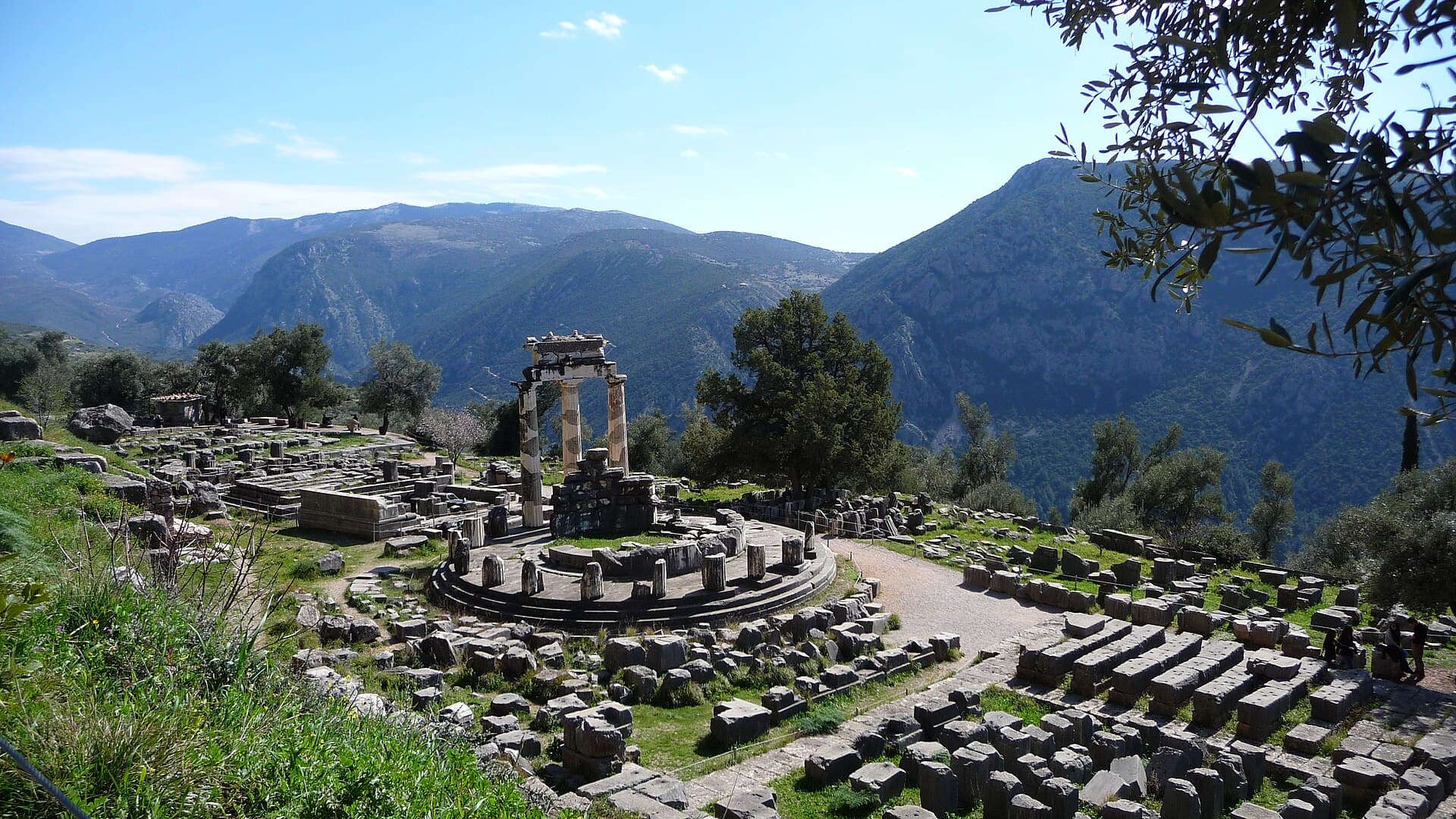
This iconic circular building, a symbol of Delphi, has long puzzled scholars.
Discover every secret of Delphes
Every address, every reveal in full — in your ear, right where it happened.
You pick your stops. You walk. The voice reveals what the others miss.
No tours available yet. Check back soon — we're preparing them.
Delphi, a UNESCO World Heritage site, rises dramatically on the slopes of Mount Parnassus, overlooking the Pleistos Valley and the Gulf of Corinth. For the ancient Greeks, it was the very center of the world, a sacred place where heaven and earth met, marked by the omphalos stone. Pilgrims journeyed from across the known world to this mystical sanctuary, seeking guidance from the famous Oracle of Apollo.
Today, the extensive archaeological site reveals a monumental complex of temples, treasuries, and sacred paths, reflecting the wealth, faith, and political power of the ancient world. Wandering through its ruins offers a profound insight into ancient Greek civilization, where political decisions, colonization, and alliances were often made only after consulting the oracle.
The origins of Delphi trace back to the Mycenaean period, around the 15th century BCE, when the site was a small settlement where early worship of local earth deities took place. It began as a sanctuary dedicated to Gaia, the Earth Mother. According to myth, this ancient oracle was guarded by a serpent-like dragon named Python, born of Gaia, who also possessed the gift of prophecy.
Around the 8th century BCE, the site transformed into a shrine dedicated to Apollo. The myth tells of Apollo slaying Python, claiming the sanctuary, and establishing himself as the god of prophecy. This marked a significant shift from earth worship to the worship of light and reason. The high priestess, known as the Pythia, would communicate Apollo's messages to those seeking divine guidance, often entering a trance state, possibly due to inhaling vapors from a chasm.
From the 6th to the 4th century BCE, Delphi reached the peak of its glory. Its fame and religious authority spread throughout the Mediterranean, attracting pilgrims and lavish offerings from city-states across the ancient world. The founding of the Delphic Amphictyony, a religious and political coalition of Greek city-states, further solidified Delphi's status and ensured its autonomy. This confederation played a crucial role in protecting the temple and promoting ideals of friendship and peaceful coexistence.
During this period, the Pythian Games were permanently established, acquiring a panhellenic status and prestige similar to that of the Olympic Games. Held every four years in honor of Apollo, these games included athletic, musical, and artistic competitions. City-states demonstrated their wealth and devotion by constructing treasuries along the Sacred Way to house their offerings. The site, however, was not immune to natural disasters like earthquakes and fires, which damaged many structures over time.
Delphi was captured by the Romans in the early 2nd century BCE, but its sanctity was recognized, and wealthy patrons, including Emperor Hadrian, financed restorations. However, with the spread of Christianity, the site gradually fell into decay. By the 15th century, the ancient ruins were buried under the small settlement of Kastri. It wasn't until the late 1800s that French archaeologists relocated the village and began extensive excavations, revealing the magnificent archaeological site we see today. Delphi was inscribed on the UNESCO World Heritage List in 1987.
The archaeological site of Delphi is a journey through ancient Greek history, laid out on the slopes of Mount Parnassus. Begin at the Sanctuary of Athena Pronaia, where the iconic circular Tholos stands. This enigmatic structure, with its reconstructed Doric columns, is one of Delphi's most photographed monuments.
Follow the Sacred Way, a winding path that leads to the heart of the sanctuary. Along this route, you'll encounter the Treasury of the Athenians, a well-preserved Doric building constructed from Parian marble, which once housed offerings to Apollo. Further up, the majestic Temple of Apollo dominates the site, where the Pythia delivered her prophecies. While only remnants remain, its scale hints at its former grandeur.
Above the Temple of Apollo lies the Ancient Theatre, offering expansive views of the entire sanctuary and the valley below. Higher still, carved into the natural slope, is the Stadium, where the Pythian Games' athletic contests took place. It is considered the best-preserved ancient stadium in Greece.
Conclude your visit at the Delphi Archaeological Museum, located adjacent to the main site. This important museum houses a vast collection of artifacts excavated from Delphi, including the famous bronze Charioteer of Delphi, the Sphinx of Naxos, the Omphalos stone, and exquisite gold and ivory statues.
The best times to visit Delphi are during the spring (March to May) and autumn (September to November). During these months, the weather is mild, making it comfortable for exploring the archaeological site. Spring also brings wildflowers, and autumn offers golden serenity, with fewer crowds than the peak summer season. Temperatures range from 15–22°C (59–72°F) in spring. While July and August are warmer, with average highs of 27°C (85°F), they also have very little rain. Winter (December to February) can be cold and snowy due to Delphi's high altitude, offering opportunities for snow sports on Mount Parnassus.
Delphi is approximately 110 miles northwest of Athens. The archaeological site and museum are typically covered by a single entry ticket. It's advisable to visit early morning or late afternoon for cooler temperatures and softer light, especially for photography. Wear sturdy shoes, as much of the site involves uphill walking on uneven terrain. Carrying water is essential, as shade is limited. Many hotels in Delphi town offer views of the valley and are a short walk from the archaeological museum and sites. Parking near the site fills quickly after 9 AM, so consider parking in town and walking. Small bills or coins are useful for local cafes and souvenir shops, though many places accept cards.