Parque Miguel de Cervantes Saavedra
The city's central park offers more than just shade and a statue of a famous author.
Full story unlocks in the tour
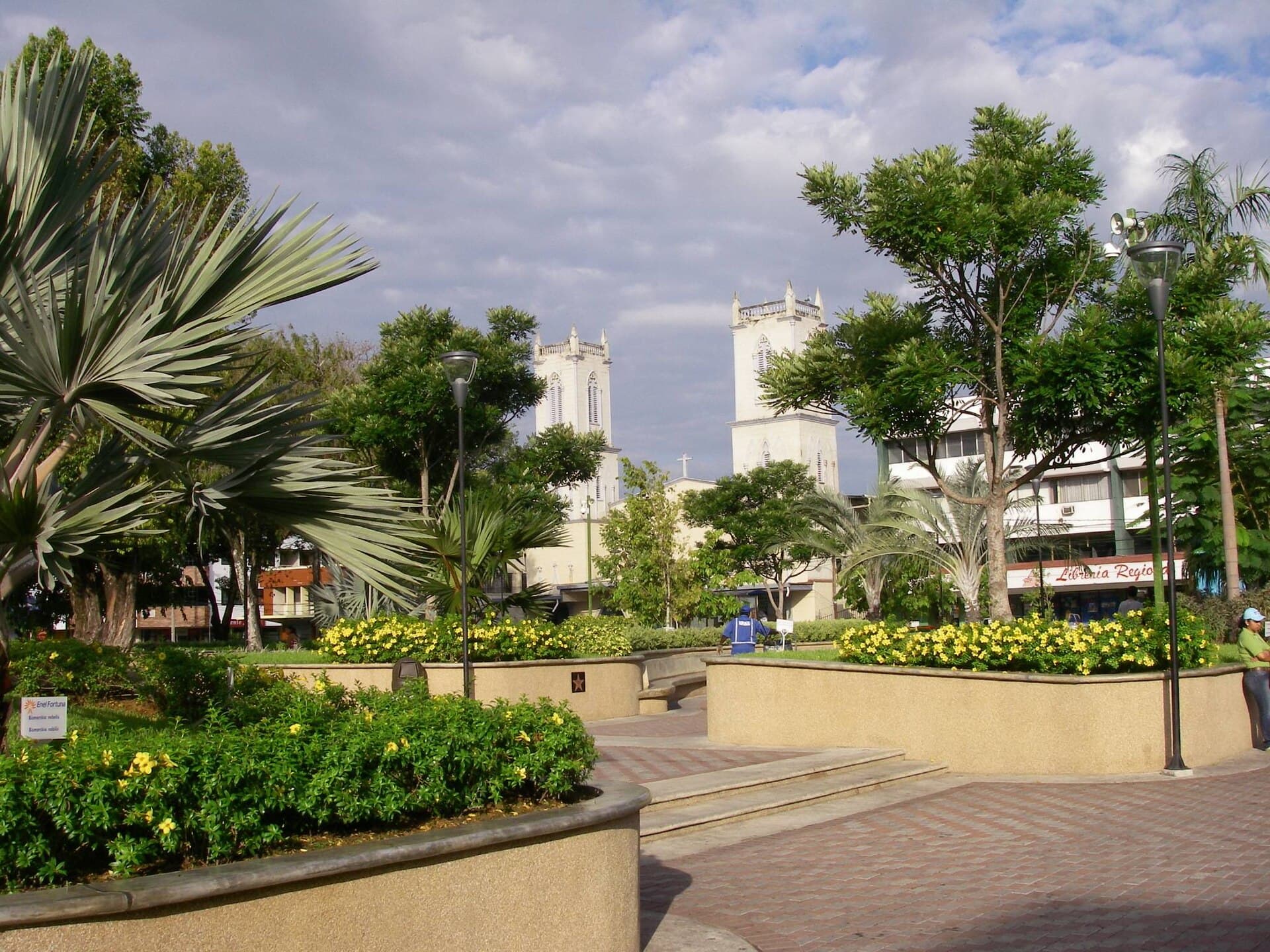 The original uploader was Moto-gundy at German Wikipedia. / CC BY-SA 3.0, via Wikimedia Commons
“David: Panama's Western Gateway, where commerce thrives and adventure begins.”
Not the postcards. The stories even locals don't know — whispered in your ear, right where they happened.
The city's central park offers more than just shade and a statue of a famous author.
While much of David has modernized, one neighborhood offers a tangible link to its past.
Panama's official currency has a surprising secret about its physical form.
Discover every secret of David
Every address, every reveal in full — in your ear, right where it happened.
You pick your stops. You walk. The voice reveals what the others miss.
No tours available yet. Check back soon — we're preparing them.
David, officially known as San José de David, is the bustling capital of Panama's Chiriquí Province and the third-largest city in the country. Situated on a fertile coastal plain in western Panama, it serves as a vital commercial and agricultural hub, often referred to as the economic heart of the region. The city's strategic location, approximately 30 miles from the Costa Rican border and 15 miles from the Pacific Ocean, makes it a significant transit point for both national and international trade and travel.
While David functions primarily as a commercial center, offering modern conveniences like shopping malls, international banks, and a well-developed infrastructure, it also acts as a gateway to the diverse natural wonders of western Panama. From David, travelers can easily access the cooler highlands of Boquete and Volcán, known for coffee plantations and hiking, or the pristine islands of the Gulf of Chiriquí. The city itself, with a population of around 145,000 to 160,000 residents, presents a dynamic blend of busy urban life and a relaxed, authentic Panamanian experience.
The city of David was officially founded on March 19, 1602, by Governor Juan Pedro de Guzmán, though Francisco de Gama was the direct executor of the plan. Initially named San José de David, its origins are somewhat debated, with one theory suggesting the name honors the Biblical King David due to the founder's Jewish heritage. In its early days, David was a rest stop for those traveling the trail connecting Central America with Panama City.
Throughout the colonial era, David experienced periods of both growth and challenge. In 1732, the city faced raids from indigenous Miskito and Zambo groups, which temporarily hindered its development. However, by 1821, residents of David actively supported Panama's movement for independence from the Spanish Empire. A significant milestone occurred in 1849 when David was officially proclaimed the capital of the newly established Chiriquí province, solidifying its political importance in the region. The city gained official "ciudad" (city) status in 1860.
The late 19th and early 20th centuries marked a period of significant transformation. The development of the Chiriquí Railway, the only public railway system built in the interior of Panama, was a catalyst for an economic boom. This railway connected David with the port of Pedregal and the fertile highlands, facilitating the large-scale export of coffee and livestock and establishing David as the region's primary trading hub. The construction of the Pan-American Highway further propelled David's growth, connecting it to the rest of Panama and Costa Rica and stimulating the development of roadside infrastructure, logistics, and the service sector. More recently, the modernization of Enrique Malek Airport to international standards has further opened the province to the world, enhancing its role as a key transportation and commercial center. Today, David continues to evolve, with ongoing commercial and residential construction reflecting its increasing importance within Panama.
David offers a blend of urban experiences and serves as a launching point for regional adventures. Begin at Parque Miguel de Cervantes Saavedra, the city's central park, known for its shade trees, local vendors, and resident iguanas. Nearby, explore the historic Barrio Bolívar, where some of David's colonial-era architecture can still be appreciated, including the 19th-century Catedral San José de David. For a deeper dive into the region's past, visit the José de Obaldía Museum of History and Art. You can also explore the David's New Artisan Center for local crafts.
Beyond the city limits, David is a gateway to diverse natural landscapes. The Chiriquí Highlands, just over an hour away, offer opportunities for hiking and birdwatching, with towns like Boquete and Volcán providing cooler climates and views of Volcán Barú. Birdwatchers will find David a great base, as it's surrounded by forests and national parks, home to a wide variety of species. For coastal experiences, the Parque Nacional Marino Golfo de Chiriquí is accessible from David, offering secluded beaches, coral reefs, sea turtles, and opportunities for snorkeling and scuba diving. Additionally, the Cangilones de Gualaca, a narrow rock canyon carved by the Río Estí, is about 45-60 minutes from David and is popular for swimming and floating.
David experiences a tropical monsoon climate, characterized by consistent heat year-round. The average monthly temperatures generally range between 24.5°C and 27.0°C (76-81°F), with daytime highs often exceeding 30°C (86°F). The city has two distinct seasons: a short, dry season from mid-December to mid-April, and a long, wet season from mid-April to mid-December. The driest months are typically February and March, with minimal rainfall and clearer skies, making this the best time for outdoor activities and exploring the surrounding natural attractions. The wet season, particularly from July to October, sees frequent tropical downpours, which can be heavy but often brief, leaving time for sunshine. For those who prefer guaranteed sunny days and don't mind higher prices, the dry season is ideal.
Panama uses the U.S. dollar for paper currency, while coins are locally minted Balboas, equivalent in value and size to U.S. coins. While major establishments accept credit cards, many smaller local eateries and street vendors operate on a cash-only basis, so it's advisable to carry cash. ATMs are widely available, especially around the central plaza and banking district.
David's Enrique Malek International Airport (DAV) offers domestic flights to and from Panama City, as well as international connections to San José, Costa Rica. Taxis are readily available from the airport to the city center for approximately $2 per person. For longer distances, the David Bus Terminal is a major transportation hub with frequent buses to Panama City (a 6-7 hour journey), Boquete, Volcán, and the Costa Rican border. Renting a car provides flexibility for exploring the wider Chiriquí province, though private transfer services are also an option.
David is generally considered safe for tourists, but standard precautions apply; it's wise to avoid poorly lit areas late at night and keep valuables secure. Tap water is generally safe to drink, but travelers with sensitive stomachs may prefer bottled water.