Knidos
The ancient city of Knidos, at the very tip of the Datça Peninsula, once held a statue so famous it drew pilgrims from across the ancient world.
Full story unlocks in the tour
 Semih Ekinci / CC BY-SA 3.0, via Wikimedia Commons
“Where the Aegean and Mediterranean embrace, and time slows to a gentle rhythm.”
Not the postcards. The stories even locals don't know — whispered in your ear, right where they happened.
The ancient city of Knidos, at the very tip of the Datça Peninsula, once held a statue so famous it drew pilgrims from across the ancient world.
There's a spot on the Datça Peninsula so narrow that its name translates to something rather amusing about fish.
Beyond its beautiful beaches, Datça is known for a particular local crop, but one variety is truly unique.
Discover every secret of Datça
Every address, every reveal in full — in your ear, right where it happened.
You pick your stops. You walk. The voice reveals what the others miss.
No tours available yet. Check back soon — we're preparing them.
The Datça Peninsula, a slender finger of land where the Aegean and Mediterranean Seas converge, offers a tranquil escape from Turkey's more bustling coastal resorts. This region, part of Muğla Province, is characterized by its rugged, forested landscapes, pristine coves, and a slower pace of life that feels akin to island living. Unlike the lively scenes of Bodrum or Marmaris, Datça invites visitors to unwind amidst olive groves and almond farms, with strict building regulations preserving its traditional character.
The main town of Datça serves as the heart of the peninsula, with a harbor lined with seafood restaurants and backstreets filled with local shops and cafes. Beyond the town, the peninsula is dotted with picturesque villages and 52 distinctive coves, offering a blend of natural beauty and historical intrigue. From ancient ruins to serene beaches, Datça is a destination for those seeking an authentic Turkish experience, where the sea, nature, and silence take precedence.
## Ancient Roots and Dorian Dominance Human settlement on the Datça Peninsula dates back to approximately 2000 BCE, with the Carians being among the earliest inhabitants. The region's civilization reached its peak during the era of the Dorians, who migrated from Thrace and Greece around 1000 BCE. They established the city of Knidos at the tip of the peninsula, which became a central city of the Dorian Hexapolis—a federation of six Dorian Greek cities.
Knidos flourished as an important commercial, cultural, and scientific hub. It featured two major ports: a northern one for military use and a southern one for trade. During this period, numerous temples, churches, and monuments were erected, and a prominent medical school was founded by the physician Euryphon. The city was also renowned for housing Praxiteles' famous nude statue of Aphrodite, which attracted pilgrims from across the ancient world.
## Persian Invasions and Shifting Powers In 546 BCE, Knidos fell under Persian rule. In an attempt to defend against the invasion, the Knidians considered digging a canal to separate the peninsula from the mainland, but an oracle at Delphi reportedly advised against it, leading them to abandon the project. Over the centuries, Knidos was subsequently dominated by the Athenian Empire, Spartans, Alexander the Great, the Roman Empire, and the Byzantines.
## Ottoman Era and Modern Day The Menteşe Tribe, a Turkish tribe, conquered Datça in 1220 AD. The peninsula later passed to Ottoman rule in 1390. During the reign of Sultan Reşad in the 18th century, the peninsula was briefly renamed Reşadiye, but it regained its original name of Datça after the establishment of the Turkish Republic in 1923. Today, Datça is a district of Muğla Province, approximately 70 kilometers west of Marmaris.
Begin your exploration in Datça town, where the pedestrianized Kumluk Yolu (Sandy Way) lines the coast, offering a pleasant stroll past restaurants and bright flowerpots. Adjacent to it is Sevgi Yolu (Love's Lane), a cobbled walkway with views of Hastane Altı Plajı. Do not miss the small freshwater Lake Ilıca, home to fish and ducks.
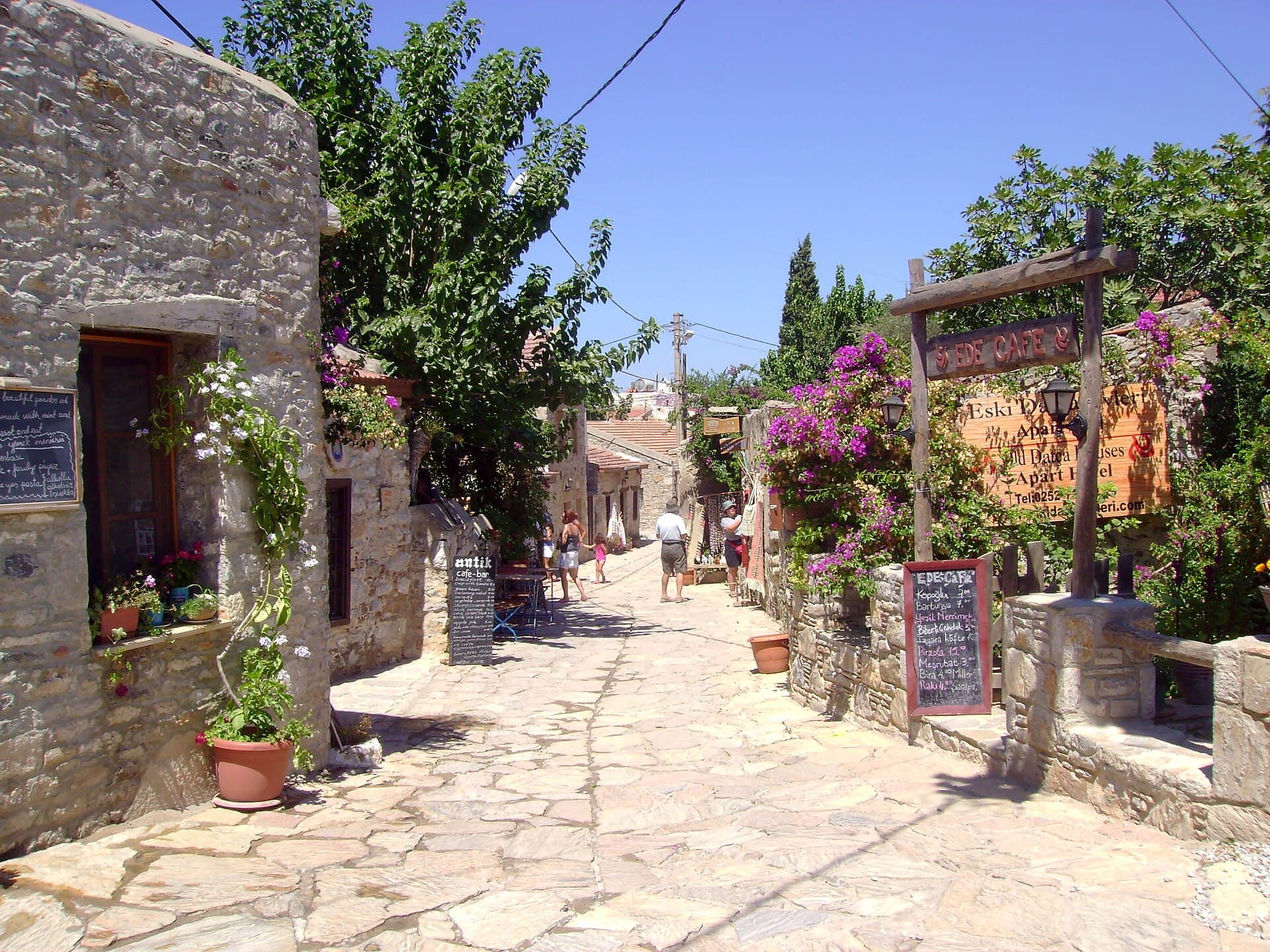
A short drive or bus ride from the main town, Eski Datça (Old Datça) is a charming village with historic stone houses, narrow alleyways, and bougainvillea-draped walls. It was once the main settlement and is notable as the former home of Turkish poet Can Yücel. Here you will find cafes, bars, and craft shops.
At the westernmost tip of the peninsula lies the ancient city of Knidos, a significant archaeological site where the Aegean and Mediterranean meet. Wander through the ruins of a theater with sea views, the remains of the Temple of Aphrodite, and ancient harbors that once facilitated trade and military operations. The site also features streets, mosaics, and remnants of ancient houses. The views, especially at sunset, are particularly memorable.
Beyond the main towns, the Datça Peninsula is renowned for its numerous coves and beaches. Popular choices include Kumluk Plajı, Taşlık Plajı, and Hastane Altı Plajı in Datça town. Further afield, consider Karaincir Beach, known for its shallow, warm waters, or the serene Ovabükü, Hayıtbükü, and Palamutbükü beaches, celebrated for their clear waters.
Datça experiences a hot-summer Mediterranean climate, with arid, clear, hot, and humid summers, and mild, wet, partly cloudy winters. The best time to visit for warm-weather activities is from early June to late September. May, June, September, and October offer pleasant weather, with temperatures in the early 20s to low 30s Celsius. July and August are the hottest months, with average daily highs around 32-35°C, and minimal rainfall. The sea temperature is ideal for swimming from June to October, peaking in August at around 25°C. Winters (November to March) are cooler and wetter, with temperatures between 15-20°C and more frequent rainfall.
Datça is accessible via either Dalaman or Bodrum airports. From Dalaman, the journey to Datça takes approximately 2 to 2.5 hours by car or transfer service. From Bodrum, you can take a ferry, which typically takes around 1.5 to 2 hours. Long-distance buses also operate from major Turkish cities like Istanbul to Datça, with journeys taking 12-14 hours.
Once on the Datça Peninsula, renting a car is highly recommended for exploring the various beaches, villages, and viewpoints, as public transportation can be less frequent for day trips. However, a local minibus network, known as 'Dolmuş' (MUTTAŞ), connects Datça town with areas like Eski Datça and various coves. Datça town itself is walkable, with its main areas easily explored on foot.
When packing, light layers are ideal for the warm climate, and comfortable shoes are essential for exploring historical sites and walking paths. Sunscreen and a hat are advisable, especially during summer months. While cards are accepted in many places, it's wise to carry some cash, particularly for smaller establishments or those outside the main town.