Chowk Bazaar's Basement Market
Most wayfarers navigate the clamoring main arteries of Chowk Bazaar, yet a distinct world unfolds just beneath their steps.
Full story unlocks in the tour
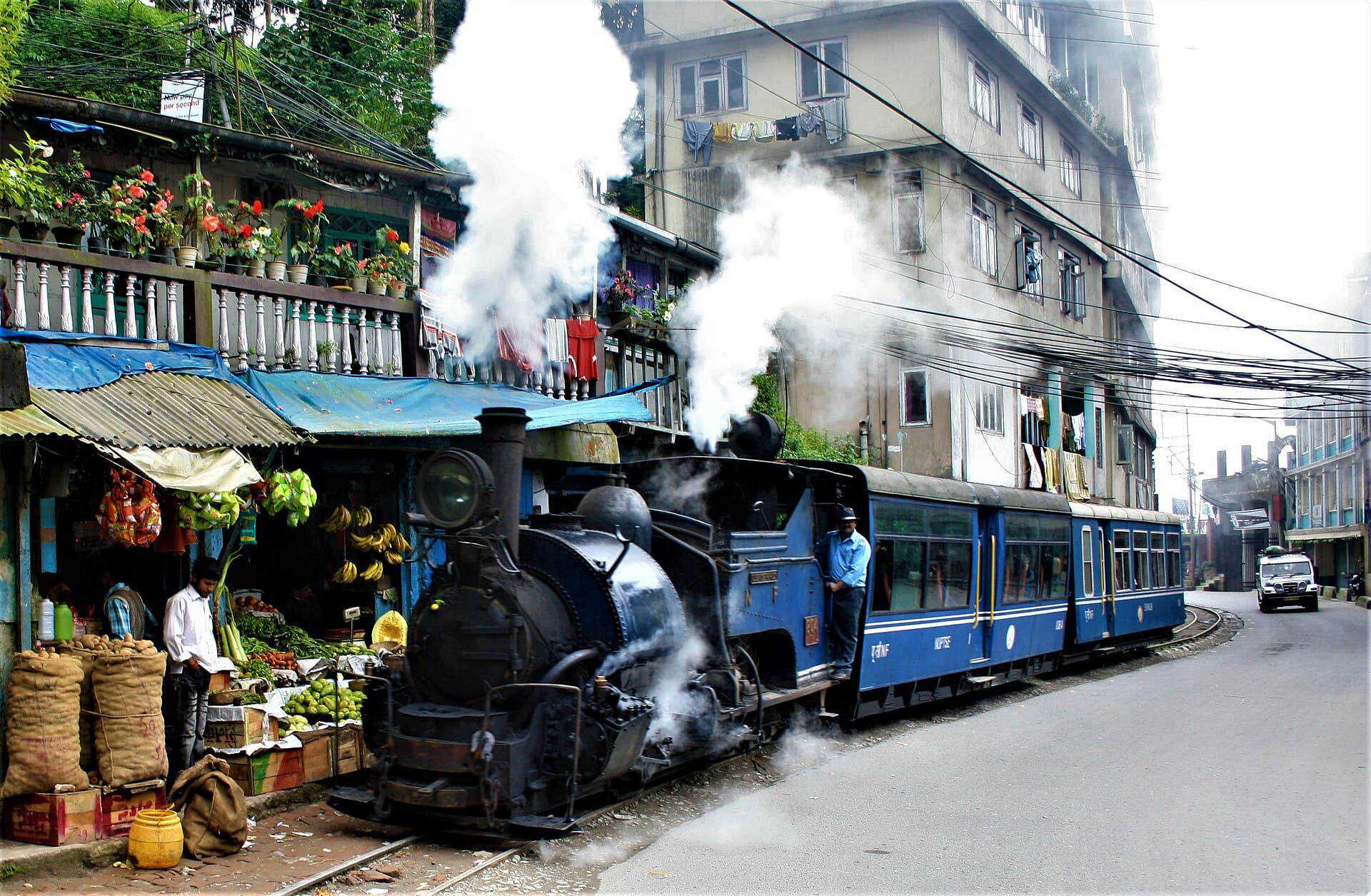 Arne Hückelheim 2010-09-21 12:41:53 This is a cropped in which the glare has been lessened / CC BY-SA 4.0, via Wikimedia Commons
“Where the mountain mists gather and the very air breathes of tea leaves.”
Not the postcards. The stories even locals don't know — whispered in your ear, right where they happened.
Most wayfarers navigate the clamoring main arteries of Chowk Bazaar, yet a distinct world unfolds just beneath their steps.
A notable Italian tea planter once possessed a considerable parcel of land in the heart of Darjeeling, bestowing upon it a distinctive name that has since evaporated from maps.
This tea garden bears a poignant designation, a tribute to a young girl whose aspirations of returning were tragically curtailed.
Discover every secret of Darjeeling
Every address, every reveal in full — in your ear, right where it happened.
You pick your stops. You walk. The voice reveals what the others miss.
No tours available yet. Check back soon — we're preparing them.
Darjeeling, a hill station in India's West Bengal, is celebrated for its tea plantations, sweeping natural beauty, and the revered Darjeeling Himalayan Railway. Situated at an elevation of about 2,042 meters (6,700 feet) in the foothills of the Himalayas, it affords wide views of Kangchenjunga, the world's third-highest mountain, on days when the sky is clear. The town's ambiance is a fusion of colonial elegance and a lively local culture, shaped by its varied ethnic population, including Nepali-speaking Gorkhas, Lepchas, Bhutias, and Tibetans.
Beyond its celebrated tea and the 'Toy Train,' Darjeeling serves as a gateway to the Eastern Himalayas, offering a refreshing reprieve from the plains. Its landscapes feature undulating green tea gardens, forests of sal and oak, and a rich diversity of plant and animal life, including rare orchids. The town's particular character is molded by its history, geography, and the unhurried pace of life that permits both tranquil reflection and spirited exploration.
The name Darjeeling is thought to derive from the Tibetan word 'Dorjeling,' signifying 'land of the thunderbolt,' or possibly from 'Dorje Ling,' a monastery constructed by Denzongpa tribals in 1765. Historically, the area formed a portion of the Kingdom of Sikkim, inhabited by the indigenous Lepcha people. However, in the late 18th century, the Gorkha army from Nepal advanced, incorporating territories extending to the Teesta River.
In the early 19th century, the British East India Company took an interest in Darjeeling, discerning its potential as a cool summer sanctuary for officials and soldiers. Following the Anglo-Gorkha War, under the 1816 Sugauli Treaty, Nepal ceded a third of its territories to the British, encompassing the land between the Mechi and Teesta Rivers. In 1817, this land was given back to the Sikkimese Chogyal under the Treaty of Titalia. However, in 1835, the British procured the Darjeeling tract from the Kingdom of Sikkim, initially leasing it and subsequently incorporating it in 1849. Dr. Arthur Campbell, a surgeon and superintendent of Darjeeling, initiated experimental tea plantations in 1841, establishing the foundation for Darjeeling's globally recognized tea industry.
Under British administration, Darjeeling swiftly evolved into a prominent hill station. Infrastructure expanded, including roads and the celebrated Darjeeling Himalayan Railway, which commenced operations in 1881 and is now a UNESCO World Heritage Site. This railway facilitated both the transit of summer residents and the export of tea. The tea industry relied significantly on labor recruited from Nepal and surrounding areas, contributing to the diverse cultural composition of contemporary Darjeeling. After India achieved independence in 1947, Darjeeling became part of West Bengal. The arrival of Tibetan refugees in 1950, following Tibet's incorporation by China, further increased the town's population. This population growth, coupled with environmental concerns and varied ethnic groups, led to socio-economic tensions and calls for a separate state of Gorkhaland, a movement that gained prominence in the 1980s.
While Darjeeling prospered, it encountered its share of adversities. In 1898, a significant earthquake, known as the 'Darjeeling disaster,' inflicted considerable damage upon the nascent town.
Begin your exploration at Tiger Hill, arriving before dawn to witness the sun ascend over Mount Kanchenjunga, with the possibility of glimpsing Mount Everest on exceptionally clear days. Afterwards, visit the nearby Ghoom Monastery, one of the oldest Tibetan Buddhist monasteries in the region. Take a leisurely journey on the Darjeeling Himalayan Railway, affectionately known as the 'Toy Train,' a UNESCO World Heritage Site that meanders through scenic mountain terrain.
Immerse yourself in the world of tea with a visit to the Happy Valley Tea Estate, one of Darjeeling's venerable tea gardens, where you can observe the tea-making process and sample different flushes. For expansive views, experience the Darjeeling Ropeway, Asia's largest ropeway, offering panoramas of tea gardens and the valley below. Explore the Padmaja Naidu Himalayan Zoological Park, a sanctuary for high-altitude Himalayan animals like the red panda and snow leopard, and the adjacent Himalayan Mountaineering Institute, established by Tenzing Norgay.
Wander through Lloyd Botanic Garden, which displays a varied collection of plants from diverse climatic zones, including an orchidarium. For a blend of spiritual tranquility and scenic beauty, visit the Japanese Temple and Peace Pagoda, offering serene vistas and a message of harmony. Do not overlook the Batasia Loop and War Memorial, a distinctive railway spiral with a memorial dedicated to Gorkha soldiers.
Darjeeling offers a pleasant experience throughout the year, but the most favorable times to visit are during spring (March to May) and autumn (October to November). In spring, the weather is cool and agreeable, with temperatures ranging from 6°C to 17°C, and rhododendrons and magnolias are in bloom. Autumn, following the monsoon, brings clear skies, crisp air, and excellent visibility of the Himalayan peaks, making it ideal for observation and photography. While summer (May to mid-June) is also comfortable, the monsoon season (June to September) delivers heavy rainfall, which can lead to travel interruptions, though it provides a unique misty and romantic atmosphere for some travelers.
Darjeeling is reachable by air, road, and rail. The closest airport is Bagdogra International Airport (IXB), approximately 95 km distant, a three-hour drive. The nearest major railway junction is New Jalpaiguri (NJP), about 88 km from Darjeeling. From both Bagdogra and NJP, private taxis and shared jeeps are readily available for the journey to Darjeeling. The Darjeeling Himalayan Railway also provides a scenic, though longer, train ride from NJP to Darjeeling.
Within Darjeeling, walking is an enjoyable method to explore the central areas. For greater distances or specific attractions like Tiger Hill, taxis or shared jeeps are convenient. While internet connectivity has improved, with most hotels offering Wi-Fi and mobile data available, speeds may fluctuate. Cash is frequently preferred in local markets. Foreign nationals do not require special permits for Darjeeling town itself, but permits may be necessary for certain border areas or parts of Sikkim. It is prudent to carry a small umbrella due to rapid weather changes.