The Three Pagodas of Chongsheng Temple
These towering structures are iconic, but their original purpose wasn't just spiritual.
Full story unlocks in the tour
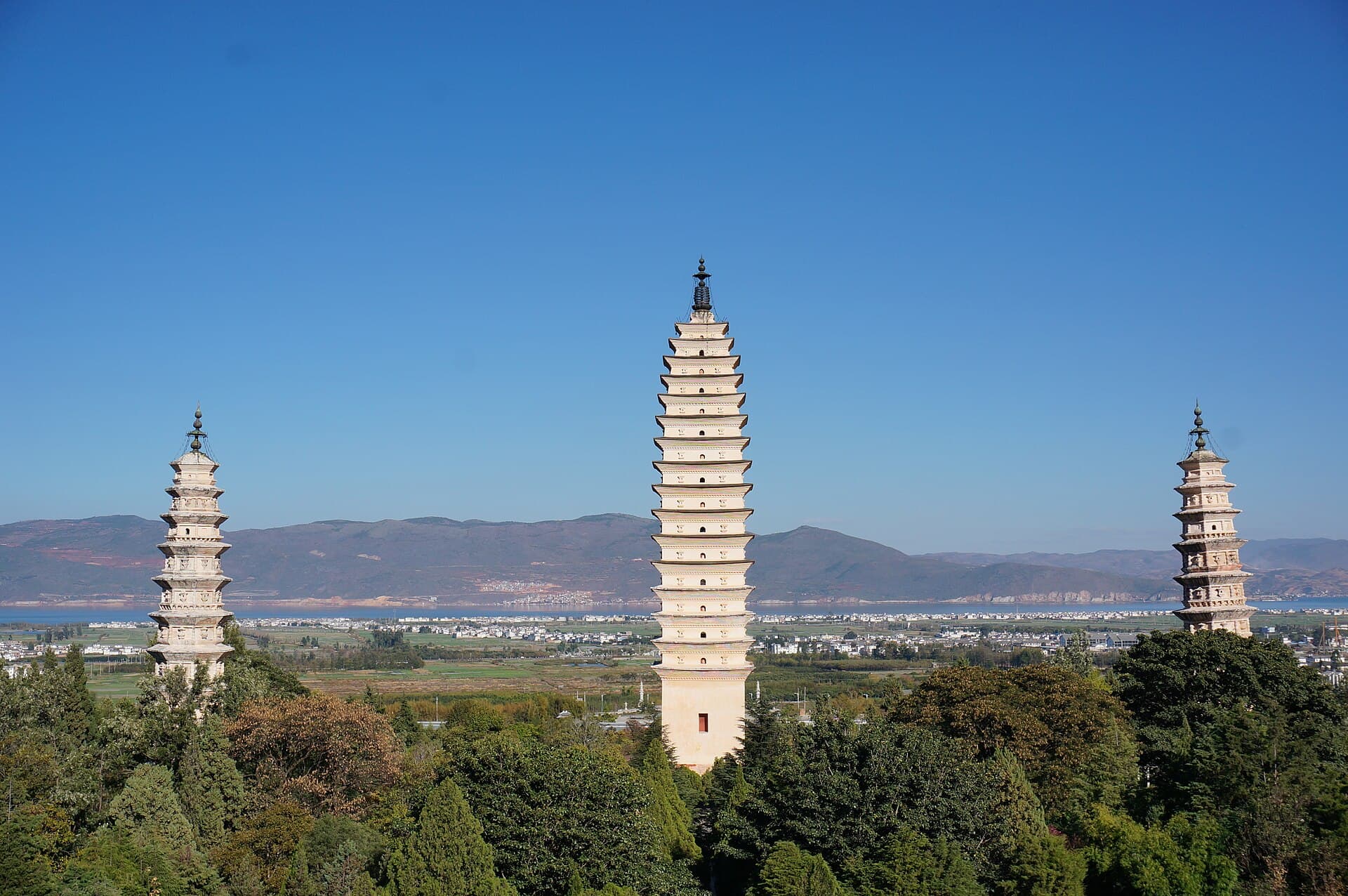 Andrew and Annemarie / CC BY-SA 2.0, via Wikimedia Commons
“Where ancient kingdoms meet mountain-fed lakes.”
Not the postcards. The stories even locals don't know — whispered in your ear, right where they happened.
These towering structures are iconic, but their original purpose wasn't just spiritual.
Beyond its serene surface, Erhai Lake holds a surprising connection to ancient royalty.
While the main streets buzz with activity, the quieter lanes offer a different kind of discovery.
Discover every secret of Dali
Every address, every reveal in full — in your ear, right where it happened.
You pick your stops. You walk. The voice reveals what the others miss.
No tours available yet. Check back soon — we're preparing them.
Dali, in China's Yunnan Province, is a captivating city where ancient history, rich ethnic culture, and striking natural beauty converge. Situated on a fertile plateau between the grand Cangshan Mountains and the shimmering Erhai Lake, Dali offers a relaxed atmosphere that sets it apart from more bustling Chinese metropolises. It was once the capital of both the Nanzhao and Dali Kingdoms, with over 1,300 years of history, and served as a crucial junction on the ancient Tea Horse Road.
The city is the cultural heart of the Bai minority, one of China's largest ethnic groups, and their distinctive architecture, with white walls and intricate paintings, is visible throughout the Old Town. Visitors can explore ancient streets, traditional markets, and old temples, experiencing a blend of history and local life. Dali's pleasant, mild climate year-round makes it an inviting destination for those seeking both tranquility and adventure.
Dali has gained a reputation as a haven for travelers, including digital nomads and backpackers, drawn by its laid-back pace and welcoming environment. The combination of the dramatic Cangshan Mountains and the expansive Erhai Lake provides a picturesque backdrop for outdoor activities and cultural immersion, making Dali a unique stop in southwestern China.
Dali's history stretches back over a millennium, rooted deeply in its strategic location and the rise of powerful kingdoms. Around 738 AD, it became the seat of the Nanzhao Kingdom, an influential empire during the Tang Dynasty (618–906). The Nanzhao Kingdom controlled vital trade routes connecting China with Southeast and South Asia, allowing Dali to flourish as a major commercial and cultural hub. The rulers of Nanzhao embraced Buddhism, transforming Dali into a significant center for the religion's spread from South Asia to other parts of China.
Following the Nanzhao Kingdom, the region saw a period of instability before Duan Siping established the Dali Kingdom in 937 AD. This Bai dynastic state lasted for over three centuries, until 1253, making it one of the longest-lasting kingdoms in the region. The Dali Kingdom continued to thrive on trade along the Southern Silk Road and the Tea Horse Route, exporting goods like Shu brocade and Pu'er tea to as far as India and Afghanistan, while importing items such as books, silk, and porcelain from China. Its name, Dali (大理), literally means "marble" in Chinese, a nod to the high-quality marble found in the area, famous throughout Asia.
In 1253, the Mongols conquered the Dali Kingdom under Kublai Khan, integrating it into the Yuan Dynasty. Despite the conquest, descendants of the Duan ruling house continued to administer the area as local chiefs under Yuan and later Ming dynasty rule. The Ming Dynasty (1368–1644) saw the construction of the formidable city walls of Dali Ancient City, which still stand today. While the region generally experienced peaceful coexistence between Han Chinese immigrants and the local Bai people, there were occasional uprisings, notably the Hui Muslim rebellion in 1874, which was eventually suppressed. In 1956, the Dali Baizu Autonomous Region was established under the Communist government, recognizing the significant Bai population. Today, Dali maintains its reputation as an "ancient capital at the crossroads of Asian culture," preserving its enduring heritage amidst modern development.
Dali Old Town is the primary draw, a well-preserved ancient city enclosed by walls, where many local families still reside. Walk along the city walls for wide views of Erhai Lake and the Cangshan Mountains. The two main streets are busy with shops, but exploring the quieter alleys reveals more authentic local life and traditional Bai architecture.
Just 1.5 kilometers from the Old Town are the iconic Three Pagodas of Chongsheng Temple, a complex of ancient temples that takes at least a couple of hours to explore. Don't miss the small pond to the right of the pagodas for a classic reflection photo.
For natural beauty, Erhai Lake offers cycling along its lakeside roads, stopping at traditional Bai villages like Xizhou, or taking a boat ride to appreciate the scenery from the water. The Cangshan Mountains, rising directly behind Dali Old Town, are ideal for hiking. The Gantong Cable Car provides easy access to the Jade Belt Road, a scenic trail with views of the town and lake.
Beyond these main attractions, consider visiting local markets, especially the morning wet market, to experience authentic Yunnan food culture and find unique local ingredients.
Dali enjoys a mild, temperate climate year-round, with no extreme heat or cold. The ideal times to visit are spring (March to May) and autumn (September to November). During these months, temperatures are comfortably mild, ranging from 15 to 25 degrees Celsius, with clear skies and minimal rainfall, perfect for outdoor activities. Spring brings blooming flowers around Erhai Lake and wildflowers on Cangshan Mountain. Autumn offers crystal-clear skies, striking fall colors, and excellent views. Summer (June to September) is the rainy season, with frequent afternoon thunderstorms, but mornings are often clear, and the landscapes are lush. Winter (December to February) is cool and dry, with snow-capped peaks on Cangshan and migratory birds on Erhai Lake, offering a peaceful retreat with fewer tourists.
Dali is well-connected and accessible. High-speed trains link Dali to Kunming in about two hours, with a second-class seat costing around CNY 145-155.5. Dali also has a small airport about an hour from the Old Town, with flights to major Chinese cities like Kunming, Shanghai, and Guangzhou. Taxis from the airport to Dali Old Town cost around CNY 80-100.
Within Dali Old Town, walking is the best way to get around as many areas are pedestrian-only. For longer distances, public buses (like routes 4 and 8 connecting the railway station to the Old Town for CNY 1.5-3) or ride-hailing apps like DiDi are convenient. Renting an electric scooter or bicycle is highly recommended for exploring Erhai Lake and nearby villages.
The official currency is the Chinese Yuan (RMB). While major hotels may accept international credit cards, digital payments via Alipay or WeChat Pay are widely preferred by vendors, so it's advisable to set these up before arrival. ATMs are available in the new city and tourist areas. Dali is generally very safe for travelers, including solo female travelers, with visible police presence and friendly locals. However, petty theft can occur, and it's wise to take standard precautions, especially in crowded tourist areas or when hiking.
Internet access is generally good, with free Wi-Fi in most guesthouses, cafes, and bars. However, China's Great Firewall blocks many Western social media sites and Google services, so a reliable VPN is essential and should be set up before arriving in China.