Coventry Cathedral Ruins
The skeletal remains of the old Coventry Cathedral stand as a stark monument to wartime devastation, yet they guard a secret of surprising resilience.
Full story unlocks in the tour
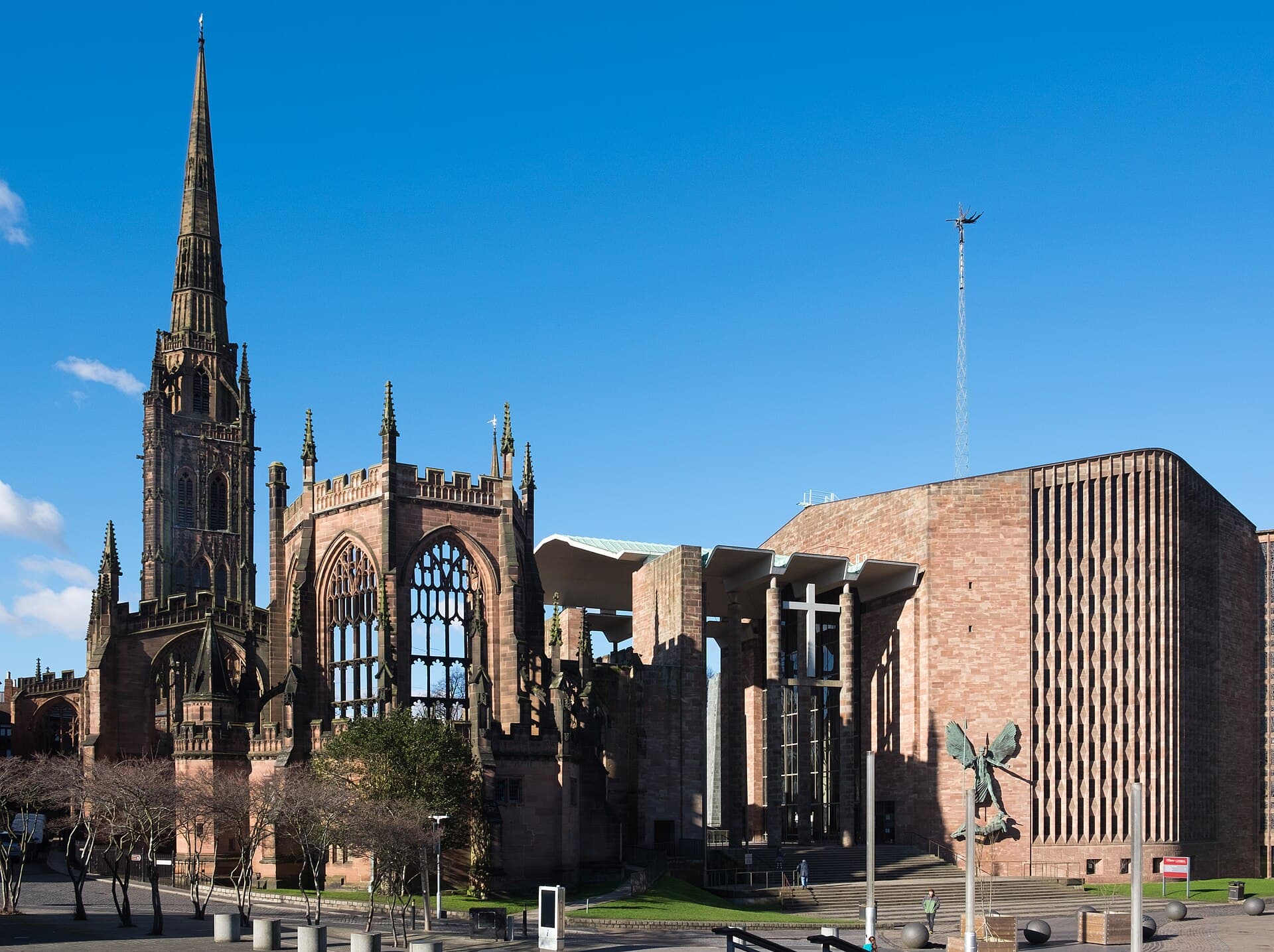 DeFacto / CC BY-SA 4.0, via Wikimedia Commons
“A city reshaped by fire, forged anew with purpose, and brimming with unexpected narratives.”
Not the postcards. The stories even locals don't know — whispered in your ear, right where they happened.
The skeletal remains of the old Coventry Cathedral stand as a stark monument to wartime devastation, yet they guard a secret of surprising resilience.
The prominent statue of Lady Godiva in Broadgate recounts a legendary journey, but the complete account of her celebrated ride through Coventry is more intricate than commonly understood.
Coventry's Walk of Fame honors local luminaries, but one of its most impactful honorees transformed personal conveyance across the globe.
Discover every secret of Coventry
Every address, every reveal in full — in your ear, right where it happened.
You pick your stops. You walk. The voice reveals what the others miss.
No tours available yet. Check back soon — we're preparing them.
Coventry, a city in the West Midlands of England, carries a profound narrative of destruction and rebirth, earning it the moniker of the 'Phoenix City.' Once a medieval powerhouse and later a driving force behind the British motor industry, Coventry's resilience is etched into its very fabric. The city's story is one of innovation, from the earliest bicycles to groundbreaking automotive manufacturing, and a powerful commitment to peace and reconciliation, particularly evident in the poignant ruins and modern architecture of its cathedral.
Beyond its widely recognized landmarks, Coventry offers a rich array of experiences. It was named the UK City of Culture in 2021, illuminating its diverse cultural heritage through music, performance, and exhibitions. Travelers can explore a city that has continually reinvented itself, offering a blend of ancient history, industrial prowess, and a forward-looking spirit.
Coventry's origins stretch back to Saxon times, with the founding of a Benedictine monastery in 1043 by Earl Leofric of Mercia and his wife, Lady Godiva. By the close of the 14th century, Coventry had grown to become the fourth most influential city in England, fueled by its flourishing woolen textile industry. The city's prosperity was evident in its paved streets and elegant sandstone and timber-framed buildings, drawing pilgrims and establishing it as a major religious center with various monastic houses.
During the Wars of the Roses, Coventry's importance was such that it served as the de-facto capital of England for a period between 1456 and 1459, when Henry VI and Margaret of Anjou moved the Royal Court there. In 1345, Coventry received a Royal Charter of Incorporation, making it the first municipal council in England to elect its own Mayor.
The city's fortunes shifted with the English Civil War, during which its strong support for Parliament led to the dismantling of its city walls by order of Charles II. However, Coventry proved adept at reinvention. In the 18th century, silk ribbon weaving became a foundational industry, followed by watchmaking. The collapse of the silk ribbon trade in 1860 led to the rise of bicycle manufacturing in 1868, attracting skilled mechanics and entrepreneurs. This industry then evolved into motorcycle and, later, automobile manufacturing, with the first Daimler car produced in Coventry in 1896, solidifying the city's role as the birthplace of the British motor industry.
Coventry's industrial importance made it a primary target during World War II. On the night of November 14, 1940, the city endured a devastating aerial attack by the German Luftwaffe, known as the Coventry Blitz. This 11-hour raid involved nearly 500 bombers, dropping high explosives and incendiaries, destroying much of the city center, including the medieval St. Michael's Cathedral. The scale of destruction was so immense that the Germans coined the term 'coventrieren' (to coventrate), meaning to raze a city to the ground.
Despite the devastation, Coventry quickly embarked on a path of rebuilding and reconciliation. The ruins of the old cathedral were preserved as a poignant memorial, and a new, modernist cathedral was constructed alongside it, completed in 1962, becoming a global emblem of peace. The post-war era saw Coventry continue as a major car manufacturer, with 12 car manufacturers operating in the city by 1950, and the UK becoming the second-biggest carmaker in the world by the 1950s and 60s. Although the motor industry experienced a decline in the 1970s and 80s, Coventry has since re-emerged as a research and development hub, particularly in electric vehicles and advanced manufacturing.
Coventry offers a compelling blend of historical sites and modern attractions. The Coventry Cathedral complex is a compelling destination, featuring the powerful ruins of the medieval cathedral alongside the striking 20th-century New Cathedral, an emblem of peace and reconciliation. Within the ruins, the Blitz Museum provides an authentic look at life in wartime Coventry.
Step back in time at St Mary's Guildhall, a miraculously preserved medieval building that welcomed kings and queens, and features intricate stained-glass windows and one of the country's oldest tapestries. For transport enthusiasts, the Coventry Transport Museum houses the world's largest publicly owned collection of British vehicles, including the record-breaking ThrustSSC and Thrust2.
Art and culture flourish at the Herbert Art Gallery & Museum, which offers a diverse range of collections. Explore FarGo Village, a creative quarter fashioned from repurposed shipping containers, offering independent shops and eateries. For a deeper dive into local music history, the Coventry Music Museum celebrates the city's contributions to the global music scene, including the 2-Tone legacy.
Outdoors, the Sherbourne Valley Way provides a restored river path for walks connecting the city center to the countryside. Do not overlook the Lady Godiva statue in Broadgate, a central point in the city, and the nearby Lady Godiva and Peeping Tom Clock, which performs a charming hourly display.
The optimal time to visit Coventry for pleasant weather and outdoor activities stretches from mid-May to mid-September. Summer, from June to August, brings extended daylight hours and average temperatures around 22°C, ideal for festivals and exploring parks. While brief rainfalls are possible, June and July typically offer the most sunshine. Spring (March-May) and Autumn (September-November) also provide comfortable temperatures for sightseeing, with blooming trees in spring and golden foliage in autumn. Winters (December-February) are generally mild, with occasional frosty mornings and festive markets in December.
Coventry is well-connected and easy to traverse. The city is approximately 19 miles east-south-east of Birmingham and 94 miles north-west of London. It is served by Coventry Baginton Airport (CVT), located 3 miles from the city center, and Birmingham Airport (BHX), about 10 miles away. The city center is walkable, and public transport options are available for longer distances. The local currency is Pound Sterling (£), and the international dialing code for the UK is +44 (0)24. Standard electricity is 220-240V with Type G plugs. Consider a two-day visit to fully experience Coventry's main sights.