Colmar's Statue of Liberty
A familiar countenance greets visitors at the city's northern threshold.
Full story unlocks in the tour
 --sinava-- from Berlin / CC BY 2.0, via Wikimedia Commons
“Where French grace meets German character, within a storybook panorama.”
Not the postcards. The stories even locals don't know — whispered in your ear, right where they happened.
A familiar countenance greets visitors at the city's northern threshold.
Examine the frescoes on this Renaissance structure, and you will uncover more than mere adornment.
On certain evenings, a spectral figure is said to appear near the Augustinian well, eternally repeating an act of penance.
Discover every secret of Colmar
Every address, every reveal in full — in your ear, right where it happened.
You pick your stops. You walk. The voice reveals what the others miss.
No tours available yet. Check back soon — we're preparing them.
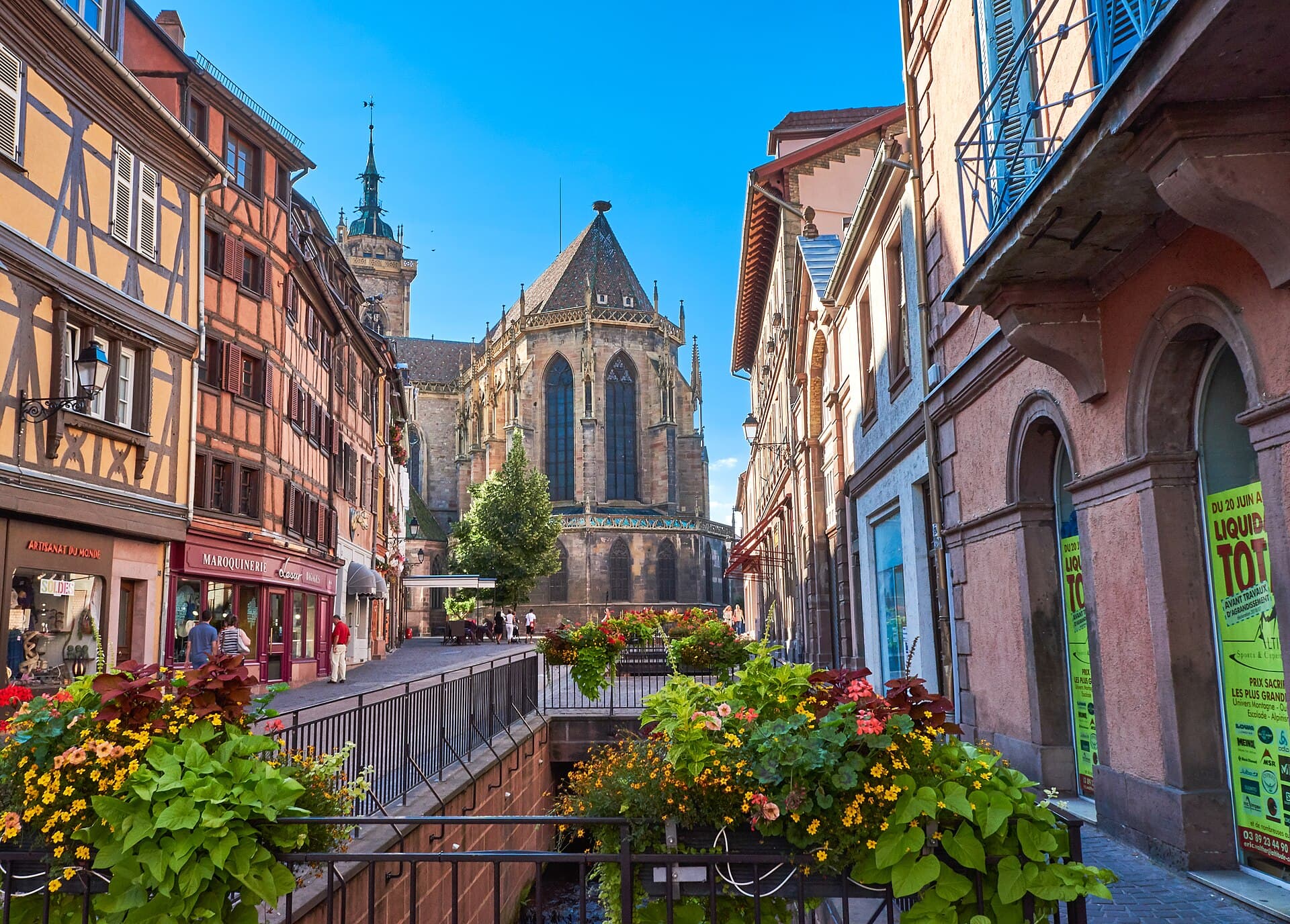
Colmar, a city in France's Grand Est region, feels like a storybook come to life with its colorful half-timbered houses, flower-lined canals, and stone-paved paths. Often called the 'capital of Alsatian wine,' it rests among the vine-covered foothills of the Southern Vosges, near the German and Swiss borders. This particular location has shaped Colmar's distinct Franco-German identity, apparent in its architecture, cuisine, and local customs.
The city's well-preserved old town, known as 'Little Venice' (La Petite Venise), is a charming network of canals where small boats drift past pastel-colored structures. Colmar's allure extends beyond its visual appeal; it is a city that invites exploration, from its bustling covered market to its quiet passages, revealing centuries of history and a lively cultural synthesis.
## From Roman Roots to Imperial City Colmar's origins trace back to the 9th century, first recorded as 'Columbarium' in 823 in a decree by Emperor Louis the Pious. The city developed throughout the Middle Ages, with its 9th-century architecture characterized by substantial wooden buildings, barns, stables, and dovecotes. By the 13th century, Colmar had become an Imperial City, a designation granted by Emperor Frederick II in 1226, affording it autonomy within the Holy Roman Empire. During this period, religious orders like the Franciscans, Dominicans, and Augustinians established themselves, constructing churches and monastic structures that still stand in the historic center today.
## Shifting Allegiances and Flourishing Eras In 1354, Colmar joined the Décapole, a confederation of ten Alsatian cities formed to safeguard their privileges and Imperial City status. The Koïfhus building, completed in 1480, served as the meeting place for the Décapole's political members. The 15th and 16th centuries marked a flourishing era for Colmar, fueled by its prosperous merchants, agriculture, and especially winemaking. This period saw the construction of many impressive buildings.
## French Governance and German Annexations Colmar's history is characterized by frequent changes in sovereignty between France and Germany. During the Thirty Years' War (1618–1648), the city experienced significant upheaval and devastation, captured by the Swedish army in 1632. In 1635, it was placed under the protection of the King of France, though it maintained its Imperial City status. Colmar was conquered by France under Louis XIV in 1673 and officially ceded by the Treaties of Nijmegen in 1679, becoming a 'Royal City of France.' In 1698, it became the judicial capital of Alsace. Voltaire even spent 13 months in Colmar between 1753 and 1754, describing it as 'a city half-German and half-French, and wholly Iroquoian.' The city was annexed by the German Empire in 1871 after the Franco-Prussian War, returning to France after World War I in 1919. It was again annexed by Nazi Germany in 1940 during World War II, finally reverting to French control after the Battle of the Colmar Pocket in February 1945. This turbulent past has left Colmar with a distinctive cultural and architectural blend.
Strolling through Colmar's Old Town offers an experience in itself, with its lively half-timbered houses and narrow, winding streets. The area known as Little Venice (La Petite Venise) is particularly evocative, providing delightful canal-side views and boat excursions. Take time to observe the Pfister House, a notable example of Renaissance architecture from 1537, with its distinctive oriel window and murals. The Koïfhus, or Old Customs House, a 15th-century building, once served as the economic and political center of medieval Colmar. The House of Heads, built in 1609, is distinctive for the 106 sculpted heads adorning its facade. For art enthusiasts, the Unterlinden Museum, situated in a 13th-century Dominican convent, is a significant destination, housing the renowned Isenheim Altarpiece. Colmar is also the birthplace of Frédéric Auguste Bartholdi, the sculptor of the Statue of Liberty, and his childhood home is now a museum dedicated to his creations. A 12-meter replica of the Statue of Liberty can be seen at the city's northern entrance. For a taste of local life, explore the Covered Market, offering a variety of regional products.
Colmar welcomes visitors throughout the year, with each season presenting a different atmosphere. Late spring (May-June) and early autumn (September-October) are often considered ideal, offering mild weather, blooming flowers, verdant vineyards, and fewer crowds than the peak summer months. Summer (June-August) is animated with festivals, including the Colmar Wine Festival, but also brings more visitors and higher accommodation prices. For a truly enchanting experience, visit from late November through December to witness Colmar's celebrated Christmas markets, though anticipate substantial crowds and book lodging well in advance. January and early November are the quietest times to visit, providing a more serene experience with fewer tourists.
Colmar is readily accessible by train, with direct connections from Strasbourg (30 minutes), Basel (45 minutes), and Zürich (2 hours). There are also direct trains from Paris Gare de l'Est, taking approximately 2.5 hours. The closest international airports are in Strasbourg, Basel (Europort), Paris, and Zürich. Once in Colmar, the city center is very walkable, allowing exploration of its charming streets on foot. For discovering the surrounding Alsatian wine villages like Riquewihr and Eguisheim, consider renting an e-bike or joining a wine tour. Many hotels do not have air conditioning, so if visiting in summer, confirm this amenity if it is important to you, as temperatures can reach 35°C (95°F). Making dinner reservations in advance is advisable, particularly during peak season.