Marktplatz
Observe the statue of Prince Albert in Coburg's market square with care.
Full story unlocks in the tour
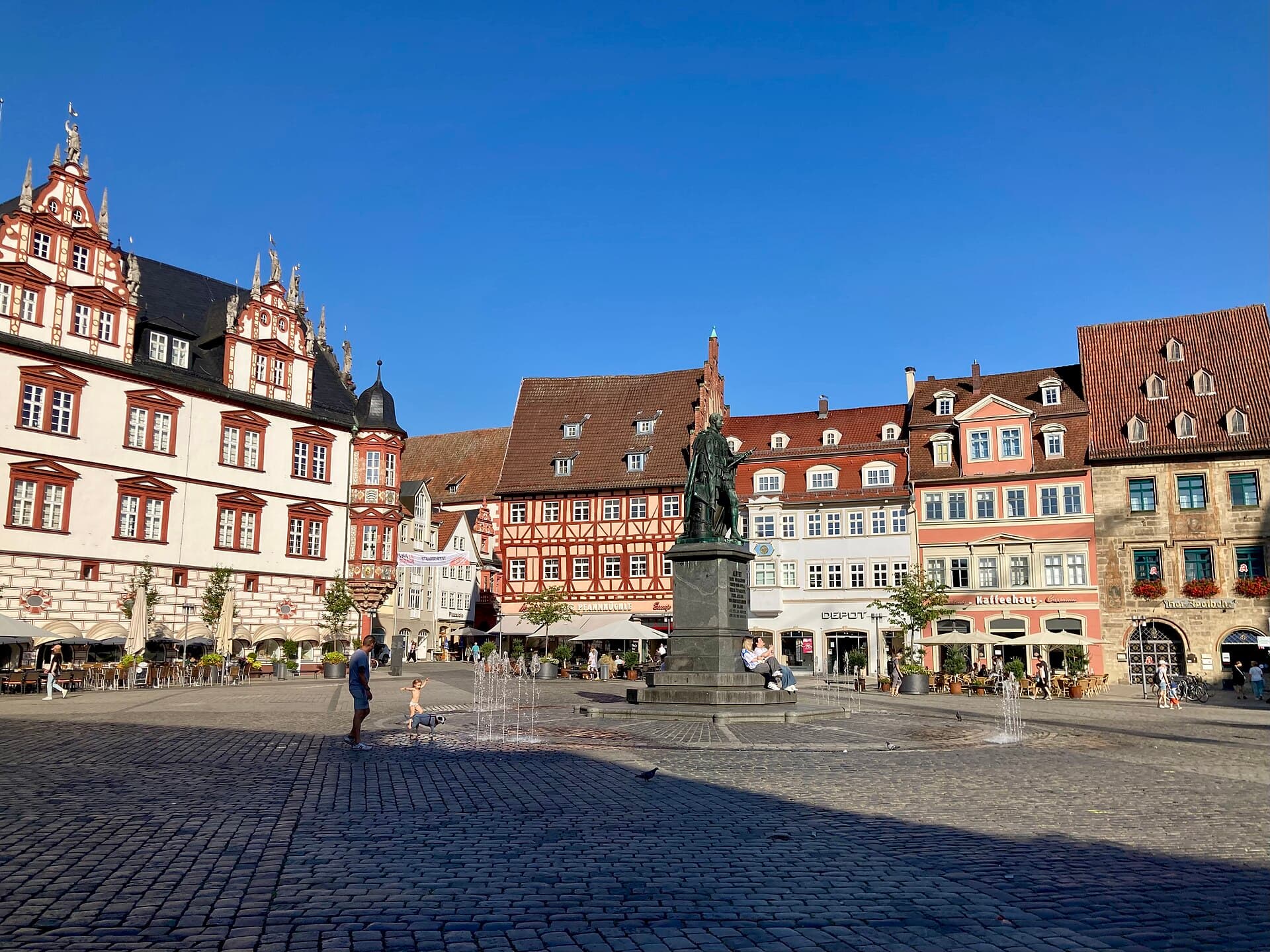 © Travis K. Witt / CC BY-SA 4.0, via Wikimedia Commons
“Where royal lineages entwine with ancient grandeur.”
Not the postcards. The stories even locals don't know — whispered in your ear, right where they happened.
Observe the statue of Prince Albert in Coburg's market square with care.
A singular liquid from Coburg's past remains available, but only here.
The essence of Coburg's renowned sausage extends beyond its meat.
Discover every secret of Coburg
Every address, every reveal in full — in your ear, right where it happened.
You pick your stops. You walk. The voice reveals what the others miss.
No tours available yet. Check back soon — we're preparing them.
Situated in northern Bavaria, at the southern border of the Thuringian Forest, Coburg is a city with a profound story, particularly recognized for its deep ties to European royalty. Once the heart of the Duchy of Saxe-Coburg-Gotha, this engaging city was the birthplace of Prince Albert, consort to Queen Victoria, forging a significant connection with the British monarchy. Coburg's well-maintained historic old town, which largely escaped significant harm during World War II, displays a blend of Gothic, Renaissance, and Baroque architecture.
Dominating the cityscape is the formidable Veste Coburg, sometimes called the 'Franconian Crown,' one of Germany's most expansive and impressive medieval fortress complexes. Beyond its regal heritage, Coburg offers a lively cultural scene, including an unexpected distinction as host to the largest Brazilian samba festival outside of Rio. This fusion of medieval majesty, royal intrigue, and spirited traditions makes Coburg a compelling destination for those seeking to explore a less familiar aspect of Bavaria.
## From Imperial Possession to Royal Dynasty Coburg's documented narrative begins in 1056, when it was first mentioned in a monastic record, though an earlier settlement, Trufalistat, existed on the site. Initially an imperial possession in the 10th century, the city was inherited by the Counts of Henneberg in 1248 and granted its charter in 1331. From 1353 until 1918, it belonged to the margraves of Meissen, members of the Wettin family. This lineage would later become the Dukes of Saxe-Coburg-Gotha, a family whose strategic unions would link them to several European royal houses, including those of Britain, Belgium, Portugal, and Bulgaria.
## Martin Luther's Sanctuary and Ducal Flourishing The 15th and 16th centuries marked a period of considerable importance for Coburg, largely due to its strongly fortified Veste, or castle, strategically positioned on a busy trade route. In 1530, the reformer Martin Luther found refuge at Veste Coburg for six months while attending the Diet of Augsburg, using his time there to advance his translation of the Bible. In 1572, Duke Johann Casimir established the independent Duchy of Saxe-Coburg. Under his governance, the city experienced an urban and cultural resurgence, with the construction of a town hall, an armory, a grammar school (Casimirianum), and expansions to Ehrenburg Palace.
## Modern Era and Post-War Identity After the Napoleonic wars, the military significance of the Veste lessened, and it became home to the art collections of the rulers of Saxe-Coburg. In November 1918, following the German revolution at the conclusion of World War I, the last duke of Saxe-Coburg and Gotha, Charles Edward, abdicated. The Free State of Coburg then faced a decision: to join Thuringia or Bavaria. In a November 1919 referendum, the local populace voted overwhelmingly, with an 88% majority, to join Bavaria, a merger that occurred on July 1, 1920. While Coburg was recognized for strong Nazi sympathies leading up to World War II, it sustained minimal damage during the conflict. Its choice to join Bavaria meant it became part of West Germany, while much of the surrounding Thuringian countryside fell under Russian occupation and became part of East Germany. This historical path has left Coburg with a remarkably preserved architectural legacy and a distinct identity at the former inner German border.
Begin your exploration at the Marktplatz, Coburg's central square since the 15th century, framed by historic buildings like the Stadthaus and Rathaus, and featuring a monument to Prince Albert. From here, ascend to Veste Coburg, one of Germany's largest medieval fortresses. This formidable complex, also known as the 'Franconian Crown,' houses art collections, including works by Lucas Cranach the Elder and Younger, historic weapons, and carriages. Observe the sweeping views of the surrounding countryside from the ramparts.
Descend through the Hofgarten, a Baroque-era park connecting the Veste with the city center, offering pleasant walks and vistas. At the base of the hill lies Schloss Ehrenburg, a 16th-century palace re-envisioned in the Neo-Gothic style in the 19th century. It served as a ducal residence and was a favored retreat for Queen Victoria. You can explore its lavish interiors, including the 'Hall of Giants,' on guided tours. The Morizkirche (Church of St. Maurice), the city's oldest church, blends Late Gothic and Baroque styles and is where Martin Luther preached during his stay. Look for the historic city gates, such as the Spitaltor, Judentor, and Ketschentor, remnants of Coburg's medieval defenses.
Coburg is agreeable to visit throughout the year, but for warm-weather pursuits and the most comfortable temperatures, the ideal time is from late June to late August, with average highs around 24°C (75°F). May and June, as well as early autumn, also provide pleasant weather. If you are drawn to traditional European Christmas markets, December is a worthwhile time to visit, though temperatures will be cold, ranging from -2°C to 3°C (28-37°F). July also brings the International Samba Festival, a lively event singular for a German city.
Coburg is easily reached by train, with direct connections from cities like Nuremberg. The train station is approximately 800 meters from the Marktplatz. For those arriving by air, Nuremberg Airport (106km) and Erfurt-Weimar Airport (116km) are the closest, though Frankfurt (230km) and Munich (268km) offer a broader selection of international flights with good rail and road links to Coburg. The city center is compact and readily explored on foot. A combined pass for Veste Coburg, Ehrenburg Palace, and Schloss Rosenau can simplify visits to multiple sites. While major museums often provide English texts, smaller sites may primarily have German panels, so a translation application can be helpful. Coburg is considered one of the more affordable university towns in Bavaria.