Ciudad Rodrigo Cathedral Choir Stalls
Beyond the soaring arches and stained glass, a surprising detail in the cathedral's choir stalls reveals a departure from typical religious iconography.
Full story unlocks in the tour
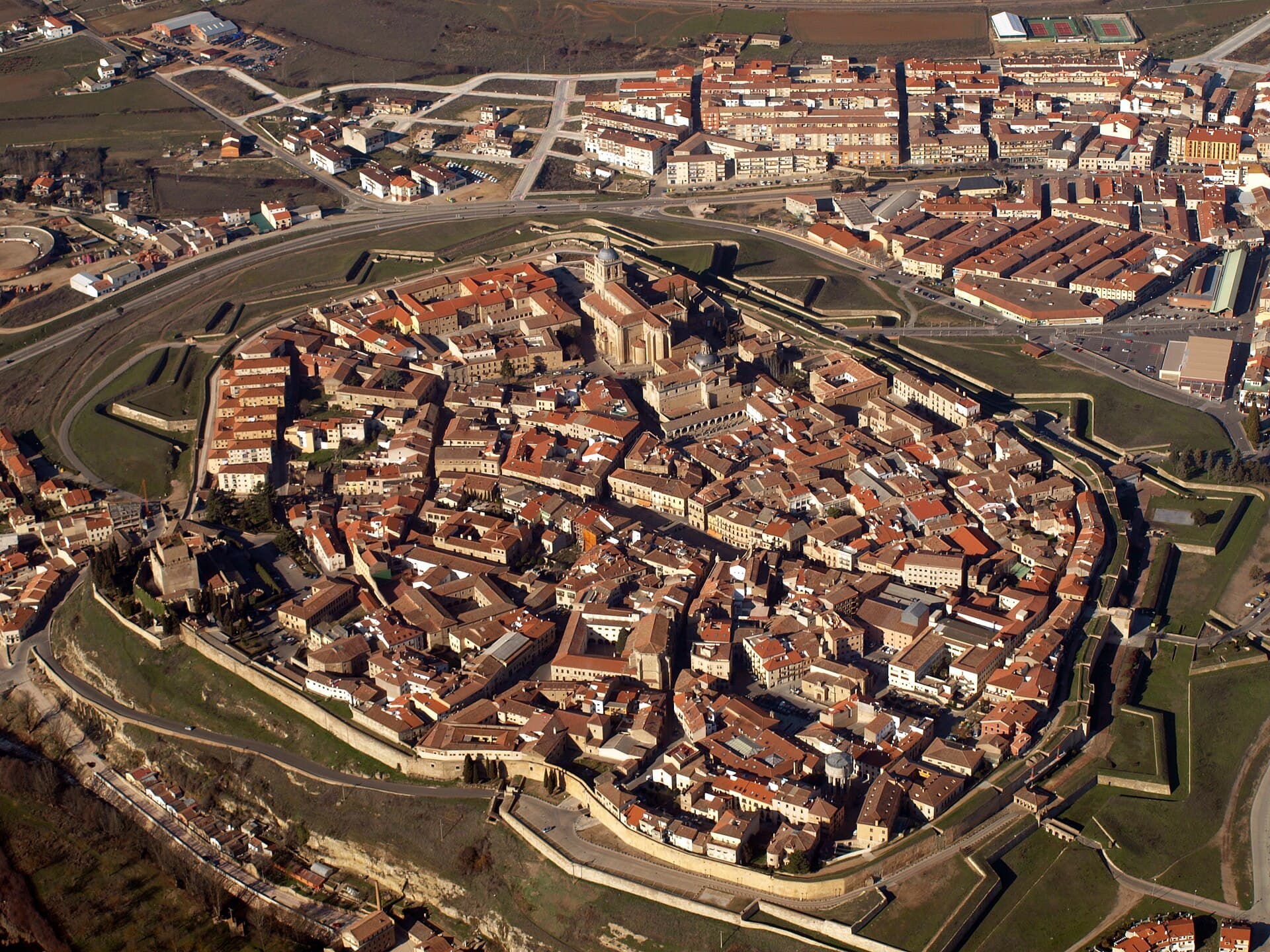 Alfontinto / CC BY-SA 3.0, via Wikimedia Commons
“Where ancient walls narrate sieges and splendor.”
Not the postcards. The stories even locals don't know — whispered in your ear, right where they happened.
Beyond the soaring arches and stained glass, a surprising detail in the cathedral's choir stalls reveals a departure from typical religious iconography.
One of Ciudad Rodrigo's ancient city gates, the Puerta del Sol, holds a local tradition concerning its wooden doors that speaks of a past tragedy.
During the Peninsular War, the British capture of Ciudad Rodrigo involved a chaotic aftermath where even the victors faced unexpected dangers.
Discover every secret of Ciudad Rodrigo
Every address, every reveal in full — in your ear, right where it happened.
You pick your stops. You walk. The voice reveals what the others miss.
No tours available yet. Check back soon — we're preparing them.
Ciudad Rodrigo, a fortified city in western Spain's province of Salamanca, rests on a rocky hill overlooking the Águeda River. Its historic center, encircled by formidable medieval walls, was designated a Historic-Artistic Monument in 1944. The city's strategic location near the Portuguese border has shaped its long and often embattled history, evident in its defensive structures and architectural heritage.
Walking into Ciudad Rodrigo feels like a journey through time, with its granite palaces, stone roads, and a Romanesque cathedral. The city offers a compelling blend of historical significance and local character, making it a captivating destination for those seeking to explore Spain's lesser-known places.
The history of Ciudad Rodrigo extends to the Neolithic Age, with evidence of human occupation on its strategic hill. The area was originally home to the Vettones, a Celtic tribe, who founded a village called Mirobriga around the 6th century BCE. The Romans later conquered the region in the 2nd century CE, renaming the settlement Augustobriga in honor of Octavian Caesar Augustus. Remnants of this Roman presence, such as aqueduct foundations and a bridge, still exist.
Following Roman rule, the city passed through Visigothic hands before the Arab invasion brought renewed conflict. In the early 12th century, after a period of battles between Moors and Christians, Count Rodrigo González Girón began the repopulation and reconstruction of the city, lending it his name: Ciudad Rodrigo, or "City of Rodrigo." A significant turning point came in the late 12th century when King Ferdinand II of León fortified Ciudad Rodrigo with walls and re-established the old Visigothic diocese. This period also saw the commencement of the grand Cathedral of Santa María.
The 15th and 16th centuries marked a period of great splendor for Ciudad Rodrigo, as it became a residence for the nobility. Many of the religious monuments, palaces, and manor houses seen today were constructed during this era, showcasing Renaissance and Plateresque architectural styles. However, its frontier location meant the city endured numerous conflicts in subsequent centuries. During the Peninsular War, Ciudad Rodrigo's strategic importance as a fortified town on the main road from Portugal to Salamanca made it a key target. It was captured by the French in 1810 after a 24-day siege, and then famously retaken by the British under Viscount Wellington in 1812 after a 10-day siege. Wellington was subsequently awarded the title of Duke of Ciudad Rodrigo in recognition of his victory.
The imposing medieval walls, stretching for two kilometers, are Ciudad Rodrigo's most striking feature, offering expansive views of the surrounding landscape. Explore the seven gateways, each with its own history, such as the Puerta del Sol and Puerta de Santiago.
At the city's heart lies the Plaza Mayor, a historic square that has been a center for public life, markets, and festivities since the Middle Ages. Here, you'll find the 16th-century Town Hall, an emblematic Renaissance building.
The Cathedral of Santa María, a blend of Romanesque, Gothic, and Plateresque styles, began construction in the 12th century. Do not miss the Portico del Perdón, adorned with over 400 Romanesque and Gothic sculptures, and its impressive Gothic cloister.
The 14th-century Castle of Enrique II of Trastámara, built for defense, now serves as a Parador hotel, offering exceptional views and a chance to experience a medieval setting. Wander through the city's streets to discover numerous well-preserved Renaissance and Baroque mansions, including the Palacio de los Águila and the Palacio de los Castro. Also, seek out the "Verraco" at Plaza del Castillo, a granite sculpture from the Celtic period.
Ciudad Rodrigo is most enjoyable during May, June, August, September, and October, when temperatures are comfortable, ranging from 19°C to 30°C (66°F to 86°F). These months offer a good balance of sunny and rainy days, with moderate precipitation. July is the warmest month, with an average high of 30°C (86°F), while January is the coldest, averaging 10°C (50°F).
Ciudad Rodrigo is easily accessible by car or bus from Salamanca, located approximately 90 kilometers away. Once in the city, the best way to explore its inviting stone roads, Plaza Mayor, and landmarks is on foot. The city is known for its traditional festivities, including the Carnaval del Toro, a bull carnival held in February, and its Holy Week celebrations. If visiting during these times, expect lively festivities. Do not leave without trying local specialties like farinato, a sausage made with breadcrumbs, pork fat, and spices, often served with fried eggs, and patatas meneás. The city also has a local craft tradition of filigree charra, gold and silver work used for traditional costumes.