Keraton Kasepuhan
Beyond its grand facade, the oldest palace in Cirebon holds a secret about its construction materials.
Full story unlocks in the tour
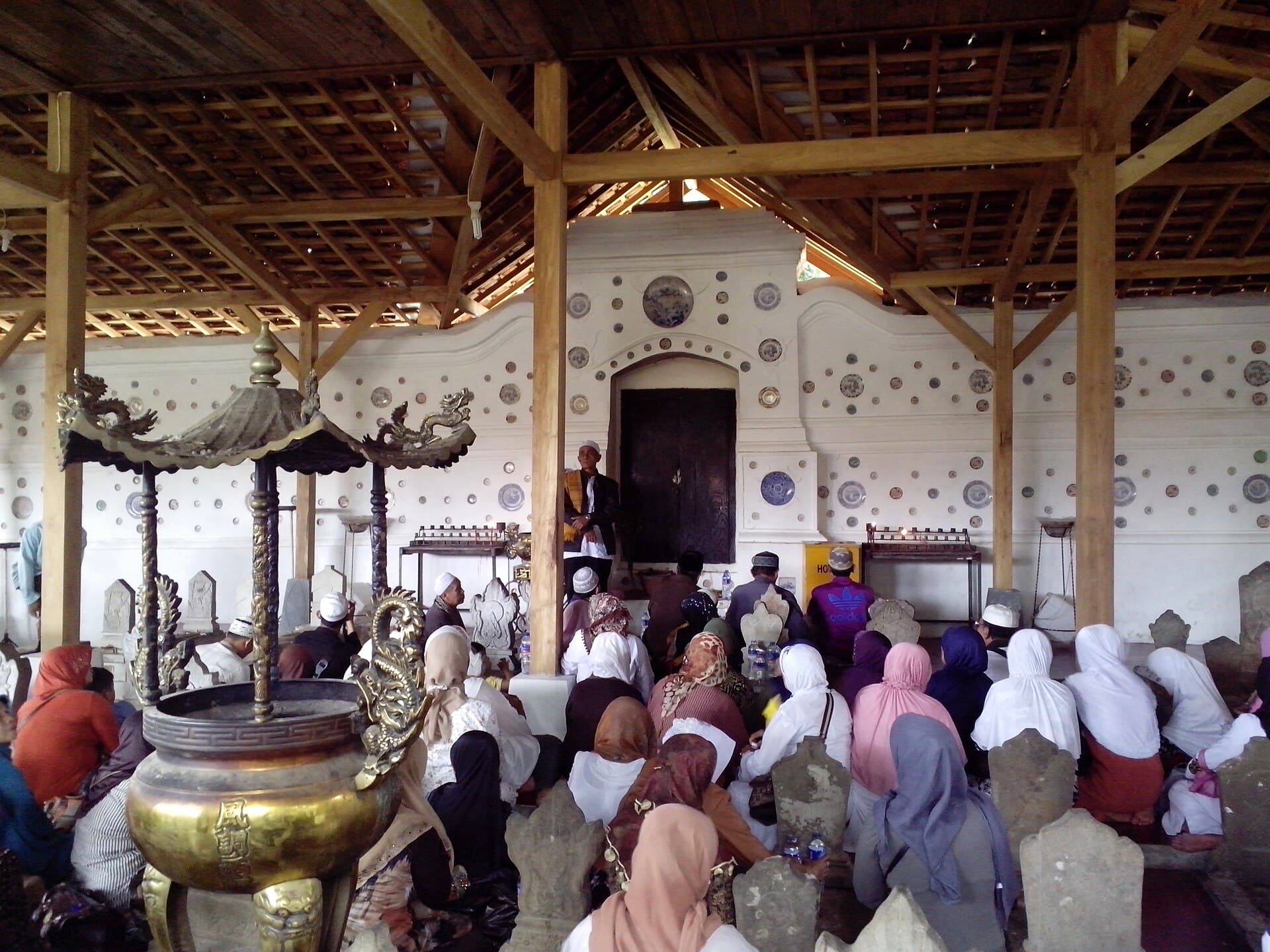 Cahyo Ramadhani / CC BY-SA 3.0, via Wikimedia Commons
“Where Javanese elegance meets coastal allure and ancient narratives linger in the air.”
Not the postcards. The stories even locals don't know — whispered in your ear, right where they happened.
Beyond its grand facade, the oldest palace in Cirebon holds a secret about its construction materials.
This local snack has a name that translates to 'poor man's cracker,' but its preparation method is surprisingly resourceful.
The iconic 'Megamendung' batik motif, with its swirling cloud patterns, carries a deeper philosophical meaning than just a decorative design.
Discover every secret of Cirebon
Every address, every reveal in full — in your ear, right where it happened.
You pick your stops. You walk. The voice reveals what the others miss.
No tours available yet. Check back soon — we're preparing them.
Cirebon, a captivating port city along Java's northern coast, presents a distinctive fusion of cultures. Situated within West Java province, near the border with Central Java, Cirebon has long served as a nexus for commerce and cultural exchange, earning it the moniker 'City of Shrimps' (Kota Udang) due to its historical connections to fishing and shrimp paste production. This dynamic city is a living story, woven from Javanese, Sundanese, Chinese, Arab, and European influences, evident in its architecture, cuisine, and artistic traditions.
To step into Cirebon is to journey through time, where venerable sultanate palaces and historic mosques stand alongside colonial-era buildings. The city invites exploration of its profound past, from its origins as a 15th-century fishing village to its evolution into a significant center for the spice trade and the spread of Islam across Java. With a welcoming tropical climate throughout the year, Cirebon promises an authentic Indonesian experience, where the fragrance of local spices mingles with the sea breeze, and gracious locals share their singular heritage.
## From Fishing Village to Sultanate Powerhouse Cirebon's narrative begins in the mid-15th century as a modest fishing village, then known as Muara Jati or Sarumban. Its strategic position on Java's northern coast swiftly drew foreign traders, establishing the foundation for its future as a thriving port. The city's name itself is thought to derive from either the Sundanese words "ci" (water) and "rebon" (small shrimp), reflecting the local fishing industry, or from the Javanese word "caruban," meaning "mixture," a nod to its diverse cultural influences.
The pivotal moment arrived with Prince Walangsungsang (also known as Prince Cakrabuana) from the Hindu Kingdom of Sunda, who founded a settlement in 1445. His nephew, Sunan Gunung Jati (Sharif Hidayatullah), a revered Islamic preacher and one of the nine saints (Wali Songo) who propagated Islam in Java, established the independent Cirebon Sultanate in the early 16th century. This marked Cirebon as the first Islamic rule in western Java, transforming it into a vital political, commercial, and spiritual center.
## A Confluence of Influences Throughout the 15th and 16th centuries, Cirebon prospered as a key player in the spice trade, drawing a diverse array of Chinese, Arab, and European merchants. This active commerce and its position at the intersection of Javanese and Sundanese cultures fostered a singular multicultural identity, vividly expressed in its distinctive architecture, language, and art, particularly its celebrated batik. The palaces of the Cirebon Sultanate, such as Keraton Kasepuhan, exemplify this synthesis, blending traditional Javanese pavilion architecture with Hindu motifs, Chinese ceramics, and Dutch tiles.
## Colonial Era and Modernity In the 19th and 20th centuries, Dutch colonial presence further shaped Cirebon, introducing European architectural trends like Neoclassicism and Art Deco. The city continued to develop as an important port for exporting commodities such as sugar, coffee, and indigo. In 1906, Cirebon was granted municipality status within the Dutch East Indies. Following Indonesia's declaration of independence in 1945, Cirebon became an integral part of the new republic and the province of West Java. Today, Cirebon remains a significant economic and transport hub, a dynamic city that gracefully balances its deep-rooted traditions with the rhythm of contemporary life.
Cirebon's profound history and varied cultural influences are best experienced through its architectural landmarks and lively local crafts. Begin at Keraton Kasepuhan, the oldest and most carefully preserved palace of the Cirebon Sultanate, dating back to 1447. Wander its expansive grounds, admire the unique blend of Javanese, Chinese, and Islamic architectural styles, and uncover royal relics. Nearby, the Masjid Agung Sang Cipta Rasa, one of Indonesia's oldest mosques from the 15th century, displays distinctive multi-tiered Javanese roof architecture adapted for Islamic worship.
Another significant royal dwelling is Keraton Kanoman, established in the late 16th century, which continues to house the Sultan of Kanoman's descendants and a collection of historical artifacts. For a truly singular experience, visit Sunyaragi Cave Park (Taman Sari Gua Sunyaragi), an artificial cave complex that served as a meditation retreat for Cirebon's sultans, featuring a captivating blend of Javanese and Chinese architectural elements. Be sure to explore Kampung Batik Trusmi, the heart of Cirebon's batik industry, where you can observe the intricate art of batik making and acquire unique, locally crafted textiles.
Cirebon experiences a warm and humid tropical climate throughout the year, with average temperatures typically between 25–27°C (77–81°F). The most favorable time to visit is during the dry season, from May to October. During these months, rainfall is minimal, and the weather is generally pleasant for exploring and outdoor pursuits. While the rainy season from November to April brings more precipitation, it can still be an appealing time to visit, though an umbrella is advisable.
Reaching Cirebon is convenient due to its central location. From Jakarta, a train journey offers a comfortable ride of approximately 3-5 hours to either Kejaksan or Prujakan station. Buses are also available from major cities like Jakarta, Bandung, and Semarang, though travel times may be longer due to traffic. For local transit, public minivans known as angkot are an economical choice, or you can opt for taxis and ride-hailing applications. Becaks (rickshaws) provide a distinctive local experience, but it is wise to agree on the fare beforehand.
Cirebon's culinary offerings are a highlight; be certain to sample local specialties such as Nasi Jamblang (rice wrapped in teak leaves with various side dishes), Empal Gentong (a hearty beef soup), and Tahu Gejrot (fried tofu with a spicy sauce). Many local vendors primarily accept cash, so carrying Indonesian Rupiah (IDR) is recommended. Light, comfortable clothing made from natural fibers like cotton is suggested due to the warm and humid climate. While Cirebon is generally safe for evening strolls in central districts, standard precautions should always be observed.