The Great Pyramid of Cholula
Imagine a pyramid so vast it was mistaken for a natural hill, even by conquistadors.
Full story unlocks in the tour
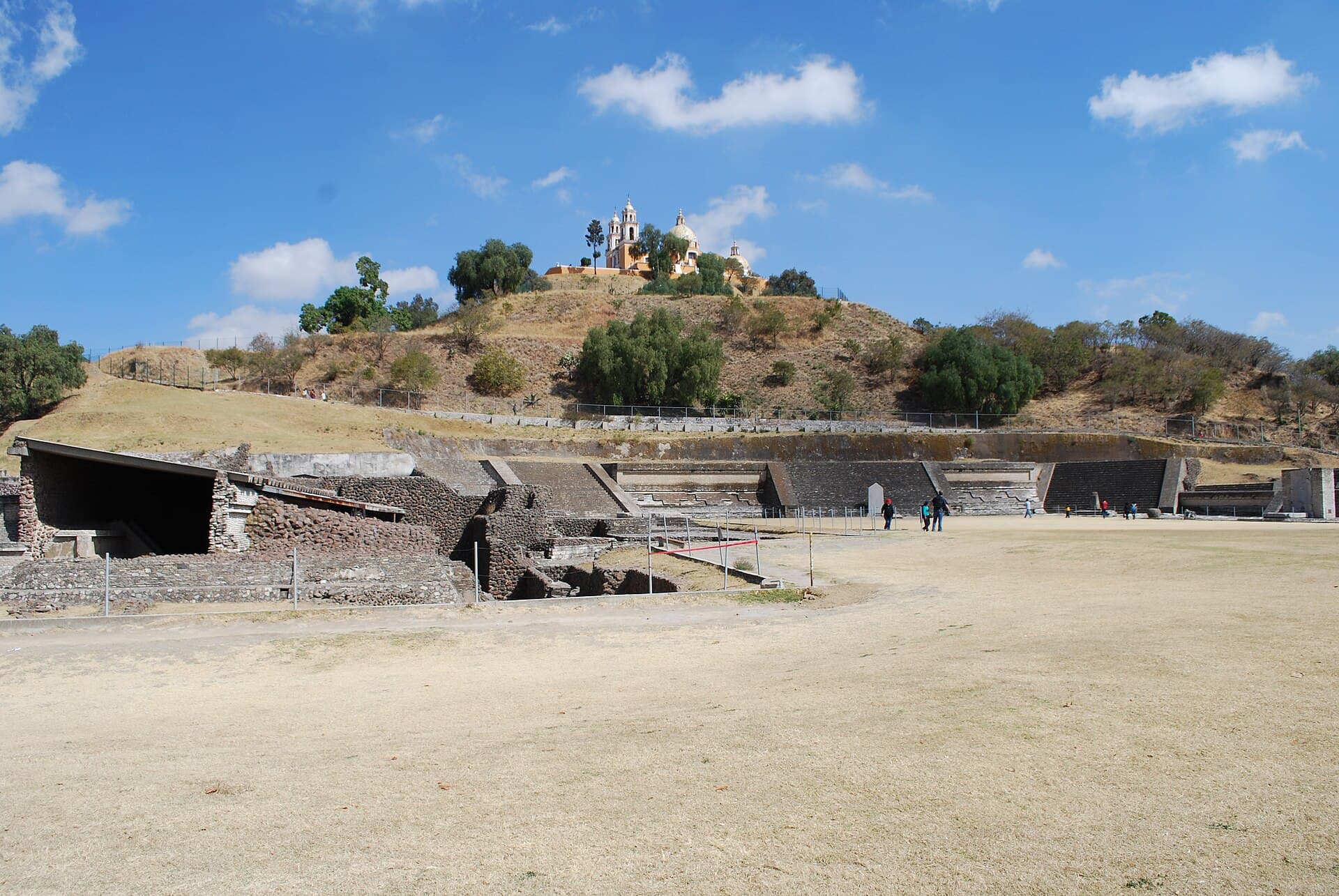 AlejandroLinaresGarcia / CC BY-SA 4.0, via Wikimedia Commons
“Beneath a church, a mountain of history awaits.”
Not the postcards. The stories even locals don't know — whispered in your ear, right where they happened.
Imagine a pyramid so vast it was mistaken for a natural hill, even by conquistadors.
Legend claims Cholula possesses a church for every day of the year.
A seemingly welcoming city once bore witness to a brutal and pivotal event in the Spanish conquest.
Discover every secret of Cholula
Every address, every reveal in full — in your ear, right where it happened.
You pick your stops. You walk. The voice reveals what the others miss.
No tours available yet. Check back soon — we're preparing them.
Cholula, a city in the state of Puebla, Mexico, is a place where ancient history and colonial influences intertwine, creating a singular atmosphere. Situated at an elevation of approximately 2,150 to 2,200 meters (7,050 to 7,218 feet) above sea level, it rests in a valley framed by agricultural land and the grand Popocatépetl and Iztaccihuatl volcanoes. Recognized as a "Pueblo Mágico" (Magical Town) by the Mexican Secretary of Tourism, Cholula is celebrated for its authenticity and enduring traditions.
Divided into two municipalities, San Pedro Cholula and San Andrés Cholula, the city is considered the oldest continuously inhabited city in North America, with its history reaching back to around 500 B.C. This long lineage is palpable, particularly at its most famous landmark: the Great Pyramid of Cholula, a colossal structure crowned by a vivid 16th-century church.
Cholula's origins stretch back over a millennium before the common era, with evidence of a growing population by the sixth century BC. It evolved from a small village into a regional center between 600 BCE and 700 CE, becoming a major religious and mercantile hub. During the Classic period (200–800 CE), Cholula saw the initial construction of its Great Pyramid, a monumental undertaking that would be built over six times, expanding to an enormous base. This period also shows influence from Teotihuacan, a larger city in the Valley of Mexico, indicating Cholula's strategic importance on trade routes.
By the Postclassic period (900–1521), Cholula reached its largest size and population, covering 10 square kilometers and housing between thirty and fifty thousand people. It was a dominant political force, known for its distinct Mixteca-Puebla artistic style, particularly in pottery, which spread through extensive Mesoamerican trading networks. The city was a significant pilgrimage site, with the Quetzalcoatl Temple being one of the most important in the central Mexican highlands.
The arrival of the Spanish in 1519 marked a dramatic turning point. Hernán Cortés, initially welcomed, orchestrated a massacre of the Cholulan nobility, a brutal act that decapitated the city's leadership and sent a clear message to other indigenous cities. Following the conquest, Cortés vowed to construct a Christian church for every indigenous temple, leading to the building of numerous churches, including the Santuario Nuestra Señora de los Remedios atop the Great Pyramid. During the colonial period, Cholula's importance was somewhat overshadowed by the newly founded city of Puebla, though it remained a significant agricultural and commercial center.
The most iconic sight in Cholula is the Zona Arqueológica de Cholula, home to the Great Pyramid. What appears to be a natural hill is, in fact, the world's largest pyramid by volume, with tunnels accessible to visitors that offer a glimpse into its layered construction. On top of this pyramid stands the striking 16th-century Santuario Nuestra Señora de los Remedios, a yellow-facaded church with ornate bell towers, providing sweeping views of the city and surrounding volcanoes.
Near the archaeological site, the Museo de Sitio de Cholula provides context for the pyramid's history and construction, while the larger Museo Regional de San Andres Cholula (or Museo Regional de Cholula) offers a broader look at the region's cultural evolution through its archaeological artifacts and exhibits.
The Plaza de la Concordia (Zócalo) serves as the city's lively center, lined with the longest arcade in Latin America, known as the portales. Here, you'll find vendors, street food, and the impressive Convento de San Gabriel Arcángel, a 16th-century friary built over the ruins of a Quetzalcóatl temple. Beyond the main square, explore other unique churches like the Templo de Santa María Tonantzintla, known for its intricate indigenous-baroque fusion, and the Templo de San Francisco Acatepec, with its colorful Talavera facade.
For a different experience, Container City in San Andrés Cholula offers a modern hub of shops, bars, and restaurants housed in shipping containers.
Cholula enjoys a temperate climate year-round due to its elevation, with daytime temperatures typically ranging between 15°C and 25°C (59°F to 77°F). The dry season, from November to May, offers lower humidity and minimal rainfall, making it an excellent time for outdoor activities. The clearest skies are often seen in February. The warm season, from late March to early June, is ideal for warm-weather activities, with a peak in late April. Evenings and nights, especially in winter, can be cooler. The rainy season extends from June to October, with September being the wettest month, so an umbrella or light rain jacket is advisable during this period.
Cholula is easily accessible, located just a short drive northwest of Puebla City (about 20-30 minutes by car or 45 minutes by local bus). Taxis and ride-sharing services like Uber are readily available from Puebla. While a tourist train from Puebla to Cholula previously existed, it is no longer operational. The city itself is very walkable, especially around the pyramid and main plaza. For longer stays, Cholula can serve as a relaxed base for exploring the region.
Cholula is generally considered safe for travelers, including solo female travelers, particularly in tourist areas. However, standard precautions apply, such as avoiding secluded areas at night and securing belongings. The city has a lively food scene, with options ranging from traditional street food in the Plaza de la Concordia to diverse restaurants, including vegetarian and vegan choices. More English speakers are found here due to the presence of international students.