Rani Padmini's Palace
The legend of Rani Padmini is often associated with a mirror, but the story behind its inclusion is more complex than a simple reflection.
Full story unlocks in the tour
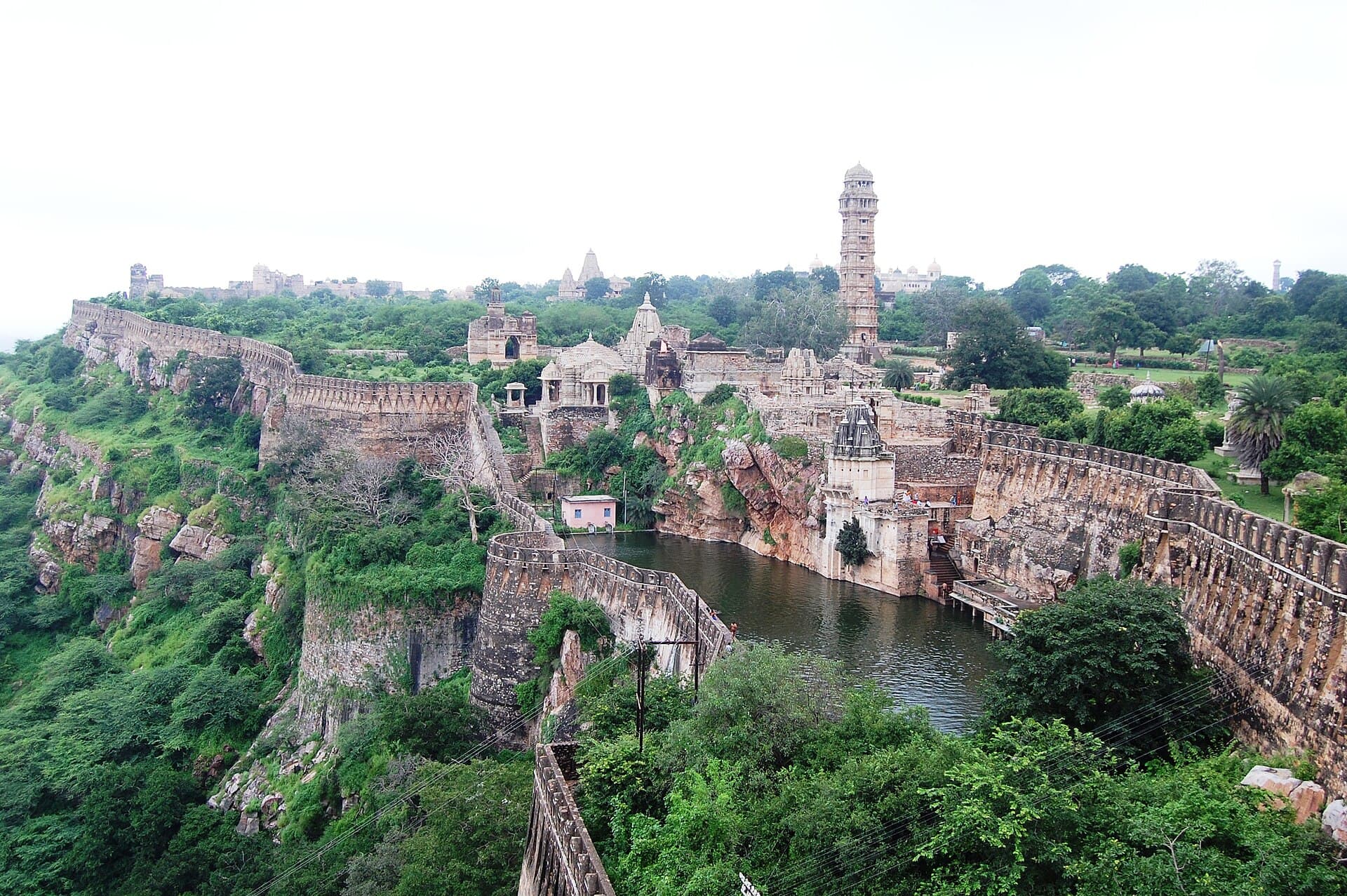 Ssjoshi111 / CC BY-SA 3.0, via Wikimedia Commons
“Echoes of valor: where history breathes in stone.”
Not the postcards. The stories even locals don't know — whispered in your ear, right where they happened.
The legend of Rani Padmini is often associated with a mirror, but the story behind its inclusion is more complex than a simple reflection.
This tower, dedicated to Jainism, holds a unique architectural detail that speaks to its purpose beyond mere height.
Among the royal artifacts and weaponry, a specific collection here reveals an unexpected connection to European craftsmanship.
Discover every secret of Chittorgarh
Every address, every reveal in full — in your ear, right where it happened.
You pick your stops. You walk. The voice reveals what the others miss.
No tours available yet. Check back soon — we're preparing them.
Chittorgarh, a city in southern Rajasthan, stands as a testament to Rajput valor and sacrifice. Its defining feature is the colossal Chittorgarh Fort, a UNESCO World Heritage Site that sprawls across 700 acres atop a 180-meter-high hill. This formidable structure, with a perimeter wall stretching 13 kilometers, has witnessed centuries of battles and tales of immense courage.
The city's essence is deeply intertwined with the fort's history, where echoes of ancient sieges and the unwavering spirit of its defenders still resonate. Exploring Chittorgarh means stepping into a living narrative, where every stone and structure tells a story of a bygone era, inviting visitors to connect with a powerful past.
Beyond the fort, Chittorgarh offers a glimpse into the cultural fabric of Rajasthan, with its temples, palaces, and markets reflecting a heritage of art and devotion. It's a destination that invites travelers to immerse themselves in a profound historical experience.
The origins of Chittorgarh Fort trace back to the 7th century AD, believed to have been built by King Chitrangad of the Mori dynasty. Some accounts also suggest its construction by Bhim, one of the Pandava warriors from the Mahabharata, with a legend stating his strike created the Bhimlat Kund reservoir. By the mid-8th century, the fort became strategically important, eventually falling under the control of the Sisodia Rajputs, who made it the capital of the powerful Mewar kingdom.
Chittorgarh Fort endured three major sieges, each a pivotal moment in its history. The first occurred in 1303 when Alauddin Khilji, the Sultan of Delhi, attacked the fort, reportedly captivated by the beauty of Rani Padmini. During this siege, Rani Padmini and many other Rajput women are said to have performed Jauhar, a ritual of mass self-immolation, to protect their honor. The men, in turn, fought to their deaths.
The fort was recaptured in 1326 by Hammir Singh, a scion of the Gehlot clan, whose dynasty became known as Sisodia. The 14th and 15th centuries saw significant development, including the construction of the iconic Vijay Stambh (Tower of Victory) by Rana Kumbha in the 1440s, commemorating his military triumph. Chittorgarh reached its zenith under Rana Sanga in the early 16th century, who further strengthened the Mewar kingdom.
However, the fort faced another devastating attack in 1535 by Bahadur Shah of Gujarat, leading to a second Jauhar where 13,000 Rajput women committed self-immolation. The final siege occurred in 1568 when Mughal Emperor Akbar attacked and seized the fort. The capital of Mewar was subsequently moved to Udaipur. It was eventually returned to the Rajputs in 1616 under Mughal Emperor Jahangir. In 2013, the Chittorgarh Fort was recognized as a UNESCO World Heritage Site.
The primary attraction in Chittorgarh is the vast Chittorgarh Fort, a sprawling complex that requires comfortable shoes and ample time to explore.
Within the fort, the Vijay Stambh, or Tower of Victory, stands as a nine-storied monument built by Rana Kumbha in the 15th century. It rises 37 meters high and is adorned with intricate carvings of Hindu deities and mythological scenes.
Nearby, the Kirti Stambh, or Tower of Fame, is a 12th-century tower built by a Jain merchant and dedicated to Adinath, the first Jain Tirthankara. It stands 22 meters tall and features detailed carvings of Jain figures.
Rana Kumbha Palace is a significant ruin within the fort, believed to be the birthplace of Maharana Udai Singh and associated with the first recorded Jauhar. Its underground chambers and massive courtyards hint at its past grandeur.
Rani Padmini's Palace is a three-storied white building surrounded by a water moat, a focal point of the legendary tale of Queen Padmini.
The Fateh Prakash Palace Museum, housed within the fort, displays a collection of sculptures, weapons, and artifacts, providing insights into the region's art and culture. The museum is closed on Mondays.
Other notable sites include the Meera Temple, dedicated to the mystic poetess Meera Bai, known for its Indo-Aryan architecture and spiritual ambiance. The Kalika Mata Temple, originally a Sun Temple from the 8th century, is also within the fort complex. The Gaumukh Reservoir is a deep tank fed by a spring, situated at the edge of a cliff.
The fort also contains several Jain temples, including the Satbis Deori Jain Temple.
The ideal time to visit Chittorgarh is during the winter months, from October to March. During this period, the weather is pleasant and cool, with temperatures ranging from approximately 10°C to 28°C, making it comfortable for exploring the expansive fort complex and other attractions. Summers, from April to June, are extremely hot with temperatures reaching 35-45°C, making outdoor sightseeing challenging. The monsoon season, from July to September, brings moderate and unpredictable rainfall, which can make the surroundings greener but may still be warm.
Chittorgarh is well-connected by road and rail. The nearest airport is Maharana Pratap Airport (UDR) in Udaipur, approximately 90-105 km away, with taxis and buses available for transfer. Chittorgarh Junction is the main railway station, connecting the city to major Indian cities like Jaipur, Delhi, Mumbai, and Ahmedabad. The city is also accessible by bus, with both private and state-run services.
The Chittorgarh Fort is open daily from 9:00 AM to 6:00 PM. Entry fees vary: for Indian citizens, it's around ₹40-₹50, while foreigners pay ₹200-₹600. The Fateh Prakash Palace Museum has separate timings, generally from 9:45 AM to 5:45 PM, and is closed on Mondays. A sound and light show is also held at the fort in the evenings. Wear comfortable shoes as exploring the fort involves a lot of walking. Guides are available for hire at the entrance, and 4WD vehicles can be hired for easier navigation of the vast fort.