Chicago River
Chicago is known for its impressive engineering feats, but one particular project literally changed the course of nature.
Full story unlocks in the tour
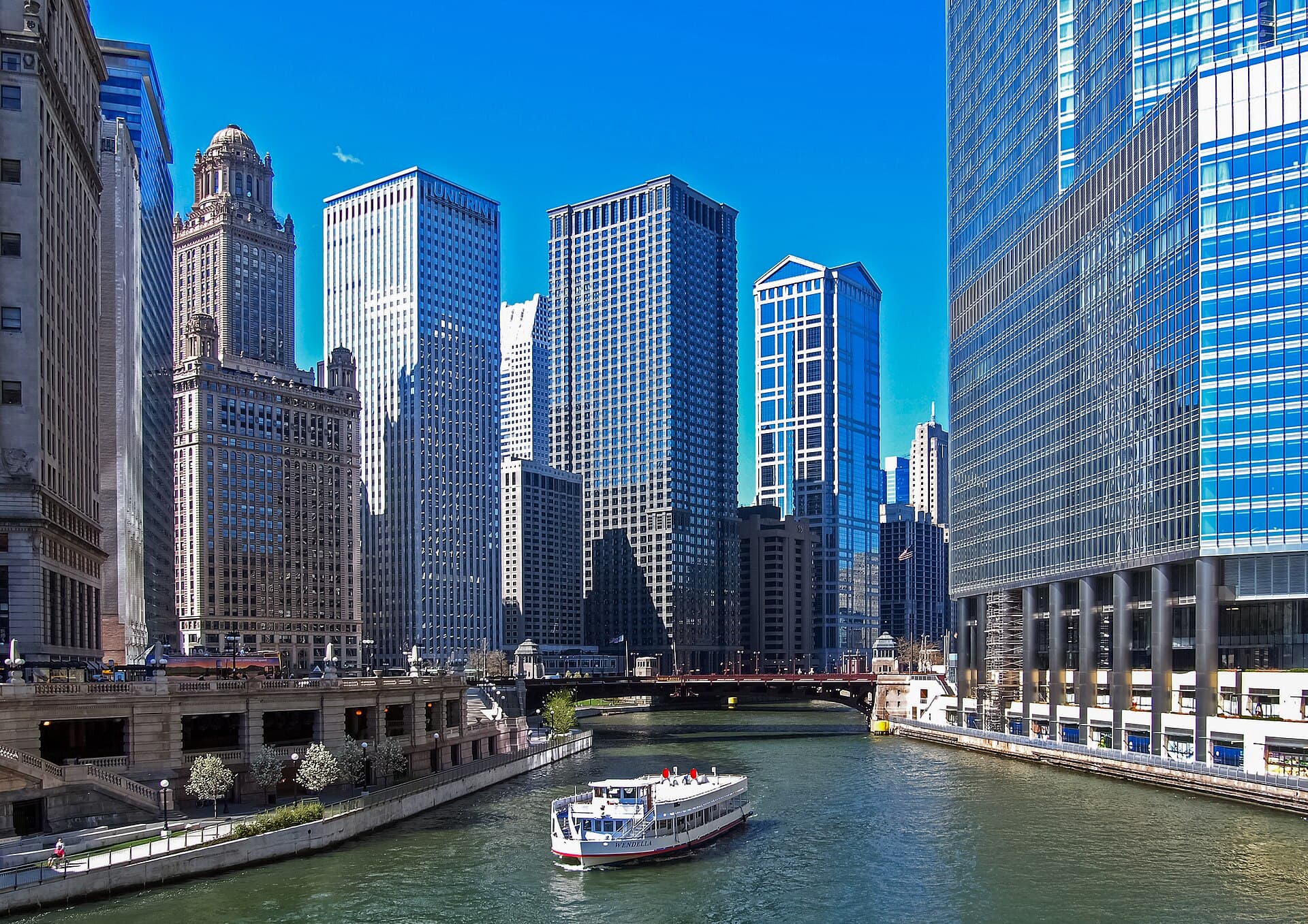 File:Chicago River ferry.jpg: John Picken derivative work: Georgfotoart / CC BY 2.0, via Wikimedia Commons
“Where steel meets sky and history flows backward.”
Not the postcards. The stories even locals don't know — whispered in your ear, right where they happened.
Chicago is known for its impressive engineering feats, but one particular project literally changed the course of nature.
Beyond its famous masterpieces, this museum holds a collection that transports you to another scale entirely.
The iconic 'Bean' sculpture has a more formal, and perhaps more poetic, name that few visitors use.
Discover every secret of Chicago
Every address, every reveal in full — in your ear, right where it happened.
You pick your stops. You walk. The voice reveals what the others miss.
No tours available yet. Check back soon — we're preparing them.
Chicago, often called the 'Windy City,' is a metropolis of architectural innovation, culture, and a resilient spirit. Situated on the shores of Lake Michigan, it's a city that has repeatedly reinvented itself, rising from the ashes of the Great Chicago Fire of 1871 to become a global hub. From its towering skyscrapers to its expansive parks, Chicago offers a dynamic blend of urban energy and green spaces.
The city's grid system and multi-level streets, including the famous Wacker Drive, reflect its thoughtful urban planning. Beyond its impressive skyline, Chicago is a city of diverse neighborhoods, each with its own character, contributing to its reputation as the 'City of Big Shoulders'—a nod to its industrial past and the hardworking people who built it. It's a place where history intertwines with modernity, offering a breadth of experiences for every visitor.
The name 'Chicago' itself has humble origins, derived from a Native American word, shikaakwa, referring to the wild leeks or ramps that grew abundantly along the Chicago River, giving the area a distinctive smell. French explorers in the 17th century adapted this word, and it evolved into the city's current name.
Chicago's first permanent settler was Jean Baptiste Point du Sable, a trapper and merchant of French and African parentage from Haiti, who established a trading post in 1779. The city was incorporated as a town in 1833 and then as a city in 1837, quickly growing into a significant trading center due to its strategic location.
One of the most pivotal moments in Chicago's history was the Great Chicago Fire of 1871, which destroyed a third of the city and left over 100,000 people homeless. However, Chicago's resilience shone through as it rapidly rebuilt. Much of the debris from the fire was used as landfill, forming the foundation for what are now prominent city parks like Grant Park and Millennium Park.
Just 22 years after the devastating fire, Chicago hosted the World's Columbian Exposition of 1893, a monumental event that showcased the city's remarkable comeback and technological advancements. The fair, also known as the 'White City' due to its neoclassical architecture and illumination by hundreds of thousands of light bulbs, drew over 27 million visitors. It was at this exposition that the Ferris wheel made its debut, designed to rival the Eiffel Tower from the 1889 Paris World's Fair. The fair also introduced new foods like Juicy Fruit gum, Cracker Jack, and brownies.
Chicago continued to be a city of innovation, becoming home to the world's first skyscraper, the Home Insurance Building, in 1885. In 1900, a remarkable engineering feat reversed the flow of the Chicago River to protect its drinking water supply. The city also saw the birth of the first planetarium in the Western Hemisphere, the Adler Planetarium, in 1930. Throughout the 20th century, Chicago continued to be a hub for "firsts," including the first controlled atomic blast at the University of Chicago in 1942 and the invention of deep-dish pizza in 1943.
Begin your exploration in Millennium Park, home to the iconic Cloud Gate, affectionately known as 'The Bean.' This reflective sculpture distorts the city skyline and is a popular spot for photographs. Nearby, the Art Institute of Chicago houses a world-renowned collection spanning centuries and cultures, from American Gothic to the fascinating Thorne Miniature Rooms.
No visit to Chicago is complete without experiencing its architectural prowess. Consider an architecture boat tour along the Chicago River to witness the city's diverse building styles and learn about their history. For panoramic views, ascend the Willis Tower (formerly Sears Tower), where on a clear day, you can see four states. The Chicago Water Tower and Pumping Station on North Michigan Avenue is another architectural landmark, notable for being one of the few structures to survive the Great Chicago Fire.
Explore the Museum Campus, which includes the Field Museum, Shedd Aquarium, and Adler Planetarium, all situated along the lakefront with city views. For a relaxed outdoor experience, wander through Lincoln Park, one of the city's largest green spaces, which also houses a free zoo.
The shoulder seasons of late spring (May to early June) and early fall (September to October) generally offer the most pleasant weather for visiting Chicago. During these months, temperatures are comfortable, crowds are often thinner than in summer, and the city's parks and architecture are particularly appealing. While summer (June to August) is lively with festivals and outdoor activities, it can be hot and humid, with larger crowds. Winter (November to March) brings cold temperatures and snow, but also festive lights and holiday markets.
Chicago's public transportation system, the CTA (Chicago Transit Authority), is an efficient way to navigate the city, offering extensive bus routes and eight 'L' train lines that operate above ground, at street level, and underground. Two train lines, the Blue Line and the Red Line, operate 24/7. Fares for buses are typically $2.25 and trains are $2.50, with free transfers within two hours. Consider purchasing a Ventra Card or using the Ventra app for easy payment and access to multi-day passes, which can offer significant savings for unlimited travel.
Both O'Hare International Airport (ORD) and Midway International Airport (MDW) are well-connected to downtown Chicago via CTA train lines. The Blue Line serves O'Hare, and the Orange Line serves Midway, with fares typically around $5 from the airports to downtown. The city's grid system makes walking relatively straightforward, and the Chicago Pedway, a system of underground tunnels, provides a weather-protected way to traverse the Central Business District.