Karl Marx Monument
The world's largest bust isn't of a local luminary, but a figure whose ideology once shaped a continent.
Full story unlocks in the tour
 Kora27 / CC BY-SA 3.0, via Wikimedia Commons
“Chemnitz: A city forged in industry, blossoming with unexpected green spaces and cultural ambition.”
Not the postcards. The stories even locals don't know — whispered in your ear, right where they happened.
The world's largest bust isn't of a local luminary, but a figure whose ideology once shaped a continent.
One of Chemnitz's most elegant buildings holds a subtle clue within its ornate facade, hinting at a past far from its current grandeur.
This impressive cultural center, now home to museums and a library, possesses a surprising origin story that speaks to Chemnitz's commercial prowess.
Discover every secret of Chemnitz
Every address, every reveal in full — in your ear, right where it happened.
You pick your stops. You walk. The voice reveals what the others miss.
No tours available yet. Check back soon — we're preparing them.
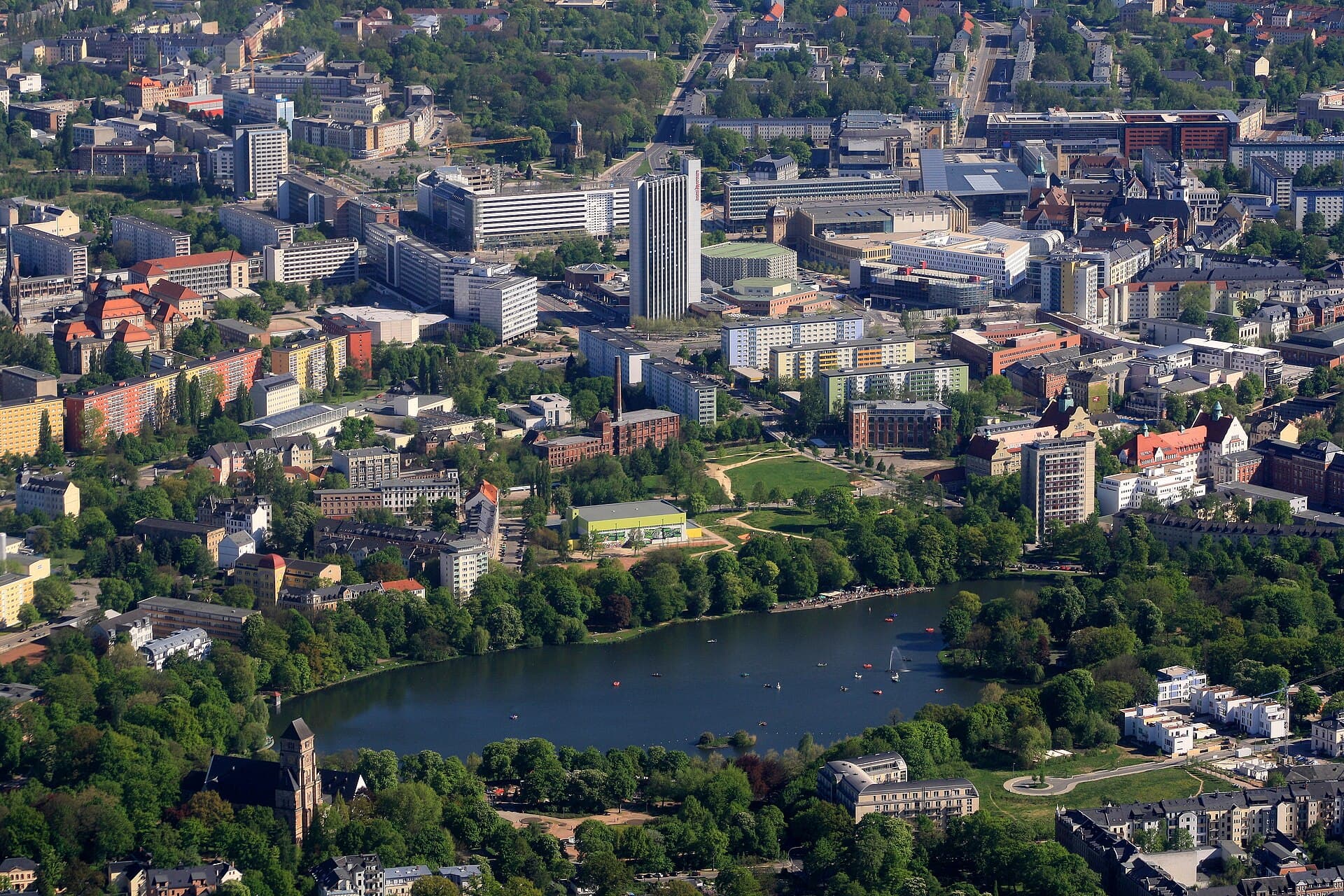
Chemnitz, situated in the Free State of Saxony, presents a compelling narrative of profound transformation. Once a powerhouse of industrial innovation, earning it the moniker 'Saxon Manchester,' the city has reimagined itself while retaining its distinct character. Its urban landscape combines Wilhelminian-era architecture with socialist-era monuments and contemporary design, creating a captivating visual dialogue between eras.
The city is increasingly recognized for its cultural contributions, having been designated a European Capital of Culture for 2025. This honor underscores its dedication to the arts, community, and forward-thinking urban development. Visitors will discover a city that is both historically grounded and forward-looking, offering ample green spaces and a flourishing creative scene.
## Industrial Ascent and Decline Chemnitz's journey from a modest settlement to a major industrial center commenced in the Middle Ages with textile production. By the 19th century, it stood at the vanguard of Germany's industrial revolution, specializing in mechanical engineering and textile machinery. The city's population swelled, and its factories produced goods that were exported globally, earning it the designation 'Saxon Manchester.' This period saw the construction of stately villas and public buildings, reflecting the city's newfound prosperity and significance.
## Conflict and Rebuilding The Second World War brought immense devastation to Chemnitz. Extensive Allied bombing raids in 1945 obliterated much of the city center, leaving a landscape of ruins. In the post-war era, under the German Democratic Republic (GDR), Chemnitz was renamed Karl-Marx-Stadt in 1953, a testament to its industrial working-class heritage and the prevailing socialist ideology. The city underwent a substantial reconstruction effort, much of it in the functionalist architectural style characteristic of the GDR, which prioritized efficiency and collective living.
## Post-Reunification and Renewal Following German reunification in 1990, the city reverted to its original name, Chemnitz. The transition presented significant economic challenges as many state-owned industries closed. However, Chemnitz has since embarked on a path of renewal, concentrating on research and development, particularly in automotive and mechanical engineering. The city has also invested considerably in culture and urban regeneration, culminating in its selection as the European Capital of Culture 2025, an acknowledgment of its dynamic cultural scene and its efforts to foster community and innovation.
Begin your exploration at the Karl Marx Monument, an imposing bust that serves as a powerful symbol of the city's GDR past. Nearby, the Kulturkaufhaus Tietz, a former department store, now houses the Natural History Museum, the city library, and the New Saxon Gallery. For art enthusiasts, the Kunstsammlungen Chemnitz (Chemnitz Art Collections) presents a diverse array of works from the 19th century to the present, including a significant collection of Expressionist art.
Walk through the Schlossteichpark, a tranquil green oasis embracing a picturesque pond, offering a peaceful respite. The Industriemuseum Chemnitz provides a compelling insight into the city's industrial heritage with operational machinery and historical exhibits. Do not overlook the Roter Turm (Red Tower), one of the oldest surviving structures in Chemnitz, offering expansive views of the city from its observation deck. For a deeper understanding of local history, the Siegert'sches Haus displays elegant Baroque architecture and its textile manufacturing past.
Chemnitz offers enjoyment throughout the year, but late spring (May-June) and early autumn (September-October) provide the most comfortable weather for walking and outdoor exploration. Summers are generally mild, with various outdoor events and festivals. The city's designation as European Capital of Culture 2025 means a heightened program of events will be available throughout that year, making it an especially exciting time to visit.
Chemnitz is well-connected by train to major German cities like Leipzig and Dresden. The city center is compact and easily traversable on foot, with an efficient public transport system of trams and buses for longer distances. Consider acquiring a Chemnitz Card for reductions on attractions and public transport. Many museums and cultural institutions provide information in English, but a basic grasp of German phrases can be beneficial.
Accommodation options range from economical hotels to more luxurious choices. Dining in Chemnitz offers a blend of traditional Saxon cuisine and international flavors. Tipping is customary, typically around 5-10% for good service.