Pachelbel's House (Cheb Museum)
A pivotal moment in European history unfolded within a seemingly ordinary house on Cheb's main square.
Full story unlocks in the tour
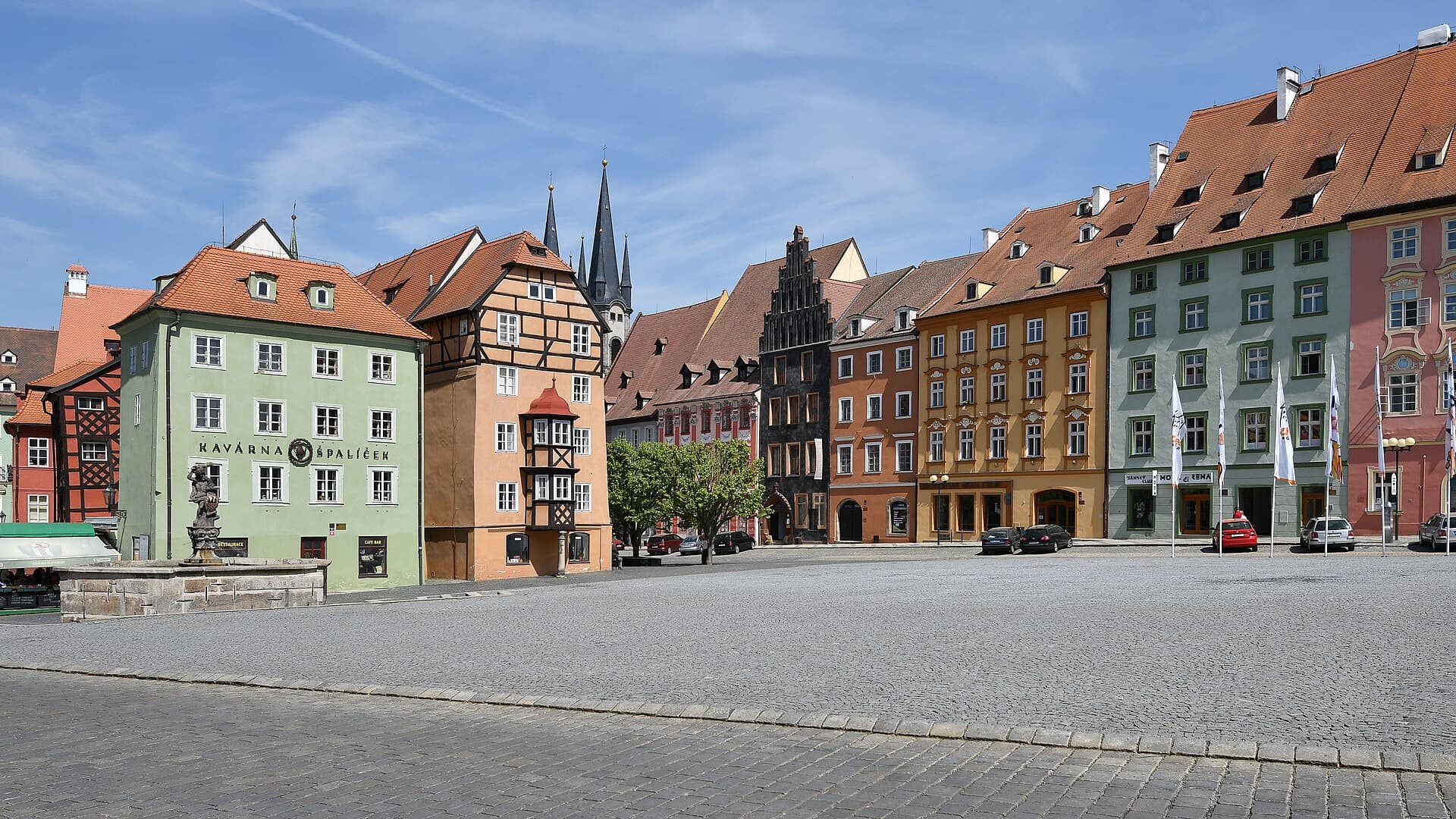 Isiwal / CC BY-SA 4.0, via Wikimedia Commons
“Where Bohemian history and German echoes intertwine.”
Not the postcards. The stories even locals don't know — whispered in your ear, right where they happened.
A pivotal moment in European history unfolded within a seemingly ordinary house on Cheb's main square.
These enduring medieval merchant houses hold a revelation about Cheb's intricate past.
The distinctive color of this ancient tower arises from more than just age or grime.
Discover every secret of Cheb
Every address, every reveal in full — in your ear, right where it happened.
You pick your stops. You walk. The voice reveals what the others miss.
No tours available yet. Check back soon — we're preparing them.
Cheb, historically recognized by its German name Eger, is a town in the Karlovy Vary Region of the Czech Republic, situated along the Ohře River near the German border. It possesses a well-preserved historic town center, acknowledged as an urban monument reservation, standing as one of the Czech Republic's oldest and most historically significant cities. The town's strategic location at the borderlands of Bohemia and Germany has shaped its identity, forging a singular cultural blend.
With a population of approximately 33,000, Cheb offers a balance of historical sights, riverside walks, and recreational pursuits. Visitors can explore its medieval architecture, delve into its turbulent past, and experience a more authentic, less tourist-saturated atmosphere compared to some of its larger neighbors. Cheb's historical importance is underscored by its role as a former imperial city and later a royal town within the Kingdom of Bohemia.
The first written mention of Cheb dates to 1061. Around 1125, a castle was established on the site of a Slavic gord, and by 1149, Cheb was described as a fortified marketplace. Emperor Frederick Barbarossa acquired Cheb in 1167, making it a significant administrative and political center and constructing a Kaiserpfalz (imperial palace) there. The town became the heart of a historical region known as Egerland.
Cheb's history is characterized by frequent shifts in dominion. It was part of the Holy Roman Empire, then became property of King Ottokar II of Bohemia in the 13th century. After a fire in 1270, the historic town center took its current form. King Wenceslaus II of Bohemia held the town from 1291 to 1304, before it was acquired by Albert I of Germany. It was not until 1322 that Cheb permanently became part of the Lands of the Bohemian Crown, when King John of Bohemia acquired it from Emperor Louis IV. This period granted Cheb the right to mint its own coins, underscoring its exclusive standing.
The town suffered severely during various conflicts, including the Hussite Wars (1419–36), the Swedish invasion during the Thirty Years' War (1618–48), and the War of the Austrian Succession (1740–48). A notable event during the Thirty Years' War was the assassination of Albrecht von Wallenstein in 1634 in Pachelbel's House, now the Cheb Museum. In 1723, Cheb became a free royal town, but its financial self-government was abolished in 1757 due to Austrian centralization. A large fire in 1809 devastated the northern part of the old town, destroying many medieval buildings.
In the 1930s, Cheb's population was largely ethnic German, and with economic downturn, there was a strong movement for autonomy and separation from Czechoslovakia to join Germany. The Munich Agreement of September 1938 allowed this to happen, leading to the expulsion of many thousands of ethnic Czechs. After Germany's defeat in World War II, Cheb was restored to Czechoslovakia, and the German inhabitants were expelled.
Begin your exploration in the main square, Náměstí Krále Jiřího z Poděbrad, a central point adorned with Gothic burgher houses and the baroque Old Town Hall. Here, you will find Špalíček, a distinctive complex of eleven medieval merchant houses dating back to the 13th century.
Cheb Castle, a national cultural monument, stands as an excellent example of Romanesque architecture. Built in the late 12th century, it is one of Central Europe's largest Romanesque structures. Key attractions within the castle grounds include the Chapel of Saints Erhart and Ursula, a unique two-tiered Romanesque-Gothic chapel, and the Černá věž (Black Tower). Ascend the Black Tower for expansive views of the town.
Across from Špalíček is the Cheb Museum, situated in Pachelbel's House, where Albrecht von Wallenstein was assassinated. The museum offers insights into Cheb's history, including a vivid depiction of the assassination. The Old Town also features several churches, with the Church of St. Nicholas being particularly notable for its blend of Romanesque, Gothic, and Baroque architectural styles.
For a peaceful interlude, visit the Fort Gardens by the Ohře River, a stretch of parkland with play areas, an amphitheater, and formal gardens. You can also visit the Franciscan Monastery with its Gothic church. Outside the town center, consider a trip to the Soos Nature Reserve, a peat bog with mineral springs and mofettas (mud volcanoes), or Komorní Hůrka, the youngest volcano in the Czech Republic.
The ideal time to visit Cheb for outdoor activities extends from late June to late August, when the weather is comfortable and partly cloudy. During these months, average daily high temperatures remain above 65°F (18°C to 23°C). July typically stands as the warmest month, with an average high of 72°F (22°C). While June, July, August, and September offer pleasant weather, July is also the wettest month. Clearer skies are generally observed from April to early October, with August being the clearest month.
Cheb is readily accessible by train, with several daily express services from Prague. The journey takes approximately three hours, with routes typically passing through Plzeň or Karlovy Vary. Trains also run regularly between Cheb and nearby spa towns like Mariánské Lázně and Karlovy Vary.
Within Cheb, many of the main sights are easily reached on foot, particularly within the historic town center. The Tourist Information Centre (Jateční 476/2) can provide maps and information on guided tours, walking excursions, and local transport. Most attractions are closed on Mondays. The local currency is the Czech Koruna (CZK). While Czech is the primary language, German may also be heard due to the town's proximity to Germany. Cheb is close to the renowned Spa Triangle (Františkovy Lázně, Mariánské Lázně, and Karlovy Vary), making it a convenient base for exploring the region.