Château de Chantilly
Beyond its opulent halls and priceless art, a secret lies beneath the very ground the château stands upon.
Full story unlocks in the tour
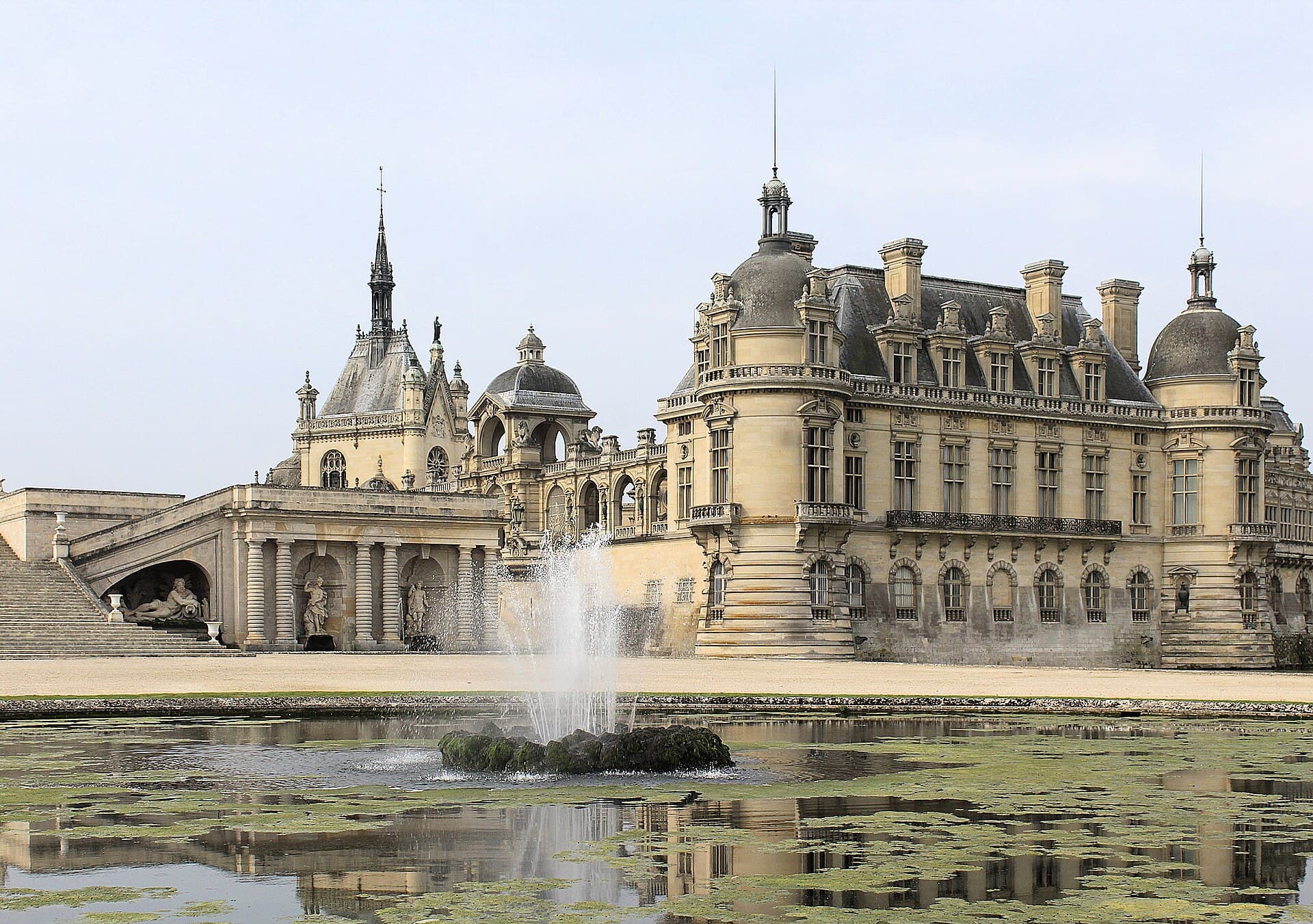 Dguendel / CC BY 4.0, via Wikimedia Commons
“Where princely grandeur meets equestrian grace.”
Not the postcards. The stories even locals don't know — whispered in your ear, right where they happened.
Beyond its opulent halls and priceless art, a secret lies beneath the very ground the château stands upon.
The thrilling races here conceal a specific disadvantage that can determine a horse's fate.
The sheer scale of the Great Stables has a whimsical, almost unbelievable origin story.
Discover every secret of Chantilly
Every address, every reveal in full — in your ear, right where it happened.
You pick your stops. You walk. The voice reveals what the others miss.
No tours available yet. Check back soon — we're preparing them.
Chantilly, a captivating town a short 40 kilometers north of Paris, offers a blend of aristocratic heritage, equestrian excellence, and natural splendor. This destination, a significant draw for visitors to the Paris area, is known globally for its grand château, expansive parklands, historic racecourse, and the delicate Chantilly lace and cream that bear its name.
With a population of around 11,000, Chantilly maintains an intimate atmosphere while serving as a vital cultural center. The town is embraced by the sprawling Chantilly Forest, a 6,340-hectare woodland featuring oak, lime, and beech trees, popular for walking, cycling, and horse riding. The Nonette River gracefully meanders through the area, enhancing the scenic beauty. A journey to Chantilly promises an immersion into French elegance, history, and a world where equestrian traditions are deeply woven into the community's fabric.
## From Medieval Fortress to Princely Domain Chantilly's story reaches back to the 11th century when the Bouteiller family were its first lords, with a fortified building situated on a rocky island in the Nonette river valley. This strategic location commanded the road between Paris and Senlis. During the Hundred Years' War, the château was plundered in 1358 during the Jacqueries peasant uprisings. The d'Orgemont family acquired the estate in 1386 and erected a new fortress, ensuring the property would thereafter be inherited rather than sold.
In the early 16th century, Constable Anne de Montmorency, a companion-in-arms to King François I, owned the Château de Chantilly. Inspired by Italian palaces, he commissioned architect Jean Bullant to construct a Renaissance-style château for recreation between 1557 and 1558, known today as the Petit Château. The château was briefly confiscated by the King in 1632 but returned to Charlotte de Montmorency, wife of Henri II de Bourbon, Prince of Condé, in 1643. Their son, Louis II de Bourbon, famously known as the Grand Condé, inherited the estate and established a courtly life in Chantilly that rivaled Versailles, hosting renowned artists like Molière, Racine, and La Fontaine. He also commissioned André Le Nôtre to design the opulent French-style gardens.
## Revolution and Rebirth The French Revolution brought significant upheaval. In 1793, the estate was dismantled, and the Grand Château was demolished, leaving only the Petit Château and the Great Stables intact. The Bourbon-Condé lineage ended with the execution of the young Duke of Enghien in 1804 by Napoleon Bonaparte's order.
The estate was inherited in 1830 by Henri d'Orléans, Duke of Aumale, the fifth son of King Louis-Philippe, the last King of France. The Duke of Aumale, a prodigious collector, dedicated his fortune and energy to rebuilding the Grand Château from 1857 to house his vast art collection, which now forms the Musée Condé. He bequeathed the entire estate, including its collections, to the Institut de France in 1886, with the condition that the presentation of the collection remain unaltered.
## The Rise of Equestrianism and Local Industries Chantilly's association with horses deepened in the 19th century. The first horse races were held in 1834, leading to the construction of a dedicated racecourse. Today, Chantilly is recognized as France's largest horse training center, housing over 2,600 horses in approximately 100 stables. The town also gained renown for its fine lacework and porcelain in the 18th century. Chantilly lace, particularly its black silk variety, became highly sought after, with Marie Antoinette being a notable admirer. The town also lent its name to the iconic Chantilly cream, a sweetened whipped cream whose origins are often linked to the château's kitchens in the late 17th century.
Begin your exploration at the Château de Chantilly, a dual-structure marvel comprising the 16th-century Petit Château and the 19th-century Château Neuf. Within its walls, the Musée Condé houses one of France's most significant collections of old master paintings, second only to the Louvre, featuring works by Raphael, Botticelli, Poussin, and Delacroix.
Adjacent to the château are the Great Stables (Grandes Écuries), an impressive 18th-century architectural feat that is home to the Living Museum of the Horse. Here, you can witness equestrian shows and demonstrations, showcasing high-level dressage.
The château's gardens, designed by André Le Nôtre, span 115 hectares and offer a variety of styles, including formal French parterres, an Anglo-Chinese garden with a charming hamlet, and an English garden. The Chantilly Racecourse (Hippodrome de Chantilly), established in 1834, is a picturesque setting for prestigious horse races, particularly the Prix du Jockey Club and Prix de Diane in June.
Beyond the main domain, consider a stroll through the Chantilly Forest, a vast woodland ideal for walking, cycling, or horseback riding. You might also visit the Musée de la Dentelle to learn about the town's lacemaking heritage or the Pavillon de Manse, an 18th-century water mill demonstrating hydraulic ingenuity.
Chantilly offers unique experiences throughout the year. For pleasant weather and flourishing gardens, spring and early summer (April to June) are ideal, with flowers in bloom and numerous cultural events. Summer months are the most active, featuring equestrian shows and a lively cultural scene. Autumn brings fewer crowds and the beautiful golden foliage of the Chantilly Forest. While quieter, winter provides a peaceful opportunity to explore the museums and heritage sites at a more relaxed pace. The most comfortable temperatures for outdoor activities are typically from mid-June to mid-September.
Chantilly is easily accessible from Paris. Regional trains from Gare du Nord to Chantilly-Gouvieux take just over 20 minutes. From the Chantilly-Gouvieux station, the château is a pleasant 25-minute walk, or you can take the No. 15 bus towards Senlis, disembarking at the 'Chantilly, église Notre-Dame' stop. Taxis are also available, taking approximately 5 minutes.
The Château de Chantilly and its grounds generally open at 10:00 AM, with varying closing times depending on the season. It's advisable to check the official website for current hours and any closures, especially during mid-January, Christmas Day, and New Year's Day. Allow a full day to explore the château, its gardens, and the Great Stables thoroughly. Dining options are available within the château's grounds and in the town center. For those considering a longer stay, Chantilly offers a range of accommodations, from luxury hotels to more intimate options.