Changwon Daero
This wide thoroughfare, a daily route for many, holds a secret purpose beyond its asphalt surface.
Full story unlocks in the tour
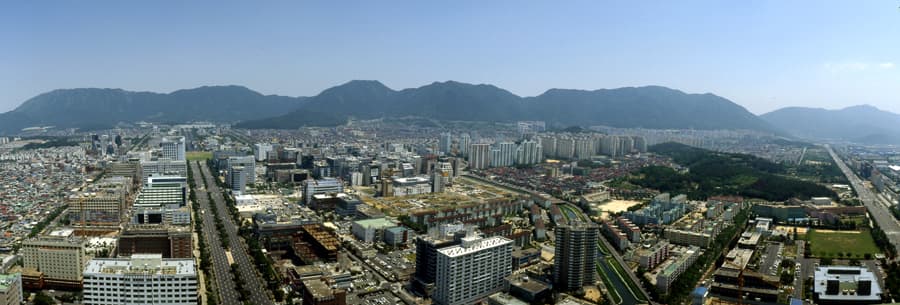 Edward Seongho Jeon (talk) / CC BY-SA 3.0, via Wikimedia Commons
“Where meticulous planning shapes a landscape of natural splendor.”
Not the postcards. The stories even locals don't know — whispered in your ear, right where they happened.
This wide thoroughfare, a daily route for many, holds a secret purpose beyond its asphalt surface.
Beneath the colorful murals and imaginative art installations lies a surprising narrative of urban renewal.
The city's abundant parks and tree-lined streets are more than mere aesthetic flourishes.
Discover every secret of Changwon
Every address, every reveal in full — in your ear, right where it happened.
You pick your stops. You walk. The voice reveals what the others miss.
No tours available yet. Check back soon — we're preparing them.
Changwon, the capital of South Gyeongsang Province, presents an urban experience distinct from many South Korean cities. With a population nearing a million, it offers a refreshing blend of meticulously planned urban spaces and accessible natural beauty. Unlike older Korean cities with their winding paths, Changwon's layout features wide avenues and a grid-like structure, a direct outcome of its unique development as South Korea's first planned city, drawing inspiration from Canberra, Australia.
This coastal city, cradled by Masan Bay to the south and encircled by mountains, exemplifies a harmonious coexistence between industry and environment. While it maintains a significant industrial complex, it also takes pride in its numerous parks, gardens, and eco-conscious initiatives, including a globally recognized bike-sharing program. Changwon's identity deepened with the 2010 merger of the historically distinct cities of Masan and Jinhae, enriching its modern fabric with layers of cultural heritage and maritime charm.
The land that is now Changwon traces its origins to the Bronze Age, with archaeological discoveries indicating early human presence. During the Three Kingdoms period, around 209 AD, the region formed part of the Silla kingdom and was identified as Gulja-gun. Over succeeding centuries, its administrative designation shifted multiple times, becoming Uian-gun during the Unified Silla Period in 739 AD and later Uichang-hyeon in the Goryeo Period.
The name "Changwon" first appeared in 1408 during the Joseon Dynasty, when King Taejong established the city as Changwon-bu. This marked a significant administrative restructuring, and the name continued to evolve, becoming Changwon-dohobu in 1415 and Changwondae-do hobu in 1601. The late 19th and early 20th centuries brought further transformations, including the opening of Masan Port in 1899, which stimulated economic growth in the area.
A defining moment in Changwon's story arrived in 1974 when the South Korean government selected it to be the nation's first planned industrial city. This ambitious undertaking aimed to forge a new industrial and residential center, with urban planning principles modeled after Canberra, Australia. The Changwon National Industrial Complex was established, leading to rapid economic expansion and transforming the area into a major industrial center. In 1983, Changwon solidified its standing as an important administrative hub by becoming the capital of Gyeongsangnam-do province.
The city's most recent evolution occurred on July 1, 2010, with the unification of Changwon, Masan, and Jinhae into the present-day Unified Changwon City. This merger created a larger, more diverse metropolis, combining Changwon's industrial strength and planned urban design with Masan's historic port and Jinhae's naval heritage and celebrated cherry blossoms.
Changwon offers a varied array of attractions, blending its planned urban landscape with natural beauty and cultural sites. For those who appreciate nature, Junam Reservoir provides a vital habitat for migratory birds and a tranquil setting for walks. The reservoir is particularly important as a wintering location for various species, including white-naped cranes and Eurasian spoonbills.
During spring, the Jinhae Gunhangje Festival transforms the Jinhae District into a spectacle of cherry blossoms, drawing visitors from across the globe. This 10-day event, beginning April 1st, features not only cherry blossom viewing but also fireworks, concerts, and military parades. Beyond the blossoms, Jinhae Marine Park offers an innovative experience with its ZipTrack and marine-themed attractions. Another notable green space is Yongji Park, centered around a large lake that hosts a musical fountain and laser show in the evenings.
For a glimpse into traditional Korean culture, the House of Changwon is a recreated hanok village and education center. Art lovers can explore the Changdong Art Village, a revitalized area in Masan recognized for its murals, galleries, and cafes. The Changwon Rose Garden is another popular spot, displaying a wide variety of roses, especially beautiful in May. Additionally, Masan Robot Land provides futuristic amusement with its robot-themed attractions.
Changwon experiences four distinct seasons. The most favorable times to visit for warm-weather activities are from late May to late June and from mid-August to early October, when temperatures are mild and pleasant. Spring (April and May) offers agreeable weather, with temperatures typically ranging from 20°C to 25°C, making it ideal for outdoor exploration. This period also coincides with the spectacular Jinhae Gunhangje Festival in early April, when cherry blossoms are in full bloom. Autumn (October) also provides comfortable, mildly cool, and breezy weather, with temperatures between 11°C and 20°C. Summers (July and August) are hot, humid, and wet, with significant rainfall, while winters (December to March) are very cold and mostly clear.
Changwon is well-connected and straightforward to navigate. The nearest airport is Gimhae International Airport (PUS) in Busan, approximately 25 km away, serving as the primary entry point for air travelers. From there, ground transportation to Changwon is readily available. The city is also integrated into South Korea's KTX high-speed rail network, with direct trains from Seoul Station to Changwon Station, Changwonjungang Station, and Masan Station, taking approximately 2.5 to 3 hours. Intercity buses also provide frequent connections from major cities like Seoul, Busan, Jinju, and Daegu.
Within Changwon, a well-developed public transportation system includes buses and taxis. The city is also notably bike-friendly, offering a public bike-sharing program called Nubija, with numerous rental stations available. For navigation, local Korean map apps like Naver Map or Kakao Map are recommended, though Google Maps can also be used. While not strictly necessary, learning a few basic Korean phrases can enhance interactions.