Rock Garden
The Rock Garden, a sprawling wonderland of art, began its life as a clandestine project.
Full story unlocks in the tour
 Raakesh Blokhra / CC BY-SA 2.0, via Wikimedia Commons
“Where concrete dreams meet lively reality.”
Not the postcards. The stories even locals don't know — whispered in your ear, right where they happened.
The Rock Garden, a sprawling wonderland of art, began its life as a clandestine project.
The museum's striking interiors, often attributed solely to Le Corbusier, hold a lesser-known design secret.
Sukhna Lake, a tranquil man-made reservoir, carries a poignant personal connection to Chandigarh's architectural legacy.
Discover every secret of Chandigarh
Every address, every reveal in full — in your ear, right where it happened.
You pick your stops. You walk. The voice reveals what the others miss.
No tours available yet. Check back soon — we're preparing them.
Chandigarh, often called 'The City Beautiful,' stands as a testament to modern urban planning in India. Conceived by India's first Prime Minister, Jawaharlal Nehru, and meticulously designed by the renowned Swiss-French architect Le Corbusier, it was envisioned as a symbol of post-independence India's modernity and a new capital for Punjab. Its unique grid-like layout, expansive green spaces, and monumental architecture set it apart from other Indian cities.
More than just a city, Chandigarh functions as a Union Territory and serves as the capital for two Indian states: Punjab and Haryana. The city's design, based on Le Corbusier's principles, aimed to integrate functionality with aesthetic appeal, creating a harmonious environment for its residents. It has consistently been recognized for its cleanliness and high quality of life, earning it a reputation as one of the happiest cities in India.
The land where modern Chandigarh now stands has a deep past, once being a wide lake surrounded by marshland. Fossil evidence from the site indicates a variety of aquatic and amphibian life. Around 8,000 years ago, the area was also inhabited by the Harappan Civilization.
Chandigarh's modern history began in the tumultuous aftermath of India's partition in 1947. With Lahore, the former capital of Punjab, ceded to Pakistan, the newly formed Indian state of East Punjab needed a new administrative center. In 1948, the Indian government selected the foothills of the Shivaliks as the site for this ambitious new capital, intending it to be a symbol of modernity and a place to resettle refugees.
Initial plans for the city's master plan were drafted by American town planner Albert Mayer and Polish architect Maciej Nowicki in 1950, based on Garden City and Radburn ideals. However, following Nowicki's untimely death in a plane crash, the project was entrusted to Swiss-French architect Le Corbusier in 1951. Le Corbusier, along with a team including his cousin Pierre Jeanneret and English architects Maxwell Fry and Jane Drew, developed the city's iconic master plan and architectural designs. His vision organized the city into rectangular sectors, each designed to be self-sufficient and fulfill the functions of living, working, circulation, and care of the body and spirit. Construction began in the early 1950s, and the city was largely completed by 1960.
In 1966, with the reorganization of Punjab into the states of Punjab, Haryana, and Himachal Pradesh, Chandigarh gained the unique status of being the shared capital of both Punjab and Haryana, while simultaneously becoming a Union Territory under the direct control of the central government. Le Corbusier's Capitol Complex, comprising the Secretariat, High Court, and Legislative Assembly, along with the Open Hand Monument, was designated a UNESCO World Heritage Site in 2016, recognizing its significance in modern architecture.
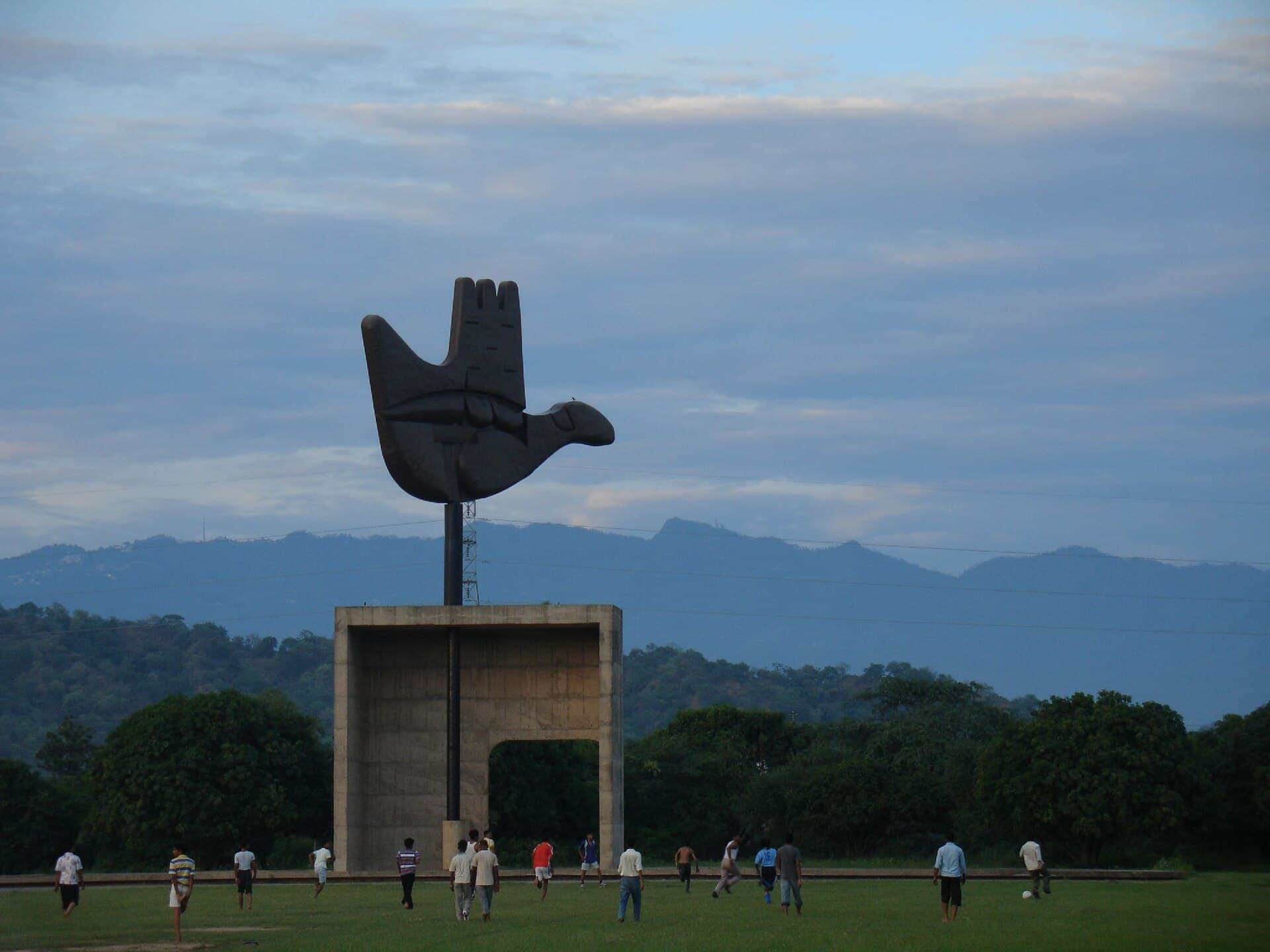
Begin your exploration at the Capitol Complex, a UNESCO World Heritage site and the administrative heart of Chandigarh. This architectural marvel, designed by Le Corbusier, includes the Secretariat, High Court, and Legislative Assembly, each a distinct example of modernist design. Do not miss the Open Hand Monument within the complex, a symbol of peace and unity.
Just a short distance away lies the Rock Garden, a captivating sculpture garden created entirely from industrial and home waste by Nek Chand Saini. This imaginative space features intricate sculptures, waterfalls, and winding paths, offering a unique artistic experience.
For a tranquil escape, visit Sukhna Lake, a man-made reservoir at the foothills of the Shivalik Hills. It is ideal for morning walks, boating, and birdwatching, especially during winter when migratory birds arrive. The Garden of Silence, a meditative space with a sitting Buddha, can be found at one end of the lake.
Nature enthusiasts will appreciate the Zakir Hussain Rose Garden, a sprawling botanical garden with hundreds of varieties of roses and medicinal plants. The city also features numerous other themed gardens, including the Garden of Fragrance, Butterfly Park, Japanese Garden, and Terraced Garden.
Delve into art and history at the Government Museum and Art Gallery, home to a collection of Gandharan sculptures, miniature paintings, and artifacts related to the city's planning. Other notable museums include the International Dolls Museum and the Chandigarh Architecture Museum.
The most pleasant time to visit Chandigarh is during the autumn and winter months, from October to March. During this period, temperatures range from approximately 5°C to 25°C, providing comfortable conditions for sightseeing and outdoor activities. The city's gardens are particularly alive with color, and events like the Rose Festival in February and the Chandigarh Carnival in November take place. Summers, from March to June, can be very hot, with temperatures reaching up to 40°C. The monsoon season, from July to September, brings moderate rainfall, making the city's greenery lush, but heavy downpours can occur.
Chandigarh is well-connected by air, rail, and road. Shaheed Bhagat Singh International Airport (IXC) in Mohali is 11 km from downtown, offering domestic and some international flights. The Chandigarh Railway Station (CDG) is about 6-8 km from the city center, with regular trains connecting to major Indian cities like Delhi, Mumbai, and Amritsar. The city possesses an excellent road network, with national highways linking it to neighboring states and popular hill stations.
Within Chandigarh, public transportation is efficient. The Chandigarh Transport Undertaking (CTU) operates an extensive bus network covering all major sectors. Auto-rickshaws, taxis, and app-based cab services like Uber and Ola are readily available for convenient travel. E-rickshaws also offer an eco-friendly option for shorter distances.
For dining, Chandigarh offers a diverse culinary scene. Explore local street food for delights like Amritsari Kulcha, Chole Bhature, Aloo Tikki, and Golgappe. Popular eateries like Pal Dhaba are known for authentic Punjabi cuisine, including Butter Chicken and Dal Makhani. Sindhi Sweets is a well-regarded spot for traditional Indian sweets.