Kuelap Fortress
The formidable walls of Kuelap hold a secret about its construction that sets it apart from other Andean sites.
Full story unlocks in the tour
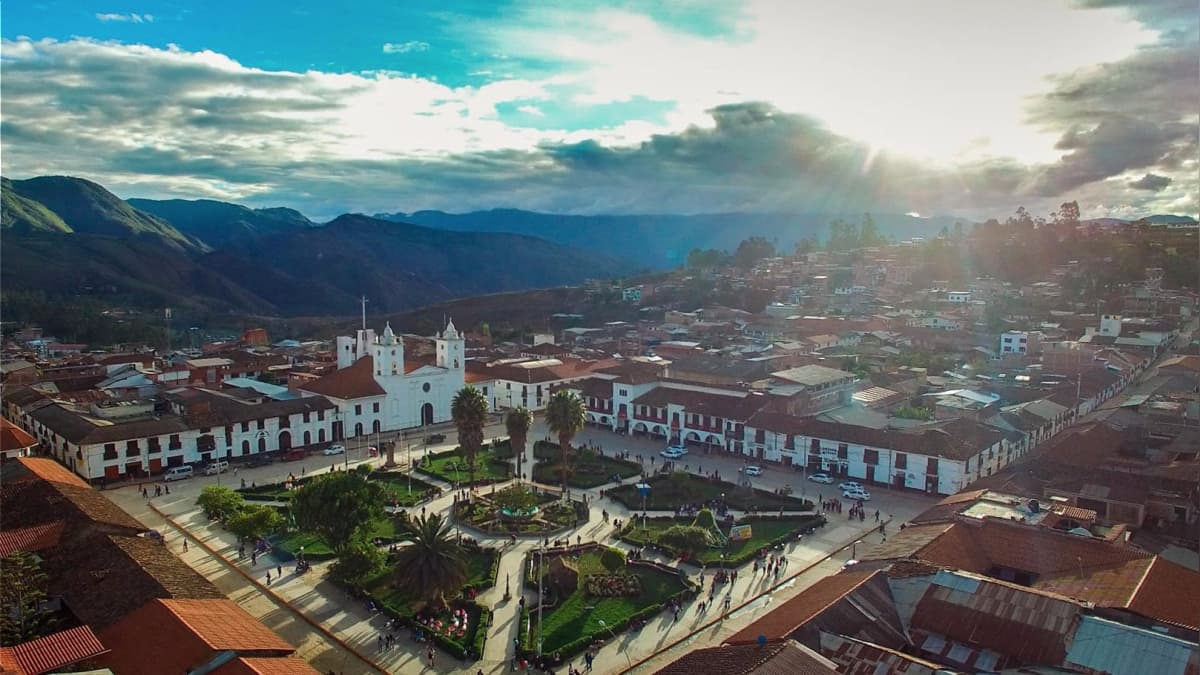 J0EL 20001 / CC BY-SA 4.0, via Wikimedia Commons
“Where cloud forests guard ancient secrets and waterfalls roar.”
Not the postcards. The stories even locals don't know — whispered in your ear, right where they happened.
The formidable walls of Kuelap hold a secret about its construction that sets it apart from other Andean sites.
The lively red and white 'houses' clinging to the cliffs at Revash hold a surprising detail about the Chachapoyas' artistic interpretations.
This remote lake, also known as Laguna de las Momias, was the site of a discovery that profoundly changed our understanding of the Chachapoyas.
Discover every secret of Chachapoyas
Every address, every reveal in full — in your ear, right where it happened.
You pick your stops. You walk. The voice reveals what the others miss.
No tours available yet. Check back soon — we're preparing them.
Chachapoyas, the capital of Peru's Amazonas region, serves as a gateway to a world where the Andes meet the Amazon. This city, whose name in Quechua means "cloud forest," is a tranquil center surrounded by misty cloud forests, deep canyons, and archaeological sites that predate the Inca Empire. Often referred to as the "City of the Cloud People," Chachapoyas offers a singular blend of history, culture, and natural splendor, far removed from Peru's more traveled tourist paths.
At an elevation of approximately 2,335 meters (7,660 feet), Chachapoyas provides a base for exploring the remnants of the Chachapoya civilization, known as the "Warriors of the Clouds." This ancient culture flourished from around 800 AD until the Inca conquest in the late 15th century, leaving behind impressive stone fortresses, cliffside mausoleums, and intricate pottery. The region's rugged topography, shaped by the Utcubamba River, creates a dramatic landscape of terraced fields and lush vegetation, inviting intrepid travelers to discover a quieter, more authentic side of Peru.
The Chachapoyas civilization, known as the "Warriors of the Clouds," thrived in the cloud forests of northern Peru from approximately 800 AD until their conquest by the Inca Empire in the late 15th century. Their territory was extensive, encompassing the triangular region formed by the confluence of the Marañón and Utcubamba rivers, extending south to the Abiseo River basin. The heart of their culture, however, lay in the Utcubamba River basin.
Much of what is known about the Chachapoyas comes from archaeological evidence, as they did not keep written records. Spanish chroniclers, such as Pedro Cieza de León, provided some of the earliest accounts, noting their distinct appearance and their fierce resistance to Inca rule. The Chachapoyas were described as unusually fair-skinned and handsome, often adorning themselves in woolen clothes and distinctive headwear.
Their architectural prowess is evident in their impressive stone structures, particularly the monumental Kuelap fortress. Built around 500 AD, with most visible architecture dating between 900 and 1100 AD, Kuelap stands as a testament to their advanced engineering and defensive strategies. The Chachapoyas also developed unique funerary practices, constructing elaborate cliffside tombs and sarcophagi, such as those found at Karajía and Revash, which reflect a sophisticated society deeply connected to its environment and beliefs about the afterlife.
Despite their resistance, the Chachapoyas were eventually incorporated into the Inca Empire. This conquest, occurring in the second half of the 15th century, was difficult due to their constant defiance. The Inca period significantly impacted the Chachapoya population, with estimates suggesting a reduction of up to 50% due to battles, executions, and forced resettlements. By the 18th century, the Chachapoyas population had been devastated, yet their unique cultural identity remains a distinct part of modern Peru's indigenous heritage.
The city of Chachapoyas itself offers a charming colonial center with whitewashed buildings and traditional wooden balconies, particularly around the Plaza de Armas. The Gilberto Tenorio Ruiz room provides a small exhibition on the Chachapoyas culture, showcasing ceramics, textiles, and mummies. A visit to the local market offers a glimpse into regional produce, including sugarcane, orchids, and coffee.
Beyond the city, the region abounds with archaeological wonders and natural spectacles. Kuelap Fortress, often called the "Machu Picchu of the North," is a fortified city with massive stone walls and hundreds of circular structures, accessible by cable car. The Gocta Waterfall, one of the tallest waterfalls in the world, can be reached via a scenic hike through lush cloud forest. The Sarcophagi of Karajía are impressive anthropomorphic clay coffins resting on a cliff face, while the Mausoleums of Revash are small, house-like tombs painted with red motifs, built into natural caves on cliffs. The Leymebamba Museum houses a significant collection of over 200 Chachapoyas mummies and artifacts recovered from the Laguna de los Cóndores. For those seeking more adventure, the Sonche Canyon offers dramatic views from its 900-meter depth.
The best time to visit Chachapoyas is during the dry season, which runs from May to October. During these months, the weather is more favorable for exploring archaeological sites and hiking trails, with clearer skies and more stable conditions. July and August are typically the driest and most predictable months, though this also means they can be busier. While the term "dry" is relative in a cloud forest, occasional light rain and morning mist are still possible. The wet season, from November to April, brings more frequent rainfall, which can make some remote sites less accessible, but also causes waterfalls like Gocta to reach their most impressive flow.
Chachapoyas is a city best explored on foot, with its main plaza, market, and many restaurants within easy walking distance. Local taxis are available for short rides within the city. For excursions to nearby attractions, minibuses (combis) and colectivos (shared taxis) connect Chachapoyas to various villages and sites, though schedules can be irregular. For more remote locations, organized tours or private vehicles are often the most practical options.
Reaching Chachapoyas typically involves a flight from Lima to Jaén (approximately 1.5 hours), followed by a 3-4 hour road journey. Alternatively, direct flights from Lima to Chachapoyas are available seasonally. Overnight buses from major cities like Lima (22-24 hours), Trujillo (12-13 hours), and Chiclayo (9-10 hours) are also an option. A stay of 4-5 days is recommended to comfortably explore the main attractions.