Celle Castle Theatre
Germany's oldest working Baroque theatre holds a secret about its founder's creative spark.
Full story unlocks in the tour
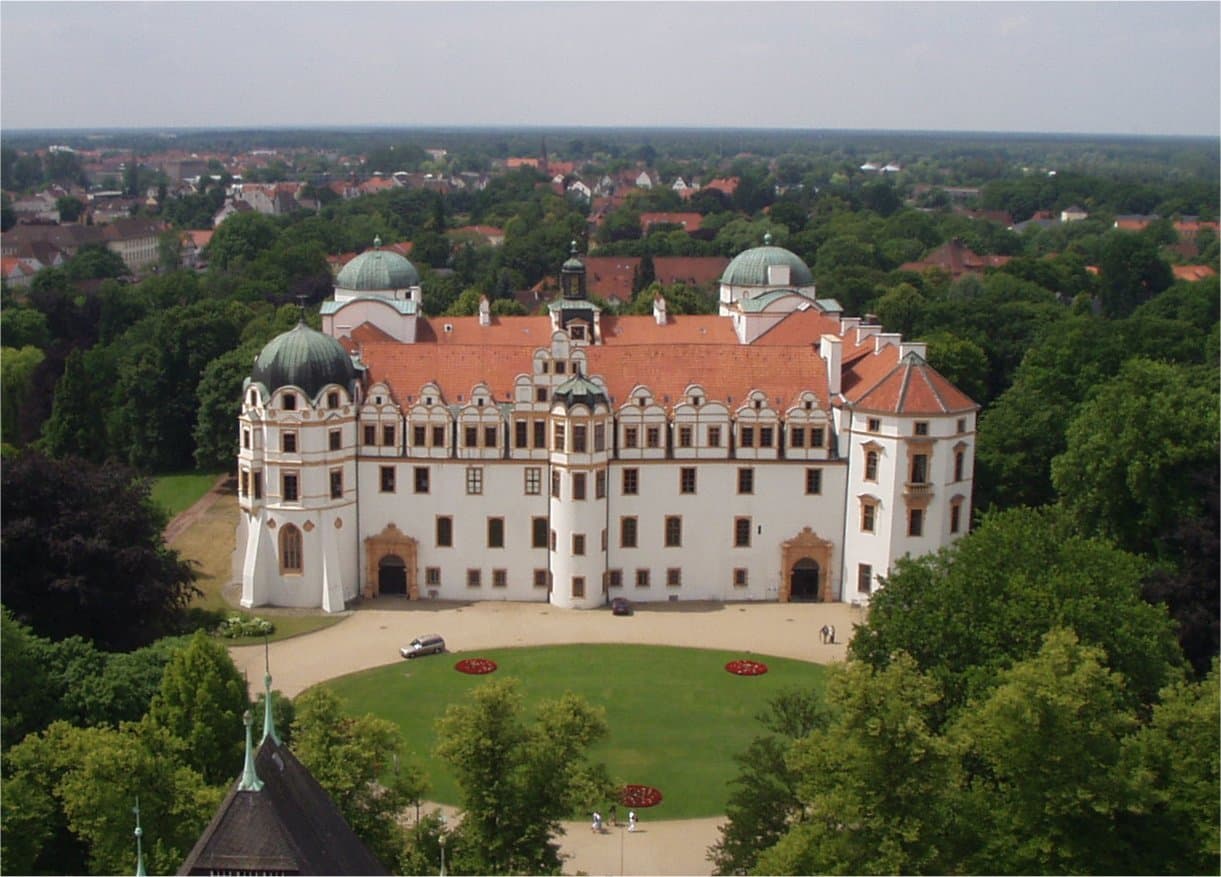 Unknown author / CC BY-SA 3.0, via Wikimedia Commons
“Where timber-framed facades tell centuries of stories, alongside echoes of royalty and modern artistic expression.”
Not the postcards. The stories even locals don't know — whispered in your ear, right where they happened.
Germany's oldest working Baroque theatre holds a secret about its founder's creative spark.
This modest half-timbered building survived a night of widespread destruction due to an unexpected neighbor.
One of Celle's most elaborately carved half-timbered houses engages in an unusual dialogue.
Discover every secret of Celle
Every address, every reveal in full — in your ear, right where it happened.
You pick your stops. You walk. The voice reveals what the others miss.
No tours available yet. Check back soon — we're preparing them.
Celle, a city in Lower Saxony, Germany, invites visitors to step into a living storybook. With a population of around 71,000, it serves as the southern entrance to the Lüneburg Heath. The city is celebrated for its remarkably preserved Old Town, featuring between 450 and 500 half-timbered houses dating from the 16th to 18th centuries, establishing it as a significant stop on the German Timber-Frame Road. These buildings, with their intricate carvings and colorful facades, create a deeply authentic streetscape, feeling lived-in rather than merely a display for visitors.
Beyond its architectural splendor, Celle offers a blend of historical depth and cultural vitality. It was once the official residence of the dukes of Brunswick-Lüneburg, a lineage that eventually connected to the British monarchy. This royal past is evident in the grand Celle Castle, a landmark that combines Renaissance and Baroque styles. The city also embraces contemporary influences, showcasing pioneering Bauhaus architecture and innovative museums, including the world's first 24-hour art museum. Situated on the banks of the River Aller, Celle provides a tranquil setting for leisurely walks, cultural exploration, and relaxed dining, offering a rewarding experience for those seeking authenticity and beauty without the crowds of larger German destinations.
## From Medieval Origins to Ducal Residence Celle's story begins in the 10th century, first mentioned as "Kellu" (meaning fishing bay) in a document from 985 CE. An early fortification, a fortified watchtower, was built around 980 AD to guard a ford over the River Aller. In 1292, Duke Otto II the Strict founded a new rectangular settlement and granted Celle its town privileges in 1301, moving inhabitants from the older Altencelle. This new town developed into a significant trading center.
From 1378 to 1705, Celle served as the official residence of the Lüneburg branch of the dukes of Brunswick-Lüneburg, members of the House of Welf, who had been exiled from their original ducal seat. This period marked Celle's transformation into a center of power and culture. The dukes expanded Celle Castle, turning it into a magnificent Renaissance residence. Duke Wilhelm continued this legacy by building the castle chapel, consecrated in 1585.
Celle experienced a cultural flourishing between 1665 and 1705 under the reign of Duke George William. His French wife, Eleonore d'Olbreuse, played a significant role, inviting Huguenot Christians and Italian architects to the town. During this time, the French and Italian Gardens were established, and the Baroque castle theatre was built. After the death of the last duke of the Brunswick-Lüneburg line in 1705, Celle, along with the Principality of Lüneburg, reverted to the Hanover line of the Welfs. To compensate for the loss of its status as a ducal residence, numerous administrative institutions were established in Celle, including the Higher Court of Appeal, a prison, and the State Stud Farm.
## Modern Era and World War II Celle maintained a strong connection to Britain, as George, Elector of Hanover and Duke of Brunswick-Lüneburg, ascended to the British throne as King George I in 1714. Celle remained a possession of the British Hanoverian line until 1866, when it became part of Prussia. The town largely escaped significant damage during World War II, a fortunate turn of events that preserved its historic core. While nearby Hanover was heavily bombed, Celle suffered only one major Allied bombing attack on April 8, 1945, which primarily affected industrial areas and the railway freight terminal, destroying 2.2% of the town. The town surrendered to Allied troops without a fight on April 12, 1945, ensuring the survival of its historic city center and palace.
Celle's Old Town (Altstadt) presents a remarkable collection of timber-framed architecture, with over 400 buildings dating from the 16th to 18th centuries. Stroll through streets like Stechbahn and Kalandgasse to see buildings adorned with intricate wooden carvings and colorful facades. The six-story Hoppener Haus, built in 1532, stands as a particularly striking example with its ornate carvings of mythical creatures and grotesque faces.
Celle Castle (Schloss Celle) is a significant landmark, combining Renaissance and Baroque architectural styles. Explore its State Rooms, the Baroque theatre—one of the oldest still in use in Europe, operational since 1674—and the castle chapel, featuring early Protestant art. The Residence Museum within the castle offers insights into the lives of the Welf dynasty.
The French Garden (Französischer Garten) is a historical park landscape originally designed in the 17th century for the ducal court. It is an expansive green space with symmetrical paths, ideal for a peaceful walk. The Kunstmuseum Celle is notable as the world's first 24-hour art museum, displaying contemporary art by day and transforming into a luminous light sculpture at night. Also consider visiting the Celle Synagogue, constructed in 1740, which is the oldest surviving Jewish place of worship in northern Germany.
The best time to visit Celle for warm-weather activities is from mid-June to early September, when average temperatures range from 20°C to 26°C. This period offers long, light evenings perfect for outdoor dining and exploring the Old Town. August and September are particularly appealing for nature enthusiasts as the heather blooms beautifully in the nearby Lüneburg Heath. While winter brings colder temperatures, Celle transforms with a romantic Christmas market and illuminated Old Town during the Advent season.
Celle is located in Lower Saxony, Germany, on the banks of the River Aller. Hanover Airport (HAJ) is the closest, about 40 km away, offering a 35-40 minute drive or a quick train ride via Hanover main station. Celle Bahnhof (train station) is on the major north-south railway line between Hanover and Hamburg, served by high-speed ICE and regional trains. The historic Old Town (Altstadt) is about a 10-15 minute walk from the station, or a short bus/taxi ride. Once in town, the Altstadt is compact and best explored on foot. For areas like the Bauhaus quarter or the French Garden, a bike is ideal. The town also has an extensive bus network. If driving, Celle is accessible via the A7 and B3 motorways.