Cavtat Bay
Cavtat Bay, celebrated as one of Europe's most beautiful, holds a romantic tale from centuries past that shaped the destiny of a renowned Croatian painter.
Full story unlocks in the tour
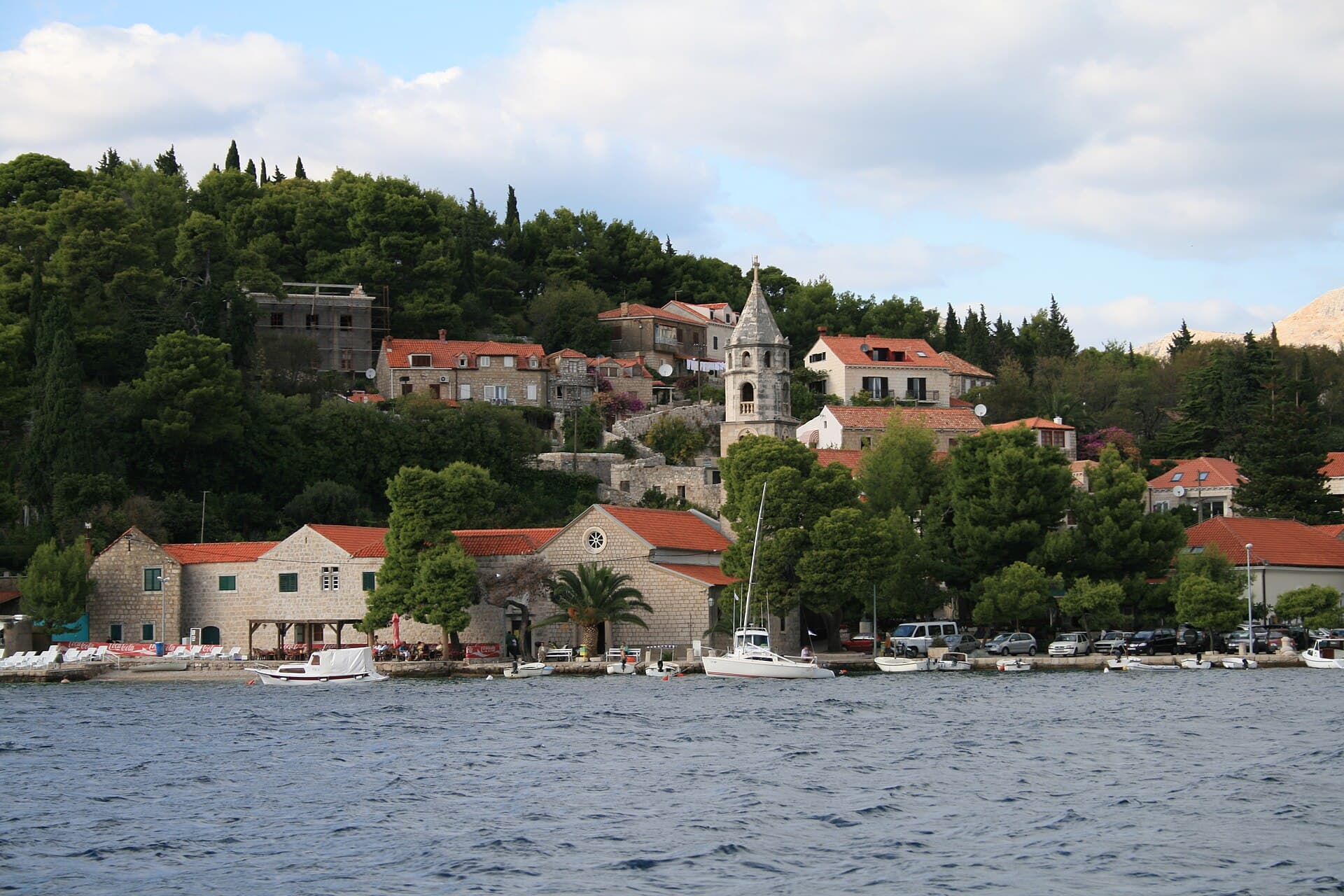 Luu / Public domain, via Wikimedia Commons
“Where ancient echoes meet the gentle rhythm of the Adriatic.”
Not the postcards. The stories even locals don't know — whispered in your ear, right where they happened.
Cavtat Bay, celebrated as one of Europe's most beautiful, holds a romantic tale from centuries past that shaped the destiny of a renowned Croatian painter.
Beyond its serene facade, this historic monastery once had a surprising, perhaps even scandalous, transformation.
The very name of this charming coastal town is bound to a dramatic and slightly tragic legend involving a beautiful maiden, two suitors, and a lizard.
Discover every secret of Cavtat
Every address, every reveal in full — in your ear, right where it happened.
You pick your stops. You walk. The voice reveals what the others miss.
No tours available yet. Check back soon — we're preparing them.
Cavtat, a tranquil coastal town in southern Croatia, offers a serene escape just 20 kilometers south of the lively city of Dubrovnik. Often described as a quieter alternative, it provides a blend of natural beauty, deep history, and a relaxed pace of life. Spreading across the Rat Peninsula and surrounding the well-protected Luka and Tiha bays, Cavtat is characterized by its palm-lined promenades, clear waters, and traditional stone houses with terracotta roofs.
This appealing destination is a favorite among European travelers, particularly those from Central Europe and the Balkan countries, drawn to its calm atmosphere and picturesque scenery. It's a place where relaxation takes precedence, inviting visitors to stroll along pedestrian-only paths, unwind at beach clubs, or simply soak in the Adriatic ambiance. Cavtat's proximity to Dubrovnik Airport also makes it an easily accessible starting point for exploring the wider Dubrovnik Riviera.
The origins of Cavtat stretch back to ancient times, with the town first established as a Greek colony named Epidaurus around the 6th century BC. The local Illyrians, who also inhabited the region, referred to the settlement as Zaptal. In 228 BC, the Romans took control, renaming it Epidaurum. Under Roman rule, Epidaurum flourished, growing into a significant colony that some historians suggest may have had as many as 40,000 inhabitants by the 4th century AD. Remnants of this Roman era, including city walls, a theater, rustic villas, and epigraphic monuments, can still be found.
The town's fate shifted dramatically in the 7th century when it was destroyed by invading Avars and Slavs. Many of Epidaurum's citizens fled northwest, establishing a new settlement called Ragusa, which would eventually evolve into modern-day Dubrovnik. For a period, Slavic Cavtat came under the control of Travunja (present-day Trebinje). By the 15th century, Cavtat became part of the powerful Dubrovnik Republic, sharing its history and serving as its second most important seaport and administrative center.
After the fall of the Republic of Ragusa in 1806, Cavtat briefly became part of Napoleon's French Empire before joining the Austro-Hungarian Empire until 1918. Following World War I, it was part of Yugoslavia until 1991. Today, Cavtat, whose modern Croatian name is thought to be derived from the Latin 'Civitas Vetus' meaning 'old city,' or perhaps from the verb 'captiti' meaning 'to flourish,' is the largest urban center in the Konavle municipality. It continues to preserve its cultural traditions and historical layers, offering visitors a tangible connection to its resilient past.
Cavtat's Old Town, a compact and walkable area, is where many of its main sights are concentrated. The town is situated on the Rat Peninsula, with the Sustjepan Peninsula also contributing to its distinctive 'crab's claw' shape around Luka and Tiha Bays. Stroll along the seaside promenade, a flat, pedestrian-only path circling the Rat Peninsula, shaded by pine trees and dotted with benches, beach bars, and swimming spots.
For cultural exploration, visit the Church of St. Nicholas, a 15th-century structure with Baroque elements, wooden altars, and an altarpiece by Carmelo Reggi. The Rector's Palace, a Renaissance mansion, houses the Baltazar Bogišić Collection of documents and over 20,000 books from the 19th-century lawyer and native son, along with ethnographic and numismatic displays and archaeological finds. The Franciscan Monastery and Our Lady of the Snows Church offers medieval altarpieces and a serene atmosphere. Do not miss the Račić Family Mausoleum, a white stone masterpiece designed by renowned Croatian sculptor Ivan Meštrović in 1921, located in the town cemetery with expansive views.
Cavtat is also the birthplace of acclaimed Croatian painter Vlaho Bukovac. His former home is now the Bukovac House Museum, showcasing his artwork, personal belongings, and studio, offering an intimate glimpse into his life and work. For a quirky stop, the Shell Museum (Glossus Humanus) is also worth a visit.
Cavtat enjoys a Mediterranean climate with warm, dry summers and mild winters. The prime season for visiting, with the most services available, is from June to August, when temperatures average around 25°C (77°F) with daily highs of 31°C. However, these months also bring the largest crowds and higher prices.
For a quieter experience with pleasant weather, consider late May and early June, or late September and early October. During these shoulder seasons, the sea remains warm, and the average highs range from 18°C to 23°C, ideal for outdoor activities without the intense summer heat. May and September are often recommended for those seeking fewer crowds and better rates.
Cavtat is conveniently located just 5 kilometers (8 minutes drive) from Dubrovnik Airport (DBV). Taxis are readily available for the short journey. To reach Cavtat from Dubrovnik, local bus number 10 runs frequently, taking about 30-40 minutes. Alternatively, scenic boat services operate between Dubrovnik's Old Town Port and Cavtat from April to November, taking 45 minutes to an hour.
Within Cavtat, exploring on foot is the best way to experience the town, as most attractions are concentrated in the walkable Old Town. Comfortable walking shoes are recommended for stone streets. While Croatian Kuna (HRK) was the currency, Croatia adopted the Euro (EUR) in January 2023. English is widely spoken. For day trips, consider visiting the nearby Konavle region, known for its villages, vineyards, and traditional folklore shows in Čilipi.