Castello Ursino
Once a formidable coastal fortress, Castello Ursino now stands surprisingly inland.
Full story unlocks in the tour
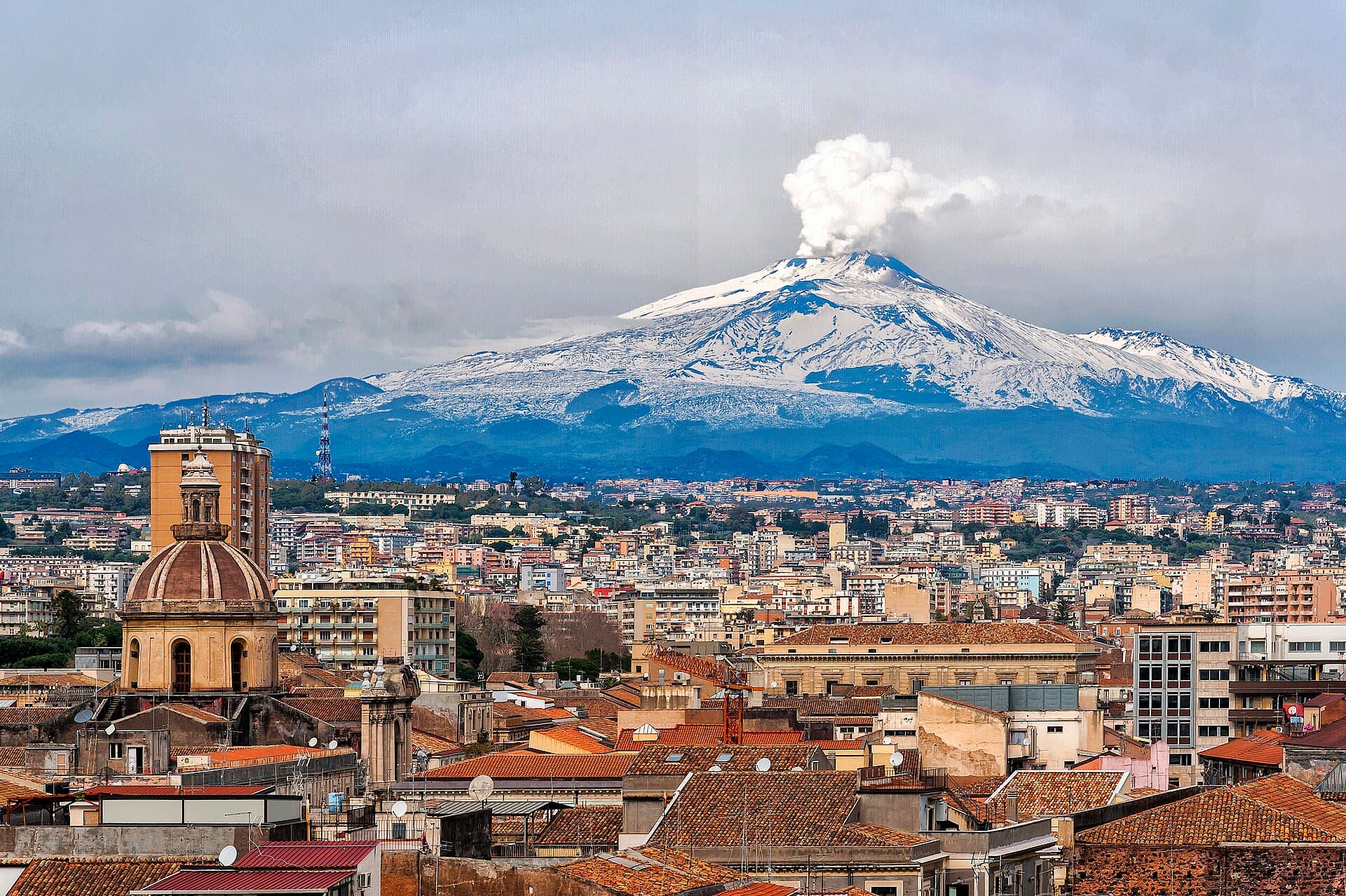 Dariolp83 / CC BY-SA 4.0, via Wikimedia Commons
“Catania: Where lava meets the sea, and resilience is etched in black and white Baroque.”
Not the postcards. The stories even locals don't know — whispered in your ear, right where they happened.
Once a formidable coastal fortress, Castello Ursino now stands surprisingly inland.
This beautiful Baroque street was once the setting for a curious local legend involving a headless horse.
Beneath the bustling streets of modern Catania lies an entire city, a layered testament to its dramatic past.
Discover every secret of Catania
Every address, every reveal in full — in your ear, right where it happened.
You pick your stops. You walk. The voice reveals what the others miss.
No tours available yet. Check back soon — we're preparing them.
Catania, Sicily's second-largest city, sprawls at the foot of the perpetually active Mount Etna, a volcano that has both devastated and defined it. This eastern Sicilian port city is a captivating study in contrasts, where the dark volcanic rock used in its Baroque architecture creates a striking dialogue with the often-bright Mediterranean sky. Its energetic pulse, profound story, and unique resilience are palpable in every piazza and alleyway, offering a deeply immersive experience of Sicilian life.
Catania's story is one of constant rebirth. Founded by Greek settlers in the 8th century BCE, it has been repeatedly leveled by Etna's eruptions and powerful earthquakes, most notably in 1169, 1669, and 1693. Yet, each time, the city has risen from its own ashes, literally, with its historic center now a UNESCO World Heritage site, celebrated for its exuberant late-Baroque architecture crafted from the very lava that once threatened its existence.
Beyond its dramatic geological backdrop, Catania is a city of profound cultural depth. It has been home to renowned artists and writers, including the composer Vincenzo Bellini and the novelist Giovanni Verga. From the boisterous fish market to the elegant Via Etnea, Catania invites exploration, promising a journey through layers of history, art, and an unwavering spirit.
## From Greek Colony to Baroque Marvel Catania's origins trace back to 729-728 BCE, when Greek settlers from Naxos (Chalcidians) founded the colony of Katane. This made it one of Sicily's earliest Greek settlements. The city quickly became a significant center in Magna Graecia, though its early history was often intertwined with conflicts with Syracuse.
Roman rule began in 263 BCE, after Catania submitted to the Roman Republic during the First Punic War. Under the Romans, the city prospered as a grain-exporting hub, and remnants of this era, such as the Roman amphitheater and Greco-Roman theater, still stand today. Following the fall of Rome, Catania experienced successive periods under Byzantine, Arab, and Norman rule, each leaving a distinct cultural imprint.
## Catastrophes and Rebirths The city's proximity to Mount Etna has profoundly shaped its destiny. Catania has been almost entirely destroyed by volcanic eruptions and earthquakes on at least seven occasions throughout its story. Notable disasters include a catastrophic earthquake in 1169 and a major eruption in 1669 that saw lava flows nearly engulf the city and push the coastline seaward. The most devastating event was the 1693 Sicily earthquake, which caused widespread destruction across the Val di Noto region, including Catania.
From these ruins, however, emerged the magnificent city seen today. The early 18th century marked a period of extensive reconstruction in a unified Sicilian Baroque style. Buildings were largely constructed using dark volcanic stone from Etna, creating a distinctive "black city" aesthetic that contrasts with white limestone, earning its historic center UNESCO World Heritage status in 2002.
## Modern Catania In the 19th century, Catania played a significant role in the Risorgimento, the movement for Italian unification, and became part of the newly formed Kingdom of Italy in 1861. The city continued to develop as an important industrial and commercial center, with its port facilitating trade. During World War II, Allied bombing in 1943 caused substantial damage, particularly to the port and industrial areas. Post-war reconstruction transformed Catania into Sicily's commercial and logistical engine, home to the island's largest university, founded in 1434, and a growing tech district.
Begin your exploration in Piazza del Duomo, the city's lively heart. Here, marvel at the Cattedrale di Sant'Agata, a Baroque masterpiece rebuilt after the 1693 earthquake, housing the relics of Catania's patron saint and the tomb of Vincenzo Bellini. In the center of the piazza stands the Fontana dell'Elefante (Elephant Fountain), a lava stone elephant, affectionately known as 'U Liotru,' carrying an Egyptian obelisk—the enduring symbol of Catania.
Just opposite the Cathedral, immerse yourself in the lively chaos of La Pescheria, Catania's historic fish market. Operating daily except Sundays, it's a sensory overload of shouting fishmongers and fresh seafood, a tradition dating back to the 1300s.
Walk along Via Etnea, the city's main thoroughfare, stretching towards Mount Etna. Along this elegant street, you'll find shops, cafes, and historical sites, including the ruins of the Roman Amphitheater in Piazza Stesicoro, one of Sicily's largest ancient arenas. A short walk leads to the tranquil Villa Bellini Gardens, Catania's oldest public park, offering a peaceful escape.
For a deeper dive into history, visit Castello Ursino, a 13th-century Swabian castle built by Frederick II, now housing the Civic Museum. Explore the Monastero dei Benedettini di San Nicolò l'Arena, a vast Benedictine monastery that is now part of the University of Catania, known for its intricate corridors and cloisters. Do not miss the Church of San Nicolò l'Arena for its secret terrace with expansive city views.
Catania enjoys a Mediterranean climate with mild, relatively rainy winters and warm, sunny summers. For general sightseeing and cultural exploration, the best times to visit are from April to June and mid-September to October. During these months, temperatures are pleasant (ranging from the 70s in May-June and September-October), and crowds are generally lighter than in peak summer. For beach activities, mid-June to early September offers the warmest weather and warmest sea temperatures. If you're interested in skiing Mount Etna, late January through early February is ideal. Winters are short and mild, making January and February quieter, more authentic months for exploring museums and historic sites.
Catania-Fontanarossa Airport (CTA) is Sicily's largest airport and the main gateway to the city, located approximately 6 kilometers southwest of the city center. Shuttle services are available for easy transfers. Within the city, the historic center is highly walkable, with most major attractions within a 5-10 minute walk of each other. Catania also has a single metro line and an extensive orange bus network (AMT) for longer distances. Tickets for public transport can be purchased from tabacchi (tobacco shops) or official AMT kiosks.
When visiting churches, remember to adhere to dress codes requiring shoulders and knees to be covered. While Catania is generally a safe city, it's always wise to be aware of your surroundings, especially in crowded areas like the fish market, where pickpocketing can occur. Certain areas, particularly around the central station and Castello Ursino, may require more attention at night. Driving in Catania's historic center is challenging due to ZTL (Limited Traffic Zones) and frequently changing one-way streets; parking outside these zones and walking or using public transport is recommended.