The Grand Staircase of Honor, Royal Palace of Caserta
The grand entrance to the Royal Palace of Caserta once welcomed more than just royal processions.
Full story unlocks in the tour
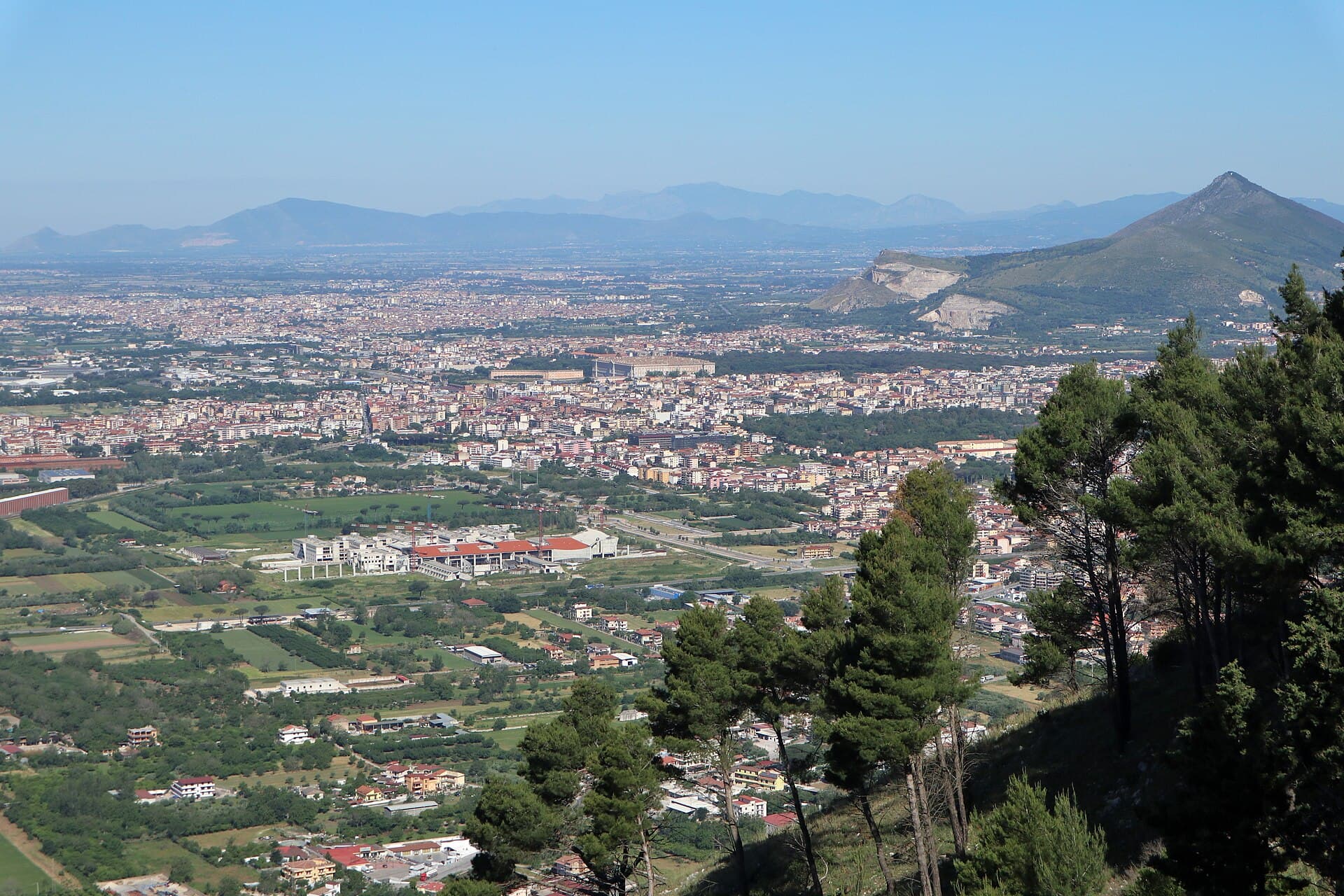 Lucamato / CC BY-SA 4.0, via Wikimedia Commons
“Beyond the Palace: Unearthing Caserta's Unexpected Layers”
Not the postcards. The stories even locals don't know — whispered in your ear, right where they happened.
The grand entrance to the Royal Palace of Caserta once welcomed more than just royal processions.
Among the lavish furnishings of a Bourbon queen's private chambers, Piedmontese officials once cataloged a curious, guitar-shaped object.
The flags of two prominent global landmarks once shared an unexpected connection to this utopian industrial village near Caserta.
Discover every secret of Caserta
Every address, every reveal in full — in your ear, right where it happened.
You pick your stops. You walk. The voice reveals what the others miss.
No tours available yet. Check back soon — we're preparing them.
Caserta, a city in Italy's Campania region, finds its identity in the monumental Royal Palace, a UNESCO World Heritage site frequently likened to Versailles. This expansive 18th-century residence, constructed for the Bourbon kings of Naples, anchors a city where historical grandeur intertwines with the rhythms of contemporary Italian life. Beyond the palace's immense scale and lavish interiors, Caserta unfolds a diverse landscape of experiences, ranging from the ancient pathways of Casertavecchia to a unique, enlightened industrial complex.
While the Royal Palace is undeniably the focal point, drawing visitors with its intricate Baroque architecture and sprawling gardens, the surrounding area reveals layers of history and culture. The city itself, an important agricultural, commercial, and industrial center, developed significantly around the palace. Exploring Caserta means delving into a past shaped by Bourbon ambition, medieval traditions, and even its pivotal role in World War II.
## From Ancient Roots to Royal Grandeur Caserta's origins trace back to Osco-Samnite tribes, with the modern city evolving from a Lombard-era defensive tower. The original settlement, known as Casa Irta (meaning "home village located above"), eventually contracted to "Caserta" and was situated on a hill, now known as Casertavecchia.
For centuries, Caserta and its surrounding lands were under the control of the Acquaviva family. However, facing considerable debts, they sold their vast property to King Charles VII of Naples in 1750. This acquisition marked a pivotal moment in Caserta's history, as Charles III (formerly Charles VII of Naples) envisioned a new royal residence that would rival Europe's most famous palaces, particularly Versailles.
Construction of the Royal Palace, or Reggia di Caserta, began in 1752 under the direction of architect Luigi Vanvitelli. The king aimed to create a new capital inland, offering better defensibility than Naples, which was vulnerable to naval attacks. Though Charles III never slept in the palace, abdicating in 1759 to become King of Spain, his son Ferdinand IV oversaw its completion in 1780. The palace was designed as a self-contained city, incorporating a university, museum, library, and military commands.
## A Wartime Headquarters The Reggia di Caserta played a significant role during World War II. From 1943 to 1945, it served as the headquarters for the Allied Forces Command in Italy. It was within these walls that the unconditional surrender of German forces in Italy was signed on April 29, 1945, marking a crucial moment in the war's conclusion. The palace also hosted the first Allied war crimes trial in 1945.
The undeniable centerpiece of Caserta is the Royal Palace of Caserta (Reggia di Caserta). This monumental Baroque palace offers 1,200 rooms, nearly 2,000 windows, and extensive royal apartments adorned with frescoes, stucco, and gilded decorations. Do not miss the grand Staircase of Honor, the elaborate Throne Room, and the Palatine Chapel. The palace also houses the Royal Crib of the Bourbons, a nativity scene with 1,200 pieces, and the contemporary art collection, Terrae Motus, featuring works by artists like Keith Haring and Andy Warhol.
Beyond the palace's interiors, the Royal Park and Gardens stretch for over three kilometers, featuring monumental fountains, cascades, sculptures, and the picturesque English Garden. The Aqueduct of Vanvitelli, also known as the Caroline Aqueduct, stands as an impressive 18th-century engineering feat that supplied water to the palace's fountains.
A few kilometers from the city center lies Casertavecchia, a charming medieval village on the slopes of Mount Tifatini. Explore its ancient pathways, the Duomo, the bell tower, and the remains of the Lombard castle. Another significant site is the Belvedere San Leucio Monumental Complex, an 18th-century utopian industrial village built around a royal silk factory. Here, you can visit the Museum of Silk and learn about its history.
The most pleasant times to visit Caserta are during spring and autumn, specifically from mid-April to mid-June and from September to early October. During these months, the weather is generally agreeable, making it ideal for exploring the palace and its expansive gardens. Summer, from June to August, can be hot and sunny, with temperatures occasionally reaching 38-40 °C (100-104 °F). Winter, from December to February, is mild with sunny periods, though rain can be abundant in autumn, particularly in October and November. The grand axial cascade in the Royal Park typically runs from spring through late autumn, so consult the official schedule for fountain operating days before your visit.
Caserta is easily reached by train from Naples and Rome. Trains from Napoli Stazione Centrale depart frequently for the 30-minute journey. From Rome Fiumicino Airport, high-speed trains to Caserta take about 1 hour and 5 minutes after a transfer at Rome Termini. The Caserta railway station is conveniently situated directly across from the Royal Palace.
Public transportation, including buses, connects major sights within Caserta. Bus no. 110 from Piazza Garibaldi (in front of the train station) can take you to Casertavecchia. Taxis are also available at Piazza Garibaldi. The Royal Palace is open daily from 8:30 AM to 7:30 PM, but is closed on Tuesdays, January 1, and December 25. The English Garden has earlier closing times, which vary by month. Audio guides are available in multiple languages for a fee. Free admission to the Historic Apartments is offered on the first Sunday of each month.