The Carnac Alignments
Many fables endeavor to account for the precise, linear arrangement of thousands of colossal stones in Carnac.
Full story unlocks in the tour
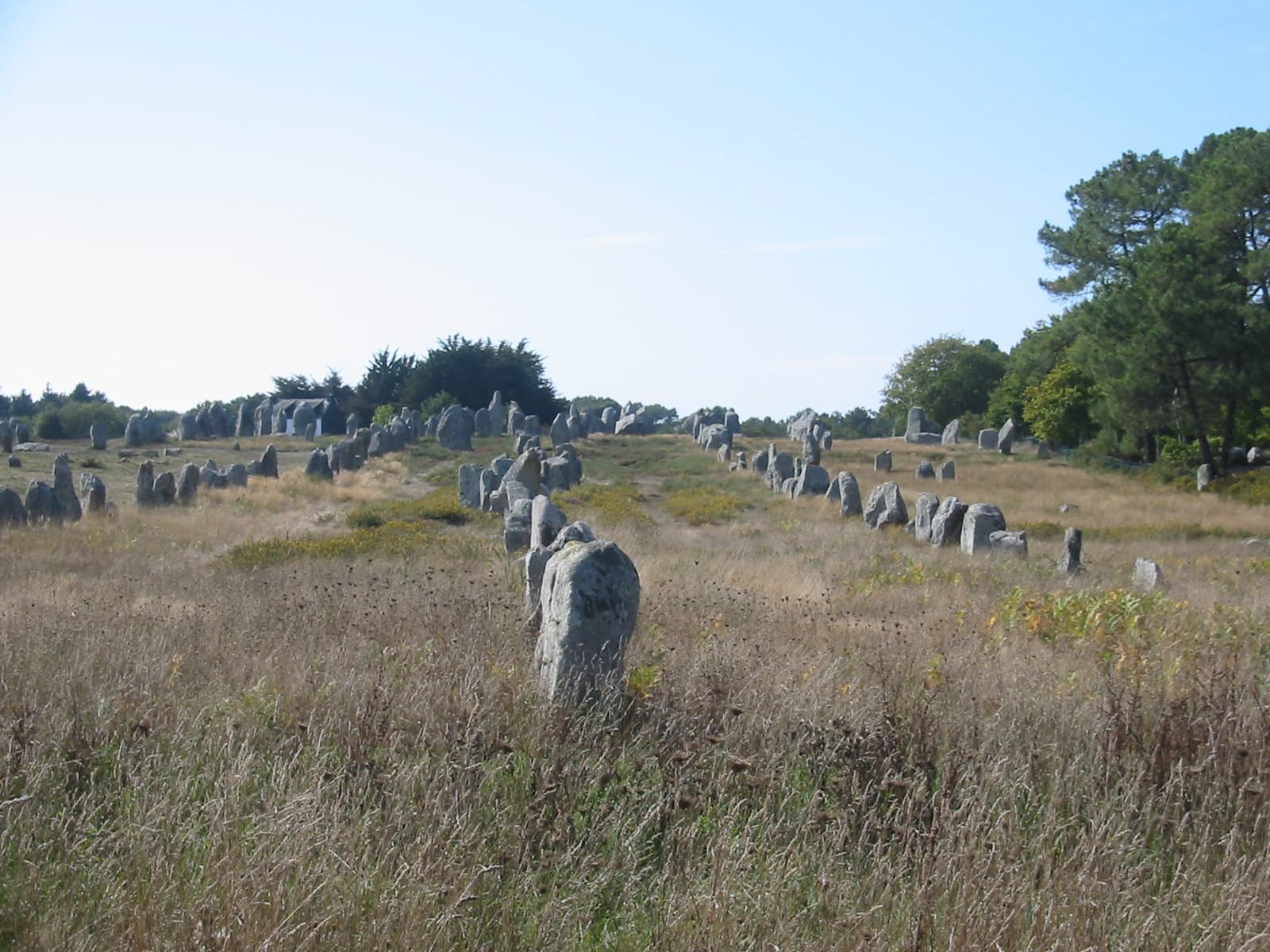 Odedr at English Wikipedia / Public domain, via Wikimedia Commons
“Where ancient stones murmur forgotten narratives of a Neolithic epoch.”
Not the postcards. The stories even locals don't know — whispered in your ear, right where they happened.
Many fables endeavor to account for the precise, linear arrangement of thousands of colossal stones in Carnac.
The Carnac Prehistory Museum safeguards a collection that unveils Carnac's astonishing ancient stature.
Despite their monumental presence, the precise function of the Carnac stones remains a profound archaeological puzzle.
Discover every secret of Carnac
Every address, every reveal in full — in your ear, right where it happened.
You pick your stops. You walk. The voice reveals what the others miss.
No tours available yet. Check back soon — we're preparing them.
Carnac, on Brittany's southern littoral in northwestern France, is a town recognized globally for its extraordinary assembly of megalithic sites. More than 3,000 prehistoric standing stones, known as menhirs, were sculpted from local granite and erected by the pre-Celtic inhabitants of Brittany. These megaliths, which encompass alignments, dolmens (stone tombs), and tumuli (burial mounds), constitute the grandest such collection worldwide.
These venerable structures date primarily from the Neolithic period, with some potentially as ancient as 4500 BC, predating Stonehenge and the Egyptian pyramids. While their exact purpose remains a topic of ongoing discussion, theories suggest they may have functioned as sacred grounds, astronomical calendars, or territorial markers. Beyond its archaeological importance, Carnac also extends a delightful coastal ambiance with shores, clear waters, and a local culinary landscape focused on fresh seafood and Breton specialties.
The Carnac megaliths are currently part of an initiative to be inscribed as a UNESCO World Heritage Site, aiming to conserve and promote this invaluable inheritance. The sheer magnitude and enigma of these ancient stones render Carnac a compelling destination for those intrigued by antiquity, archaeology, and the enduring puzzles of human civilization.
The narrative of Carnac commences in the Neolithic period, between 4500 and 3300 BC, when the pre-Celtic denizens of Brittany embarked on the monumental endeavor of erecting over 3,000 standing stones. These stones, hewn from local granite, compose the most extensive collection of megalithic sites globally. The construction of these alignments, dolmens, and tumuli was a sustained effort spanning over a millennium, demonstrating a remarkable degree of social organization and a shared cosmological vision among these early farming communities.
The principal groups of stone rows—Ménec, Kermario, and Kerlescan—may have once formed a singular, expansive complex before being separated by later removals. The Ménec alignments, for instance, consist of 1,050 menhirs arranged in eleven parallel rows extending for nearly a kilometer, commencing with a cromlech (stone circle) of 71 blocks. The stones within these alignments vary in elevation, often diminishing in size from west to east.
While the precise function of these megaliths persists as an enduring mystery, various theories have been put forth. Some propose a sacred or religious role, possibly as cult sites or for funerary ceremonies. Others hypothesize their application as astronomical observatories, charting solar and lunar cycles to mark solstices, equinoxes, and other celestial occurrences, potentially for agricultural or religious ends. The acidic soil of Brittany has eroded most organic materials, rendering precise dating and definitive conclusions about their use challenging.
Over the centuries, the Carnac stones have been interwoven into local folklore. A prominent legend recounts that the stones are a Roman legion transmuted to stone by Merlin the Wizard, while another Christian tale attributes their petrification to Pope Cornelius, who transformed pagan warriors pursuing him. These popular convictions underscore a long-standing human inclination to interpret these extraordinary 'anomalies' of nature.
The 19th century marked a period of intensified archaeological inquiry in Carnac, as scholars began to systematically investigate, restore, and conserve these ancient monuments. Excavations, particularly of the grander monuments and tombs, yielded significant artifacts, many of which are now housed in the Musée de Préhistoire James Miln – Zacharie Le Rouzic. This museum, considered one of Europe's most abundant prehistoric collections, exhibits over 7,000 artifacts, offering insights into the daily existence and funerary customs of the Neolithic people who constructed the megaliths.
Despite some stones being removed for roads or construction materials over time, and some modern re-erections in potentially incorrect positions, the Carnac alignments have largely been preserved due to their integration into popular culture and the fact that the land was historically little utilized for agriculture. Today, the ongoing endeavors to list the Megaliths of Carnac as a UNESCO World Heritage Site emphasize their global importance and the dedication to safeguarding this unparalleled prehistoric landscape.
The core of Carnac's allure resides in its expansive megalithic sites. The most prominent are the three principal groups of stone rows: the Ménec, Kermario, and Kerlescan alignments. The Ménec alignments are the grandest, showcasing over 1,000 stones in eleven converging rows. Further eastward, the Kermario alignments are notable for their particularly massive menhirs, while the Kerlescan group, though smaller, still presents an impressive display of 555 stones. While visitors can observe the stones from beyond the surrounding fences, guided excursions are available and highly recommended from April to September to gain entry within the alignments and comprehend their meaning. From October to March, visitors can wander freely among the stones.
Beyond the alignments, explore several dolmens (stone tombs) and tumuli (burial mounds) dispersed throughout the area. The Tumulus Saint-Michel, a substantial burial mound, affords expansive views of the surrounding terrain. For a deeper comprehension of the region's prehistory, the Musée de Préhistoire James Miln – Zacharie Le Rouzic is an essential stop. It houses a vast collection of artifacts, providing context to the lives of the Neolithic people who erected these monumental stones. The Maison des Mégalithes visitor center, at the western extremity of the alignments, offers exhibits, films, and an observation platform for an elevated perspective of the Ménec alignment.
Carnac is a year-round destination, but the period from late spring to early autumn offers the most pleasant weather. Summer (June to August) provides the warmest temperatures, averaging 18-22°C (64-71°F), making it suitable for both exploring the megaliths and enjoying the shores. However, this is also the peak tourist season, so anticipate larger gatherings and potentially higher prices. The shoulder seasons of May, June, and September offer mild temperatures, fewer visitors, and most attractions remain accessible. Winter (November to March) is quieter, with cooler, damp weather and average temperatures around 5-10°C (41-50°F). Rainfall is highest in December and lowest in August.
Carnac is accessible by road and rail. The nearest train station is Auray, approximately 13 kilometers distant, with regular train services from major French cities like Paris and Nantes. From Auray, you can reach Carnac via local buses or taxis. For those arriving by air, Nantes Atlantique and Rennes–Saint-Jacques airports are about two hours away by car.
Within Carnac, a complimentary shuttle service called Carnavette operates in July and August, connecting key points of interest like accommodations, the menhirs, the town center, and shores. This service runs daily from 10 am to 1 pm and 2 pm to 7:30 pm. Parking is generally convenient, with both free and paid options available near principal sites, though it can be in high demand during summer.
When visiting the megalithic alignments, remember that from April to September, access within the fenced areas is typically limited to guided excursions to safeguard the delicate stones. From October to March, visitors can explore freely. The Maison des Mégalithes serves as a visitor center and information point. Carnac's culinary landscape is deeply rooted in Breton tradition, with an emphasis on fresh seafood, oysters, mussels, crêpes, and galettes. The weekly Carnac Market on Wednesdays is a lively place to sample local produce and specialties.