The Villa Algérienne
Cap-Ferret was once home to an extravagant Moorish-style palace, complete with exotic gardens and roaming peacocks.
Full story unlocks in the tour
 Larrousiney / CC BY-SA 4.0, via Wikimedia Commons
“Where the Atlantic meets Arcachon Bay, a peninsula of pine forests and oyster dreams.”
Not the postcards. The stories even locals don't know — whispered in your ear, right where they happened.
Cap-Ferret was once home to an extravagant Moorish-style palace, complete with exotic gardens and roaming peacocks.
The iconic Cap-Ferret Lighthouse, a beacon for navigators for over 180 years, has a dramatic wartime past.
The colorful oyster huts that dot the Arcachon Bay side of Cap-Ferret are more than just picturesque.
Discover every secret of Cap-Ferret
Every address, every reveal in full — in your ear, right where it happened.
You pick your stops. You walk. The voice reveals what the others miss.
No tours available yet. Check back soon — we're preparing them.
Cap-Ferret, a narrow, finger-like peninsula on France's Atlantic coast, offers a unique blend of wild ocean beaches and the calm, protected waters of Arcachon Bay. An hour's drive from Bordeaux, this destination is known for its thriving oyster culture, pine forests, and a relaxed atmosphere that has attracted French families and creatives for generations. Unlike its glitzier Riviera counterpart, Cap-Ferret embraces a low-key elegance, where daily life revolves around fresh seafood, bike rides through shaded paths, and the rhythm of the tides.
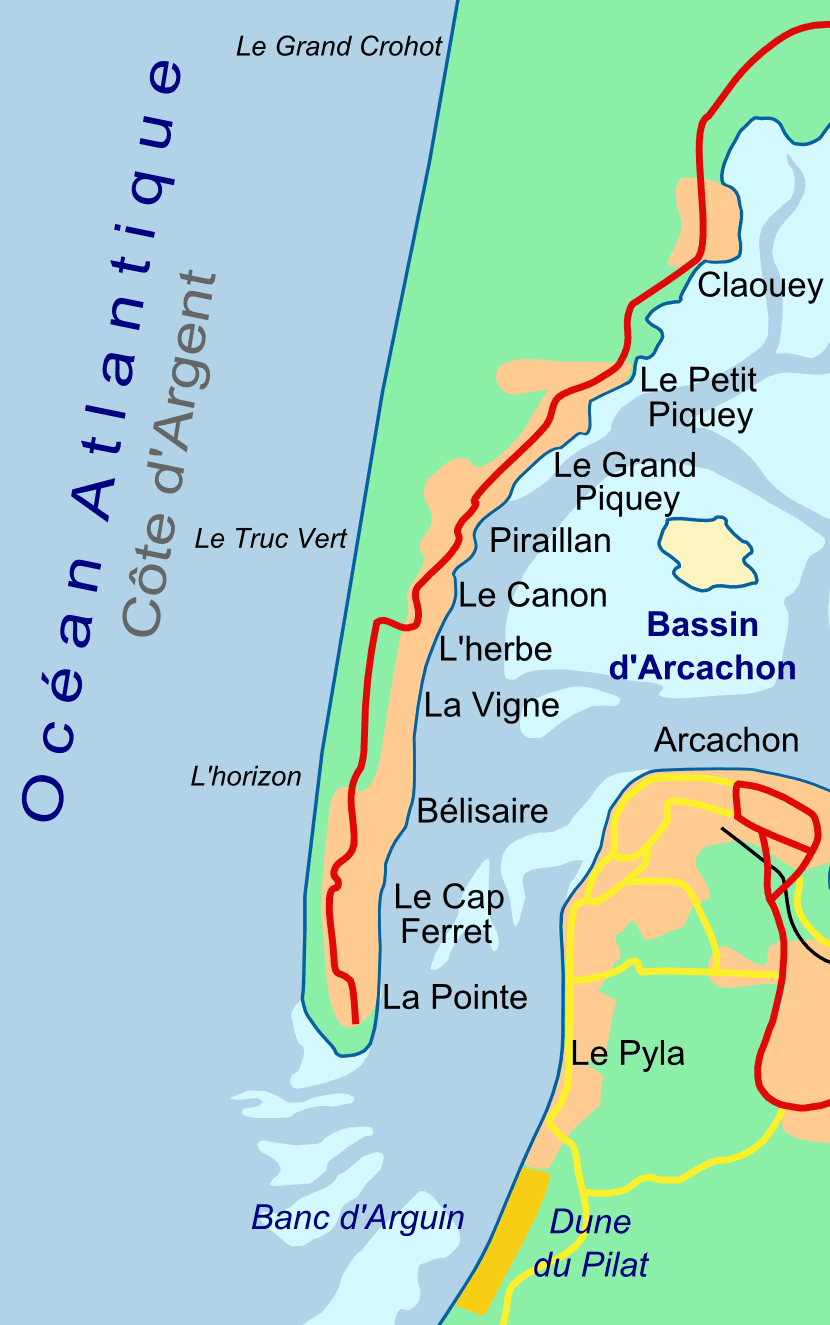
The peninsula is composed of a string of small villages, each with its own character, from the lively town of Cap-Ferret at its southern tip to the charming oyster-farming hamlets of L'Herbe and Le Canon. With 25 kilometers of coastline facing the Atlantic and 15 kilometers of beaches along the bay, Cap-Ferret provides diverse landscapes for surfing, swimming, or simply unwinding on the sand. Its natural beauty and tranquil ambiance make it a cherished escape, a place where the simple pleasures of coastal life are celebrated.
For centuries, the Cap-Ferret peninsula was largely covered by maritime pine forests, which were exploited for wood used in fuel, construction, and resin production. The 17th and 19th centuries saw an intensification of forestry, with Bordeaux merchants investing in forest management and sawmills, and a growing demand for wood for shipbuilding and the paper industry. New villages like Le Canon and Le Grand-Crohot sprang up within these forests.
Oyster farming, an industry that now defines the region, began to take root in the 18th century, with fishing families settling on the shores of the Bassin d'Arcachon and harvesting oysters from natural beds. The practice truly took off in the mid-19th century, spurred by figures like Victor Coste, commissioned by Napoleon III to develop marine species production. Coste established the first oyster beds in 1859, known as the “Imperial Farms,” and invented the first spat collector. This intensification led to the formation of the picturesque oyster-farming villages, recognizable by their colorful huts and narrow alleyways, which became centers for this activity.
The development of Cap-Ferret as a seaside resort began in the early 20th century. In 1908, a significant parcel of land, known as the '44 hectares,' was divided into building plots and sold, attracting wealthy residents from Bordeaux who built luxury establishments. Until the mid-19th century, the peninsula was relatively isolated, with no road connecting Lège to the rest of the area. The construction of a road and, later, the Arcachon-Cap-Ferret maritime link, further accelerated tourism and development. In 1976, the previously separate villages of Lège and Cap-Ferret merged to form the single commune of Lège-Cap-Ferret, recognizing a shared identity shaped by life between the ocean and the bay.
Begin your exploration with the Cap-Ferret Lighthouse, a 57-meter-tall sentinel offering a 360-degree panorama of Arcachon Bay, the Dune du Pilat, and the Atlantic Ocean after climbing its 258 steps. Inside, a museum details the lighthouse's history and the evolution of marine cartography.
Discover the character of the oyster villages along the bay side, such as L'Herbe and Le Canon, with their colorful wooden cabins and paths often adorned with flowers. Many oyster farmers offer impromptu tastings of freshly shucked oysters paired with local wine. A visit to the Chapelle de la Villa Algérienne in L'Herbe provides a glimpse into the peninsula's unique past, as it's the sole remaining structure of an extravagant Moorish-style estate.
For beach lovers, Cap-Ferret offers two distinct experiences. On the Atlantic side, Plage de l'Horizon and Plage des Dunes provide wilder landscapes and consistent waves for surfing. On the bay side, calmer waters at Plage des Américains or Plage de la Vigne are ideal for families and swimming. Consider a boat trip on a traditional pinasse to Bird Island (Île aux Oiseaux) and the famous stilt huts, the Cabanes Tchanquées, for a unique perspective of the bay.
Cap-Ferret is appealing throughout the year, though the most popular time to visit is from May to July, when average daytime temperatures hover around 23°C. The months of May, June, and September are particularly recommended for pleasant weather and to avoid the peak crowds of mid-July to mid-August, when the peninsula can get very busy. Outside of the high season, especially in late September and early October, the area offers a quieter experience with fewer tourists. Local markets are open year-round on Wednesdays and Saturdays, with daily markets during the summer months.
Cap-Ferret is approximately a one-hour drive from Bordeaux airport or train station. While driving is an option, traffic can be heavy, especially in high season, and parking can be costly. Many visitors opt to leave their cars further north in villages like Claouey and explore the peninsula by bicycle, as Cap-Ferret offers extensive cycle paths. A small tram also runs between Plage de l'Horizon and Jetée de Bélisaire from April to September.
Ferries connect Cap-Ferret (Jetée de Bélisaire) to Arcachon, offering a scenic 20-30 minute journey across the bay. Tourist information centers are available, and local taxis can be found. For accommodation, booking in advance is advisable, especially during summer, due to its popularity.