Catedral de Pedra
The grand Stone Cathedral of Canela is more than a daytime spectacle.
Full story unlocks in the tour
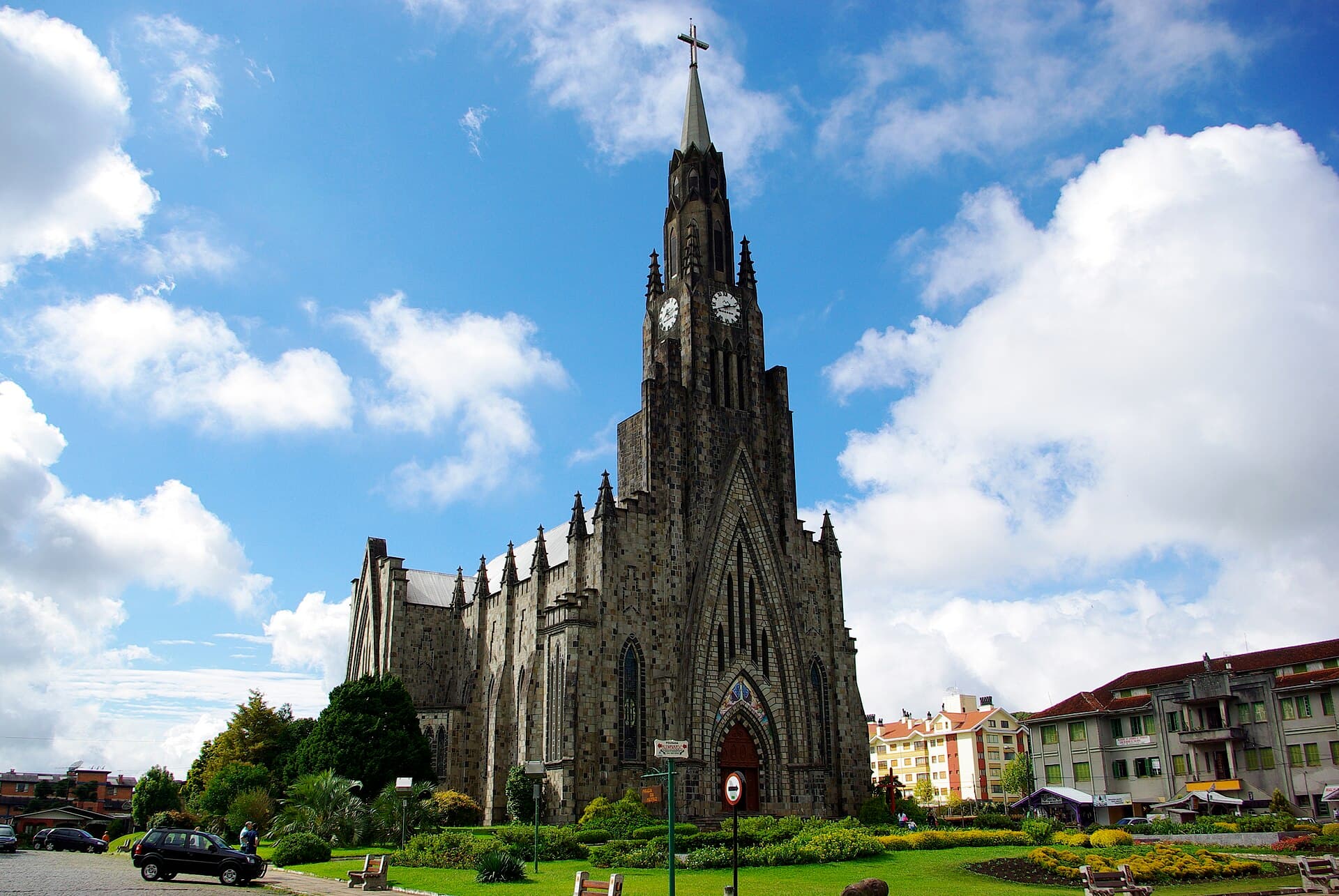 Tiago Fioreze / CC BY-SA 3.0, via Wikimedia Commons
“Where European elegance intertwines with the wild heart of Brazil's Serra Gaúcha.”
Not the postcards. The stories even locals don't know — whispered in your ear, right where they happened.
The grand Stone Cathedral of Canela is more than a daytime spectacle.
In a nation synonymous with sun-drenched warmth, Canela holds an astonishing secret: a realm where temperatures plunge far below freezing.
The city's melodious name, 'Canela,' hints at a botanical past.
Discover every secret of Canela
Every address, every reveal in full — in your ear, right where it happened.
You pick your stops. You walk. The voice reveals what the others miss.
No tours available yet. Check back soon — we're preparing them.
Canela, a captivating town in Brazil's Rio Grande do Sul state, presents a singular fusion of natural splendor and European-influenced architecture. Located in the Serra Gaúcha region at an elevation of 837 meters above sea level, Canela offers a bracing respite from Brazil's typically warm climate, with cooler temperatures and verdant scenery. Often referred to as 'the Brazilian Europe,' the town's aesthetic features chalet-style residences and meticulously maintained public spaces, distinguishing it from other Brazilian locales.
The city is a favored tourist destination, drawing visitors with its picturesque landscapes, opportunities for ecotourism, and a tranquil ambiance. Canela forms a popular tourist area with its neighboring city, Gramado, and is part of the scenic Rota Romântica (Romantic Route). Beyond its visual appeal, Canela is also celebrated as Brazil's National Capital of Theme Parks, offering 22 themed attractions that welcome approximately 9 million visitors annually.
Before European colonization, the Serra Gaúcha region, the setting for Canela, was home to indigenous groups, including the Kaingang people. The modern history of the settlement commenced at the turn of the 19th and 20th centuries. The city's name, 'Canela,' meaning 'cinnamon' in Portuguese, is believed to have stemmed from a large cinnamon tree that once stood near the original settlement, serving as a landmark for early travelers and cattle drovers.
German immigrants began arriving in the Serra Gaúcha region as early as 1824, profoundly shaping Canela's cultural identity, architecture, and gastronomy. The active development of the settlement is linked to 1903, when Colonel João Ferreira Correa da Silva began organizing the city's structure. Canela officially attained the status of an independent municipality on December 28, 1944, separating from the municipality of São Francisco de Paula.
Owing to its agreeable mountain climate and scenic vistas, Canela began attracting summer residents and holidaymakers early on, gradually evolving into a popular resort town. A significant architectural landmark, the Catedral de Pedra (Stone Cathedral), a Gothic-style church, saw its first stone laid in 1953, with construction concluding in 1987. In 1973, the Caracol State Park opened, safeguarding the iconic Caracol Waterfall and its surrounding araucaria forests. The closure of the railway line in 1963 marked a transition toward road infrastructure development, further bolstering tourism.
Canela presents a variety of attractions, blending natural splendor with singular human-made experiences. The Catedral de Pedra (Stone Cathedral), a Gothic-style church with a 65-meter tower and 12 bronze bells from Italy, stands as a central landmark that glows with a light show after dark.
Those who appreciate nature will find Parque do Caracol a highlight, home to the grand 131-meter Caracol Waterfall, one of Brazil's most photographed natural scenes. Visitors can observe the falls from an observation deck, ascend a cable car for sweeping views, or descend 927 steps for an intimate encounter. Other natural spaces include Parque da Ferradura, offering panoramic canyon views, and Parque do Lago, ideal for quiet walks and paddle boating.
For family-friendly entertainment, Canela is recognized for its theme parks. Mundo a Vapor is dedicated to steam-powered machinery, featuring a miniature steam railway. Florybal Magic Park Land unveils a fantastical realm of animatronic dinosaurs and magical woodlands. Those seeking a distinctive experience can visit Captain Frosty World (Parque Temático Mundo Gelado), an ice museum and bar where every element is crafted from ice. The Canela Automobile Museum displays a collection of classic vehicles, from Ferraris to vintage models.
Do not overlook the Castelinho Caracol, a historic residence transformed into a museum that also serves one of Brazil's finest apfelstrudels.
Canela is a destination for all seasons, each offering a distinct appeal. The most agreeable times to visit for mild temperatures and pleasant weather are autumn (April-May) and spring (September-November), perfect for outdoor pursuits and sightseeing without large crowds. Summer (December-March) is warm, with average temperatures around 20-22°C, and is marked by Christmas festivities. Winter (June-August) brings cooler temperatures, occasionally dipping below freezing, with light snowfall sometimes occurring, attracting domestic tourists. This period is also considered high season due to the cool mountain climate and festivals.
The nearest major airport is Salgado Filho Airport (POA) in Porto Alegre, approximately a two-hour drive from Canela. You can journey to Canela from Porto Alegre by car or bus. While public transport is available, renting a car offers greater freedom to explore the dispersed natural attractions and nearby Gramado. Within Canela's compact core, many prefer walking. Taxis and ride-hailing applications are also accessible.
Brazil's currency is the Real (BRL). It is wise to carry some cash, as smaller establishments may not accept credit cards. Electrical outlets in Brazil are primarily Type N, so an adapter may be necessary. The climate can be variable, so packing layers and a waterproof jacket is advisable. Learning a few basic Portuguese phrases will enrich your interactions with locals.