Cancún International Airport (CUN)
The airport's connecting bridge carries a curious local legend about its initial construction.
Full story unlocks in the tour
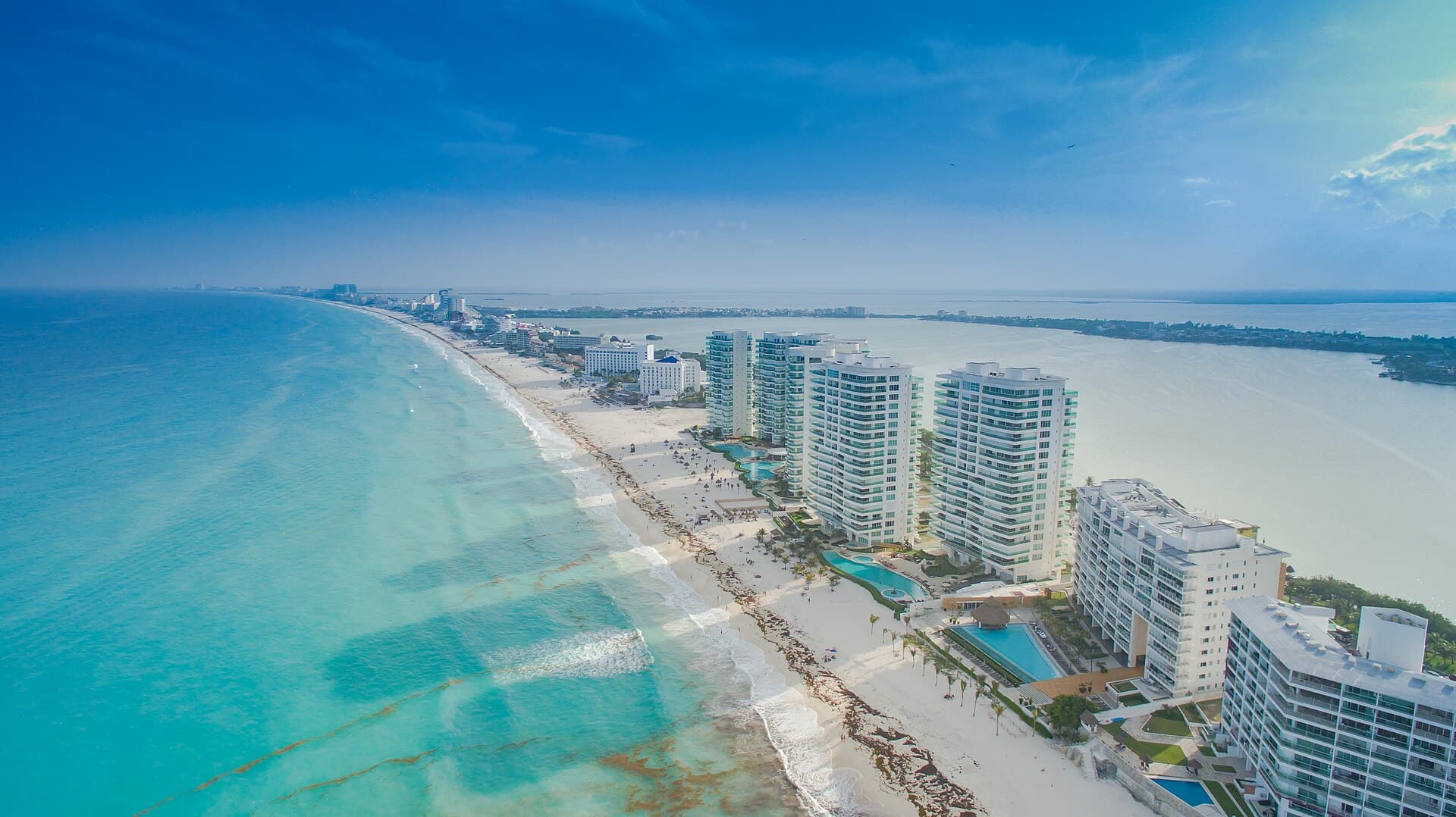 dronepicr / CC BY 2.0, via Wikimedia Commons
“Where ancient echoes meet the Caribbean's clear embrace.”
Not the postcards. The stories even locals don't know — whispered in your ear, right where they happened.
The airport's connecting bridge carries a curious local legend about its initial construction.
The brilliant white sand here possesses a natural quality that keeps it cool beneath your feet.
This celebrated stretch of resorts was not always a bustling destination; it once held only a few inhabitants.
Discover every secret of Cancún
Every address, every reveal in full — in your ear, right where it happened.
You pick your stops. You walk. The voice reveals what the others miss.
No tours available yet. Check back soon — we're preparing them.
Cancún, a city on the northeastern coast of Mexico's Yucatán Peninsula, is celebrated for its luminous turquoise waters and soft, pale-sand beaches. Once a sparsely populated strip of sand, it has blossomed into a premier global tourist destination, drawing millions of visitors each year. The city presents a distinctive blend of contemporary appeal and ancient Mayan heritage, offering a wide array of activities, from exploring historical sites to enjoying lively evening entertainment.
Divided into two primary areas, the Hotel Zone and Downtown Cancún, the city accommodates varied travel preferences. The Hotel Zone, shaped like the numeral seven and extending for 14 miles, concentrates most resorts, restaurants, and entertainment venues, bordered by the Caribbean Sea on one side and the Nichupté Lagoon on the other. Downtown Cancún offers a more authentic glimpse into local life, with its markets, street art, and traditional eateries.
Before its modern establishment, the territory now recognized as Cancún was named "Ekab," signifying "Black Earth." The name "Cancún" itself originates from the Mayan language, frequently interpreted as "nest of snakes" or "place of the golden snake," reflecting the wild, untamed character of the region in earlier times.
For centuries following the Spanish conquest, the Mayan population of the Yucatán Peninsula diminished due to illness, conflict, and starvation, leaving the Cancún area largely uninhabited save for a few fishing families. It remained a forgotten sand formation until the late 1960s, when the Mexican government, through the Bank of Mexico and later FONATUR, initiated an ambitious undertaking to forge a new tourism center. Computer analysis and extensive geographic studies identified this particular coast as the optimal location, based on criteria such as climate, beach quality, and proximity to the U.S. market.
Official construction commenced on April 20, 1970, marking the dawn of modern Cancún. The initial development included the first hotels and an international airport, which opened in 1974. This rapid expansion transformed Cancún from a deserted island into a flourishing metropolis, with its economy almost entirely focused on international tourism. The city's expansion quickly outpaced other areas of Quintana Roo, attracting thousands of people from across Mexico seeking employment opportunities in the burgeoning tourism sector.
Despite challenges such as currency devaluations and significant hurricanes like Gilbert in 1988 and Wilma in 2005, Cancún has consistently demonstrated its resilience, recovering to become Mexico's most dynamic city and the Caribbean's most sought-after destination. Today, Cancún International Airport (CUN) is Mexico's second busiest and the busiest in Latin America for international passengers, serving as a primary entry point to the Mexican Caribbean.
Cancún presents a varied collection of attractions beyond its celebrated shores. For a window into the region's ancient past, explore the Mayan ruins within the Hotel Zone, such as the El Rey Archaeological Zone and San Miguelito, found within the Mayan Museum of Cancún. For a more expansive historical journey, consider a day trip to the iconic Chichen Itza, a UNESCO World Heritage site and a New Wonder of the World.
Beyond history, the natural splendor of Cancún is a primary draw. The radiant white-sand beaches, like Playa Delfines (also known as El Mirador), Playa Langosta, and Chac Mool, offer sweeping views and moments for repose. For a distinctive underwater experience, visit the Cancún Underwater Museum (MUSA), displaying over 500 life-sized sculptures that also function as artificial reefs. The Nichupté Lagoon provides opportunities for water activities and offers a different perspective on the city's natural landscape. For an elevated view, the Cancún Scenic Tower rotates 360 degrees, providing expansive vistas of the Caribbean Sea and the Nichupté Lagoon.
For shopping and local character, Mercado 28 in Downtown Cancún is a lively market where you can discover souvenirs and local crafts. Evenings can be spent experiencing Cancún's active nightlife, with venues like Coco Bongo offering animated entertainment.
The dry season, from December to April, is generally considered the most favorable time to visit Cancún for ideal beach weather, with minimal rainfall, comfortable humidity, and temperatures in the low to mid-80s Fahrenheit. January and February offer particularly pleasant conditions, with cooler evenings. The shoulder seasons, from mid-April to May and mid-October to November, provide a balance of agreeable weather and fewer crowds, often with improved deals on accommodations. May is especially appealing for warm weather, fewer tourists, and the commencement of the whale shark migration season. While June to November is hurricane season, peaking from August to October, tropical downpours are usually brief and rarely spoil a vacation.
The official currency in Cancún is the Mexican Peso (MXN), though US dollars are widely accepted in many tourist areas, hotels, and restaurants. It is generally advisable to use pesos for more favorable exchange rates and for smaller purchases. ATMs are readily available for peso withdrawals, but be mindful of potential international transaction fees.
Cancún International Airport (CUN) is well-connected, featuring four passenger terminals and an FBO terminal for private flights. It is prudent to book airport transportation in advance with official providers. Within the Hotel Zone, a frequent bus system offers a cost-effective way to navigate. Taxis are also available, but for longer distances or tours, private transportation services are recommended.
While Cancún is generally considered secure for tourists, particularly within the Hotel Zone, it is always wise to observe standard precautions. Be aware of your surroundings, avoid isolated areas at night, and safeguard your belongings. Tap water is typically not safe for drinking, so opt for bottled or purified water. Tipping is customary for good service.