National Film and Sound Archive
This art deco building, once an Institute of Anatomy, has a reputation that extends beyond its cinematic collections.
Full story unlocks in the tour
 The 3B's / CC BY 2.0, via Wikimedia Commons
“Australia's planned capital, where nature and design converge.”
Not the postcards. The stories even locals don't know — whispered in your ear, right where they happened.
This art deco building, once an Institute of Anatomy, has a reputation that extends beyond its cinematic collections.
A former Prime Minister's presence is said to linger in this historic hotel.
Beyond the visible infrastructure, whispers persist of a network below.
Discover every secret of Canberra
Every address, every reveal in full — in your ear, right where it happened.
You pick your stops. You walk. The voice reveals what the others miss.
No tours available yet. Check back soon — we're preparing them.
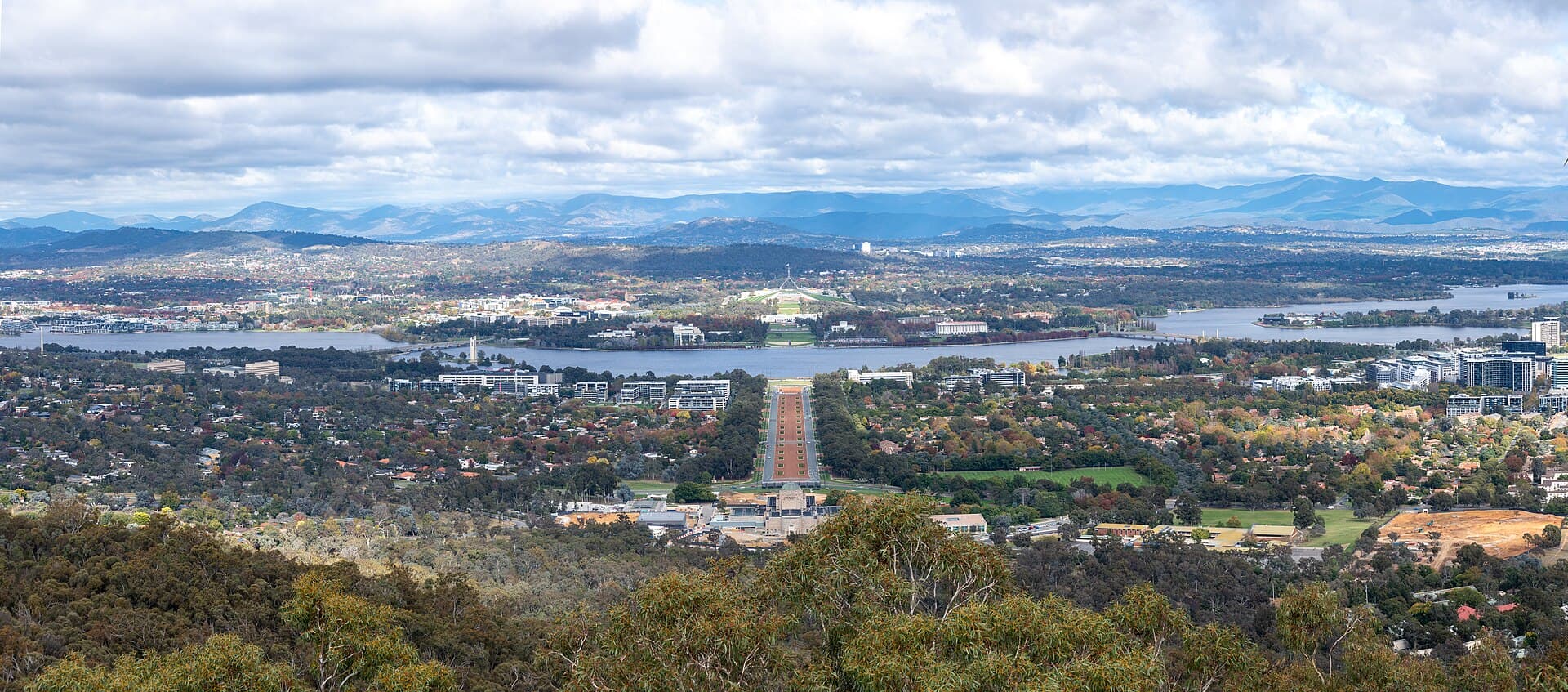
Canberra, Australia's capital, is a city unlike any other in the country. It was meticulously planned from its inception to serve as the nation's capital, a compromise between the rival cities of Sydney and Melbourne. The city's design, envisioned by American architects Walter Burley Griffin and Marion Mahony Griffin, is evident in its geometric motifs and alignment with natural landmarks like Black Mountain and Mount Ainslie. This thoughtful layout, combined with extensive green spaces, has earned Canberra the affectionate title of 'the bush capital.'
More than just a political hub, Canberra offers a unique blend of culture, history, and nature. It's a city where world-class museums and galleries stand alongside expansive parklands and nature reserves. With a population of around 484,630 as of 2025, Canberra is Australia's largest inland city, offering a distinct experience that sets it apart from its coastal counterparts.
The land where Canberra now stands has a deep and ancient history, inhabited by Aboriginal Australians, including the Ngunnawal and Ngambri peoples, for up to 21,000 years. Archaeological evidence, such as rock shelters, paintings, burial sites, and stone tools, attests to this long period of Indigenous custodianship.
European exploration of the area began in the 1820s, with Charles Throsby Smith, Joseph Wild, and James Vaughan credited with its discovery in December 1820. Early European settlement commenced in the first half of the 19th century, with landmarks like St John's Anglican Church and Blundells Cottage still standing today. The first European landowner in the region, Joshua John Moore, named his grant 'Canberry' in 1823, after the local Aboriginal clan. The name 'Canberra' itself is derived from the Ngunnawal language, thought to mean 'meeting place.'
The federation of the Australian colonies on January 1, 1901, necessitated the establishment of a national capital. The site for Canberra was chosen in 1908 as a compromise between Sydney and Melbourne, Australia's two largest cities. In 1911, the New South Wales government ceded the district to the federal government, establishing the Federal Capital Territory. An international design competition was launched in 1911, and in 1912, the American architects Walter Burley Griffin and Marion Mahony Griffin were selected for their innovative plan. Lady Denman, wife of Governor-General Lord Denman, formally named the city 'Canberra' on March 12, 1913, at a ceremony on Kurrajong Hill, now Capital Hill and the site of Parliament House. The city's development, however, was not without its challenges, experiencing slowdowns during the Great Depression and both World Wars. The federal legislature officially moved to Canberra in 1927 with the opening of the Provisional Parliament House.
Canberra offers a concentrated array of national institutions and unique attractions. Begin at the Australian War Memorial, a significant site combining a memorial, museum, and archive. Explore the heart of Australian democracy at Parliament House, a building with a distinctive grass roof. Nearby, Old Parliament House (now the Museum of Australian Democracy) provides a glimpse into the nation's political past.
For sweeping views of the city's planned layout, ascend to the Mount Ainslie Lookout, a popular spot for both locals and visitors. The man-made Lake Burley Griffin is a central feature, offering walking and cycling paths, and is surrounded by cultural institutions like the National Gallery of Australia and the National Library. The National Museum of Australia provides interactive exhibits on the nation's history. For a dose of science and fun, Questacon – The National Science and Technology Centre is a popular choice, especially for families. Don't miss the Royal Australian Mint, where Australia's coins are produced, or the National Arboretum Canberra with its diverse tree collections and city views.
Canberra experiences four distinct seasons, offering different experiences throughout the year. Autumn (March to May) is considered by many to be the most beautiful, with lively fall foliage and pleasant temperatures, ideal for outdoor activities and events like the Canberra Balloon Spectacular. Spring (September to November) is also highly recommended, with blooming wildflowers and the Floriade flower festival. Summers (December to February) are warm, suitable for water sports on Lake Burley Griffin, while winters (June to August) bring cooler temperatures, perfect for exploring indoor attractions.
Canberra is a well-planned city, making it relatively easy to navigate. While distances between attractions can be significant for walking, cycling is a popular and practical option due to extensive paths. Share A Bike stations are available for hourly or daily rentals. Public buses are the main form of public transport, and a light rail line runs along Northbourne Avenue. Cash is not accepted on buses; you'll need a pre-paid ticket or a MyWay card.
Many of Canberra's national attractions, including the Australian War Memorial, National Gallery of Australia, National Museum of Australia, and Parliament House, offer free entry. For those driving, roundabouts are prevalent in Canberra, so be prepared for them. Business hours for banks are generally Monday to Thursday 9:30 AM to 4 PM, and Friday 9:30 AM to 5 PM. Most stores and offices are open Monday to Friday 9 AM to 5:30 PM, with many shops in larger malls also open on weekends and until 9 PM on Fridays.