Caernarfon Castle's Eagle Tower
The formidable Eagle Tower of Caernarfon Castle once guarded an unexpected detail upon its battlements.
Full story unlocks in the tour
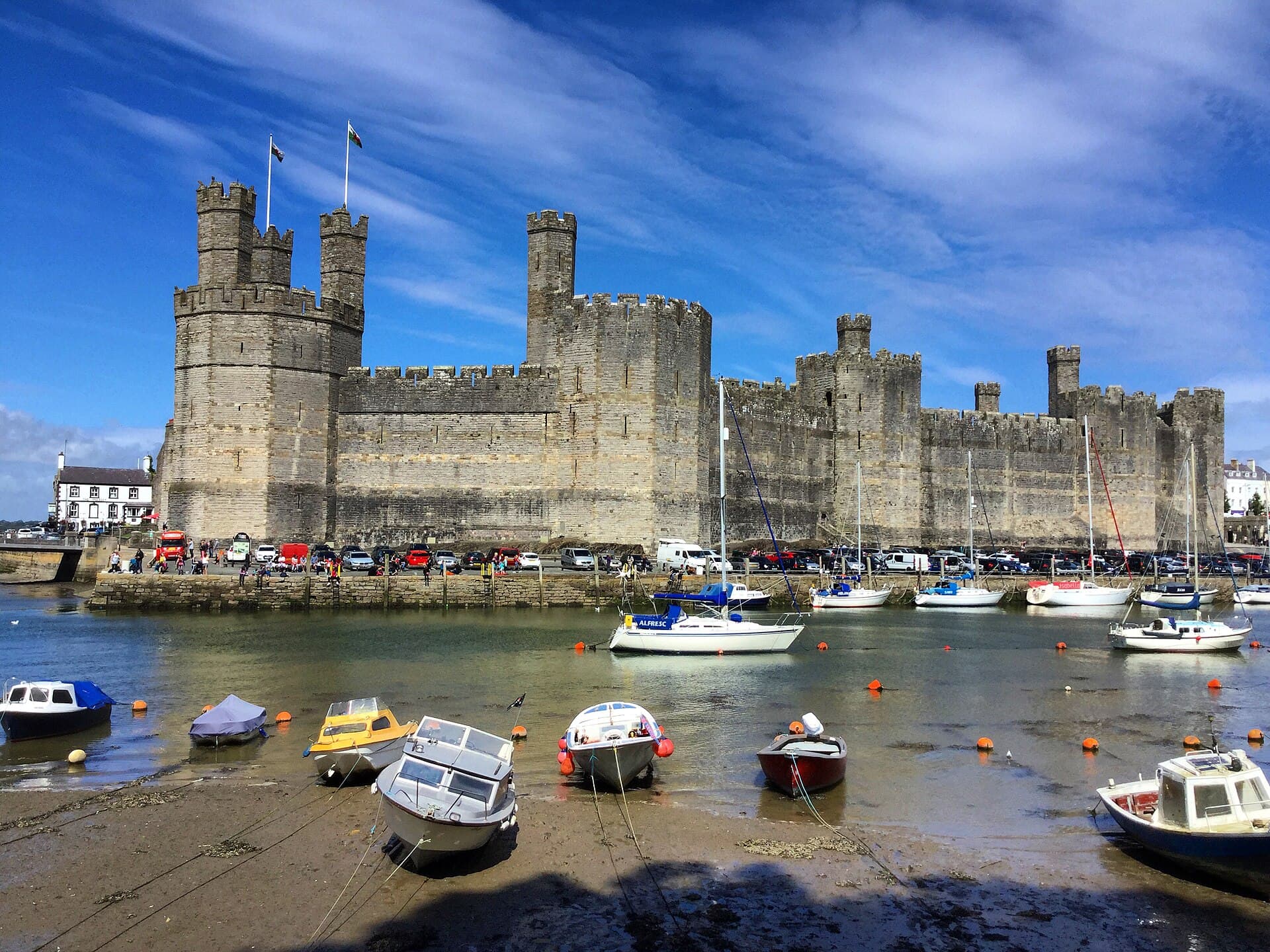 AJ Marshall / CC BY-SA 4.0, via Wikimedia Commons
“Where ancient stones recount eras of dominion and ceremony.”
Not the postcards. The stories even locals don't know — whispered in your ear, right where they happened.
The formidable Eagle Tower of Caernarfon Castle once guarded an unexpected detail upon its battlements.
Beyond their defensive role, Caernarfon's medieval town walls once participated in a curious social experiment.
A grand Victorian structure in Caernarfon preserves a secret from a time before modern plumbing became common.
Discover every secret of Caernarfon
Every address, every reveal in full — in your ear, right where it happened.
You pick your stops. You walk. The voice reveals what the others miss.
No tours available yet. Check back soon — we're preparing them.
Caernarfon, a royal town in Gwynedd, North-West Wales, offers a compelling blend of history, culture, and natural beauty. It rests on the eastern side of the Menai Strait, a narrow stretch of water separating mainland Wales from the Isle of Anglesey, and borders the western edges of Snowdonia National Park. The town is widely known for its spectacular medieval castle, a UNESCO World Heritage Site, and its deep connections to Welsh heritage.
More than 80% of Caernarfon's residents speak Welsh as a first language, making it an excellent place to experience the authentic Celtic heritage and hear the ancient language spoken. Beyond the castle, the town's engaging streets are lined with independent shops, welcoming cafés, and traditional Welsh pubs. Caernarfon provides a good base for visiting other places of interest in North Wales, including Snowdonia National Park and Anglesey.
The area around Caernarfon has a long history of human settlement. In pre-Roman times, Celtic tribes, possibly the Ordovices, inhabited the region of Gwynedd. The Roman conquest of Britain brought Roman influence to the area in the late first century AD, leading to the establishment of Roman forts and roads. Just outside the modern town center lie the remains of Segontium Roman fort, dating from around 70 AD. It was the largest Roman structure of its kind excavated in Wales and served as the military and administrative center for north-west Wales throughout the Roman period, billeting a 1,000-strong regiment of soldiers.
Following the Roman withdrawal in the early fifth century, the region saw the emergence of early medieval Welsh kingdoms. By the late 11th century, a Norman motte-and-bailey castle was built on the site. However, it was King Edward I of England who began replacing this with the current stone structure in 1283, as part of his campaign to subdue the Welsh princes. Caernarfon Castle was designed to be his grandest, taking almost 50 years to build at a cost of nearly £25,000, a substantial sum for the time. The castle and the surrounding town walls were built on a grand scale, intended to be the administrative center and a symbol of English dominance in North Wales.
The castle's unique design, with its polygonal towers and banded stonework, is thought to have been influenced by the Walls of Constantinople, reflecting Edward I's assertion of authority and perhaps even drawing on the Roman legend of Macsen Wledig, who dreamt of a magnificent, multi-colored castle. The future Edward II was born at Caernarfon Castle in 1284, and in 1301, he was invested as the first English Prince of Wales, a title still held by the male heir to the throne today. The castle was besieged multiple times throughout its history, including during the Welsh revolt of 1294 led by Madog ap Llywelyn and the Glyndŵr Rising in the early 15th century. During the English Civil War, it was held by Royalists and besieged three times by Parliamentarian forces. Despite periods of neglect, significant restoration work in the 19th and 20th centuries has preserved the castle, and it was the site of the investiture of King Charles III as Prince of Wales in 1969.
Caernarfon's primary attraction is Caernarfon Castle, a UNESCO World Heritage Site. You can walk the battlements of this medieval fortress, explore its courtyards, and ascend its unique polygonal towers for sweeping views of the town, the Menai Strait, and Snowdonia. Within the Queen's Tower, you'll find the Royal Welch Fusiliers Museum, displaying 300 years of military history with uniforms, guns, medals, and memorabilia.
Beyond the castle, explore the Caernarfon Town Walls, which form a complete circuit around the old town. A short walk from the town center leads to the remains of Segontium Roman Fort, the largest Roman structure excavated in Wales, offering a glimpse into the region's ancient past. For a different perspective, take a Menai Strait Cruise to see Caernarfon Castle from the water, along with views of Snowdonia and Anglesey. The Welsh Highland Railway offers scenic steam train journeys through Snowdonia National Park, departing from Caernarfon. Do not overlook a stroll along the revitalized Victoria Dock area, with its shops, restaurants, and cafes. For a singular local experience, seek out Bar Bach, rumored to be the smallest bar in Wales.
Caernarfon welcomes visitors year-round, but spring (April-May) is particularly pleasant, offering mild weather, blossoming landscapes, and fewer crowds than the summer months. Summer (June-August) brings warmer weather and longer daylight hours, ideal for outdoor activities like boat trips and hiking. July typically sees temperatures ranging from 13-17°C (56-63°F). During this time, the castle often has extended visiting hours, and the sunsets create a dramatic backdrop.
Caernarfon is easily accessible and best explored on foot. The town is located at the southern end of the Menai Strait, about 8 miles southwest of Bangor. If driving, allow approximately five hours from London. All-day parking is available at the Slate Quay car park (LL55 2PB), which is a minute's walk from the castle. There are other car parks available for shorter stays.
Inside Caernarfon Castle, be prepared for uneven steps and steep, winding towers. Allow for your eyes to adjust in the inner areas and use handrails. Supportive shoes with good grip are recommended for the castle and the town's uneven streets. The harbor front can be breezy, so a light windproof layer is advisable. While cards are widely accepted, carrying a small amount of cash can be useful for smaller vendors. The Caernarfon Tourist Information Centre, opposite the castle, offers free local advice.