Burgos Cathedral
Observe the Papamoscas clock, a whimsical automaton that marks the hours.
Full story unlocks in the tour
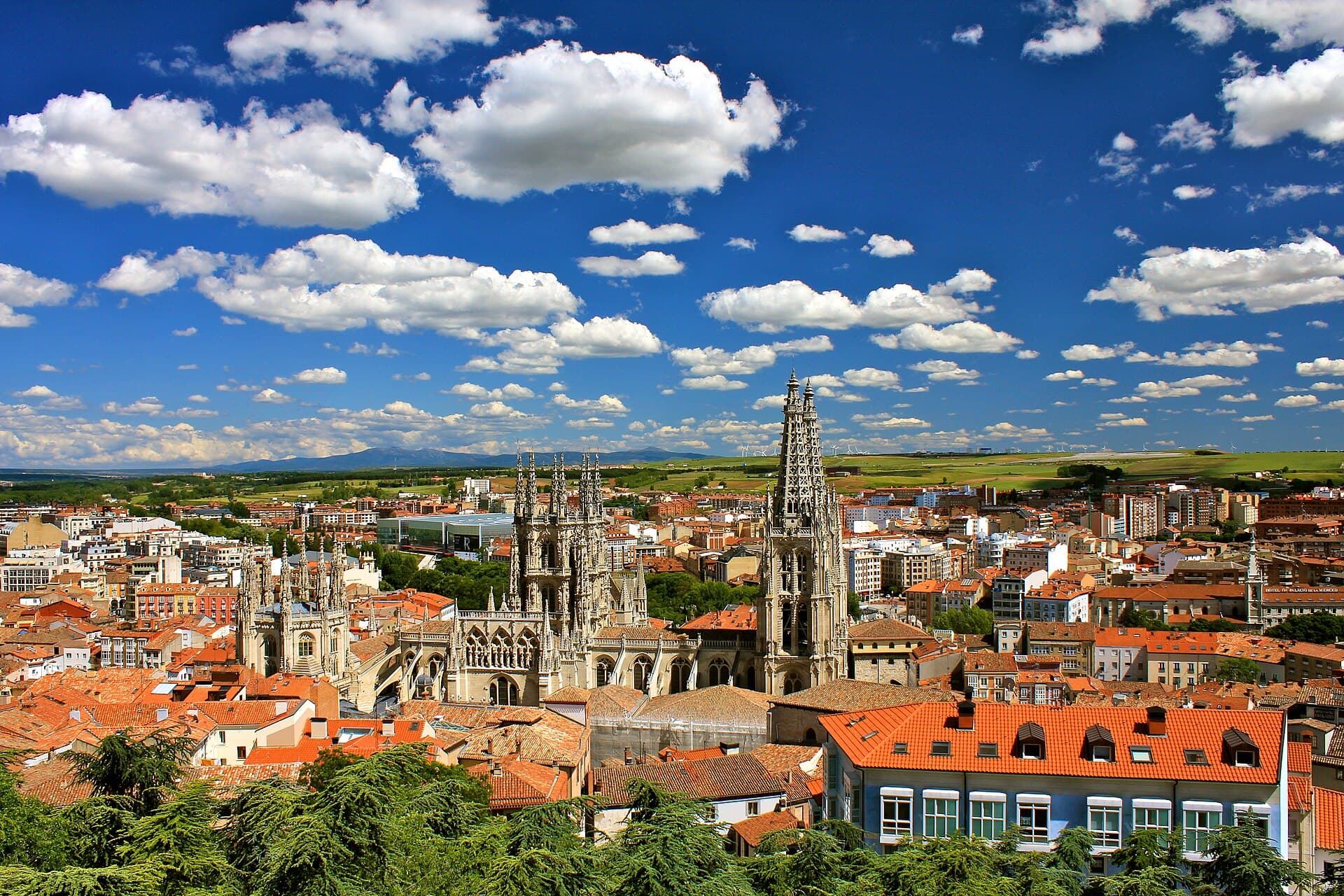 Jardoz / CC BY-SA 3.0, via Wikimedia Commons
“Where Gothic spires meet ancient tales.”
Not the postcards. The stories even locals don't know — whispered in your ear, right where they happened.
Observe the Papamoscas clock, a whimsical automaton that marks the hours.
This palace hosted a world-changing meeting after Columbus's second voyage.
The legendary El Cid and his wife, Doña Jimena, were interred here for centuries before their final resting place.
Discover every secret of Burgos
Every address, every reveal in full — in your ear, right where it happened.
You pick your stops. You walk. The voice reveals what the others miss.
No tours available yet. Check back soon — we're preparing them.
Burgos, a city in northern Spain, anchors itself on the Castilian meseta, where the Arlanzón river carves a valley between two ridges. Founded as a military outpost in 884 AD, it blossomed into a significant mercantile and cultural center during the Middle Ages. Today, with a population of around 175,000, Burgos is a key stop on the Camino de Santiago pilgrimage route, drawing visitors with its well-preserved medieval core and its celebrated Gothic cathedral.
The city's historical weight is palpable, from its ancient fortifications to its connection with the legendary El Cid. Burgos offers a blend of grand architecture, engaging museums, and a distinct regional gastronomy, earning it the title of "Spanish Gastronomy Capital" in 2013 and a place in UNESCO's Creative Cities Network as a "City of Gastronomy" in 2015.
## From Frontier Outpost to Castilian Capital Burgos was established in 884 AD by Count Diego Rodríguez Porcelos, acting on behalf of the Leonese monarch, as a fortified village against the Muslim south during the Reconquista. Its name, "Burgos," reflects this origin, meaning "fortified village." The city quickly grew in importance, becoming the capital of the County of Castile and later, in the 11th century, the capital of the unified Kingdom of Castile and León.
Throughout the medieval period, Burgos thrived as a major hub for trade, particularly in merino wool, and served as a crucial stop for pilgrims on the Camino de Santiago. This economic prosperity and strategic location fostered significant urban development and attracted a diverse population, including foreign merchants who became influential in the city's governance. The construction of the Burgos Cathedral, a project initiated in 1221 under King Ferdinand III, symbolized the city's growing power and artistic ambition.
Burgos maintained its prestige as a capital city for centuries, but its political significance waned after 1560 when Philip II declared Madrid the sole court. Despite this, Burgos continued to play a role in Spanish history, including during the Peninsular War, when it was besieged by British forces in 1812, and later as a Nationalist stronghold during the Spanish Civil War from 1936 to 1939. Today, the city embraces its layered past, with its medieval architecture and historical narratives drawing visitors from around the world.
The Burgos Cathedral, a UNESCO World Heritage site, stands as a paramount example of Spanish Gothic architecture, with construction spanning from 1221 to 1567. Its intricate spires and detailed facades are just the beginning; inside, discover the elaborate Chapel of Los Condestables, the Golden Staircase by Diego de Siloé, and the tombs of El Cid and Doña Jimena beneath the starry dome.
Beyond the cathedral, explore the Arco de Santa María, one of the medieval gates of Burgos, rebuilt in the 16th century by Emperor Charles V. It leads into the historic old town, inviting a stroll. The Paseo del Espolón offers a tree-lined promenade along the Arlanzón River, a social heart of the city with terraces and a lively atmosphere.
For a deeper dive into human history, the Museum of Human Evolution (MEH), located a few kilometers from the Atapuerca archaeological site, showcases some of Europe's oldest human remains, dating back nearly 1.2 million years. Also worth visiting is the Monastery of Santa María Real de las Huelgas, a royal Cistercian monastery with a significant Gothic cloister and chapel, and the Miraflores Charterhouse, known for its impressive polychrome altarpiece.
Burgos offers a pleasant experience for much of the year, but the sweet spot for visiting is generally from late spring to early autumn. May to June and September to October provide mild weather, agreeable city life without overwhelming crowds, and comfortable conditions for exploring historical sites and outdoor spaces. Summers, from June to August, are warm during the day, with average highs around 80°F (27°C), but nights can be cool, dropping to around 53°F (12°C). While summer offers longer daylight hours, be prepared for potential heat. Winters are cold and windy, with temperatures often falling below freezing and occasional snow.
Burgos is well-connected and accessible. You can reach the city by train or bus from major Spanish cities like Madrid, with journeys taking approximately four hours by bus. For those preferring to drive, car rentals are readily available, offering flexibility to explore the surrounding countryside. The city center is quite walkable, allowing easy access to many of its main attractions.
For tourist information, the Burgos Municipal Tourist Office (Citur) is located at C/ Nuño Rasura, 7, near the Cathedral, offering first-hand information about the city and province. It's open daily, with extended hours during summer months and holidays. While Burgos is generally considered a low-crime city, it's always wise to be aware of your belongings, especially in crowded areas like Plaza Mayor or around the cathedral entrance.
Local cuisine is a highlight, with specialties like morcilla de Burgos (blood sausage with rice), lechazo (roast lamb), and queso fresco (fresh white cheese) being local favorites.