Cathedral of the Assumption of Mary
Among the cathedral's enduring treasures resides an ancient silk shroud, its origins rumored to lie in a distant land.
Full story unlocks in the tour
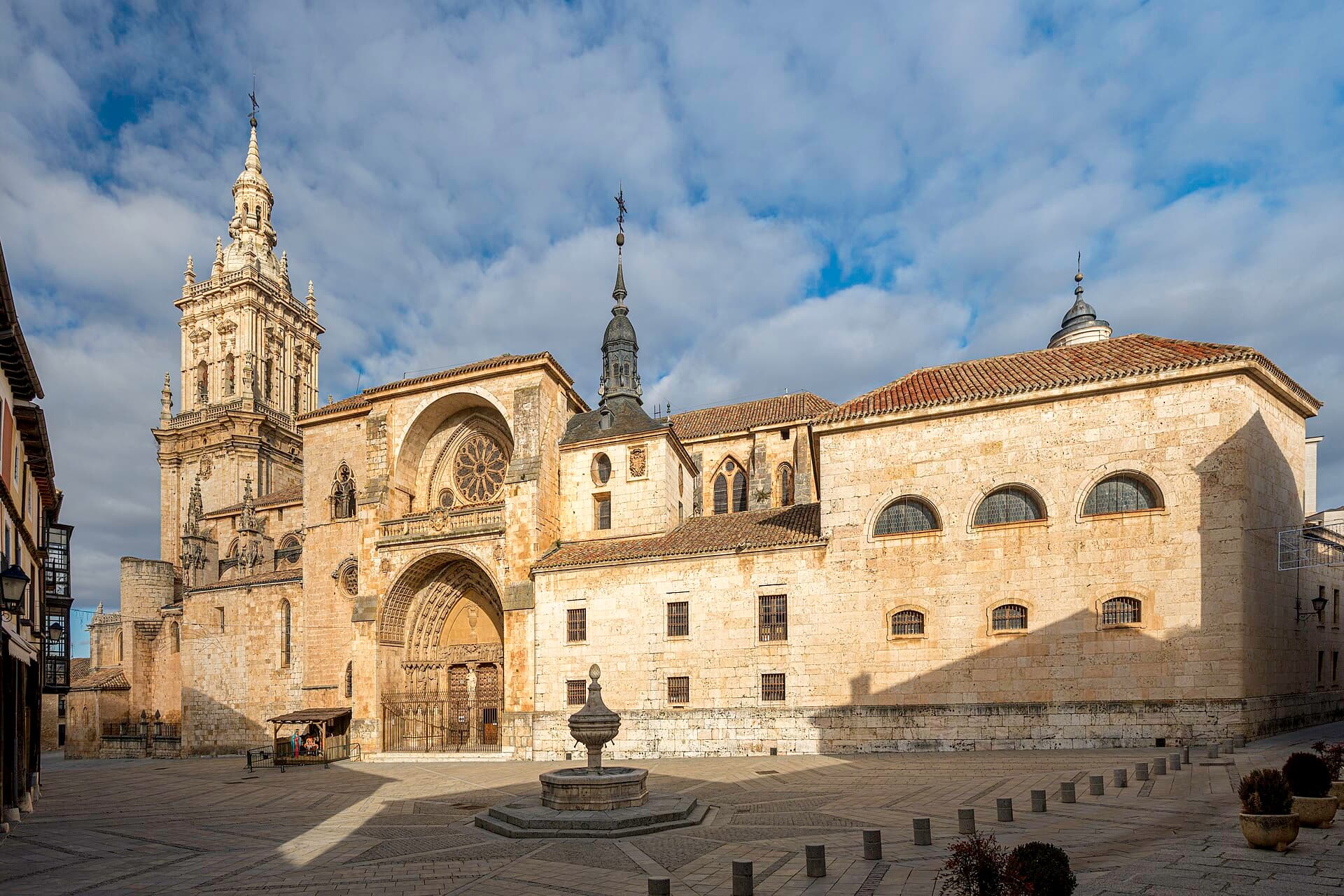 Fernando / CC BY-SA 4.0, via Wikimedia Commons
“Where ancient stones whisper stories in the heart of Soria.”
Not the postcards. The stories even locals don't know — whispered in your ear, right where they happened.
Among the cathedral's enduring treasures resides an ancient silk shroud, its origins rumored to lie in a distant land.
The grand Plaza Mayor, with its arcaded buildings, holds a secret history of public spectacles that went beyond mere markets.
The enduring ruins of Osma Castle, upon its elevation, recount a tale of strategic defense that once involved a disguised monarch.
Discover every secret of Burgo de Osma
Every address, every reveal in full — in your ear, right where it happened.
You pick your stops. You walk. The voice reveals what the others miss.
No tours available yet. Check back soon — we're preparing them.
El Burgo de Osma, formally known as El Burgo de Osma-Ciudad de Osma, is a town in the province of Soria, Spain, celebrated for its beautifully preserved medieval architecture and profound cultural legacy. Situated beside the Ucero River, this ancient episcopal city invites visitors to wander its historic thoroughfares and monumental structures. The town's beginnings trace back to a Celtiberian settlement called Uxama, which later came under Roman dominion.
Today, with a population of approximately 5,250, El Burgo de Osma maintains a serene atmosphere while offering a window into authentic Castilian culture. Its designation as a historic and artistic site is earned, reflecting centuries of prosperity and a strong connection between civic life and the ecclesiastical presence. The town divides into two sections: Ciudad de Osma to the west of the Ucero River, centered around the castle, and the larger El Burgo de Osma to the east, which developed around the cathedral.
Visitors can meander through streets paved with stones, admire the traditional Castilian houses featuring stone-columned arcades, and uncover a wealth of historical locations. The surrounding landscape, with its ecological importance and natural parks like the Cañón del Río Lobos, provides opportunities for outdoor pursuits and further historical discovery.
The history of El Burgo de Osma extends back to the Celtiberian settlement of Uxama, an important enclave that eventually fell under Roman authority. Evidence of Roman infrastructure, such as an aqueduct that channeled water from the Ucero River, underscores the sophistication of this early community. During the Visigothic era in the 6th century AD, the town, then known as Oxoma, became an episcopal see, marking the commencement of its ecclesiastical significance.
Following the Muslim conquest in the 8th century, the area, referred to as Waxsima, saw the construction of an Arab watchtower on the Uxama hill. For centuries, Osma served as a strategic frontier, frequently changing hands between Muslim and Christian forces. A pivotal event was the Battle of Osma in 939, where Christian forces decisively defeated the Caliph Abd al-Rahman III. After the death of Almanzor in 1002, the region firmly came under Christian control, and the population gradually relocated from the castle hill to the flatter ground by the Ucero River.
The contemporary town of El Burgo de Osma began to take shape in 1101 when Bishop Pedro de Bourges, later canonized as San Pedro de Osma, selected a monastery near the Ucero River as his cathedral seat. This decision fostered the growth of a thriving burgh of merchants and craftsmen around the new Romanesque cathedral. The town's importance continued to expand, and in the Renaissance period, it even hosted a university, the University of Santa Catalina. Bishop Pedro de Montoya further fortified the town in the 15th century by constructing the city walls, some sections of which endure today.
The town's historic core was designated a Historic-Artistic Site in 1993, acknowledging its well-preserved medieval character. The Cathedral of the Assumption, a predominantly Gothic structure erected in 1232 on the site of the earlier Romanesque church, stands as a testament to the town's enduring religious and architectural legacy. The close bond between the town and its ecclesiastical presence meant that for several centuries, the Church effectively governed El Burgo de Osma, providing a period of stability.
El Burgo de Osma offers a coherent journey through its past, with key locations situated within easy reach. The Cathedral of the Assumption of Mary stands central, a Gothic edifice commenced in 1232 upon the foundations of a Romanesque church. Inside, observe the main altarpiece by Juan de Juni and the polychrome stone tomb of San Pedro de Osma. The cathedral also safeguards a significant collection of codices, including a Commentary on the Apocalypse by Beatus of Liébana from 1086.
Adjacent to the cathedral is the Episcopal Palace, displaying a late Gothic façade and a doorway from the era of Bishop Alonso Enríquez with Hispano-Flemish Gothic elements and an alfiz of Muslim influence. Wander along Calle Mayor, a primary thoroughfare lined with traditional Castilian houses supported by stone-columned arcades. This path leads to the Plaza Mayor, an 18th-century baroque square, home to the Town Hall and the Hospital of San Agustín, the latter featuring two spired towers.
Beyond the town's core, the Gate of San Miguel is the last remaining entrance of the 15th-century city walls, constructed by Bishop Pedro de Montoya. A walk along the Ucero River reveals the remnants of a Roman bridge and the Water Tower, part of the castle's outer defenses. Upon a rocky hill overlooking the town stand the ruins of Osma Castle, dating back to the 8th century, offering expansive views of the surrounding landscape.
The most agreeable times to experience El Burgo de Osma are spring and early autumn (May, June, September, and October), when temperatures are mild, ranging from 19°C to 26°C (66°F to 79°F), making walking and outdoor exploration comfortable. While some rainfall occurs during these months, it is generally moderate. Summer, from mid-June to mid-September, brings warmer temperatures, often reaching around 31°C (88°F) in July, alongside lively local festivals. Winter provides a quieter experience with fewer visitors, though temperatures can descend to around 0°C (32°F) at night in January.
El Burgo de Osma is located in the province of Soria, Castile and León, Spain. The town has a population of approximately 5,250. The official language is Spanish. For visitor information, the local tourist office is situated in the Plaza Mayor, within the former Hospital of San Agustín. The office is typically open from Wednesday to Sunday, 10:00 AM to 2:00 PM and 4:00 PM to 8:00 PM, and closed on Mondays and Tuesdays. The town is easy to navigate on foot, especially its historic center, making it suitable for families. While many attractions are within walking distance, a car can be advantageous for visiting the castle ruins on the elevation or exploring the surrounding natural areas like the Cañón del Río Lobos. Local cuisine specializes in Castilian food, with stews, roasts, and pork dishes being prominent, particularly during the 'slaughter days feasts' from January to April.