Rue de Siam
This main artery of Brest carries a name that hints at an unexpected, distant connection.
Full story unlocks in the tour
 Thesupermat / CC BY-SA 3.0, via Wikimedia Commons
“Brest: Where the rugged Breton spirit meets the vast Atlantic.”
Not the postcards. The stories even locals don't know — whispered in your ear, right where they happened.
This main artery of Brest carries a name that hints at an unexpected, distant connection.
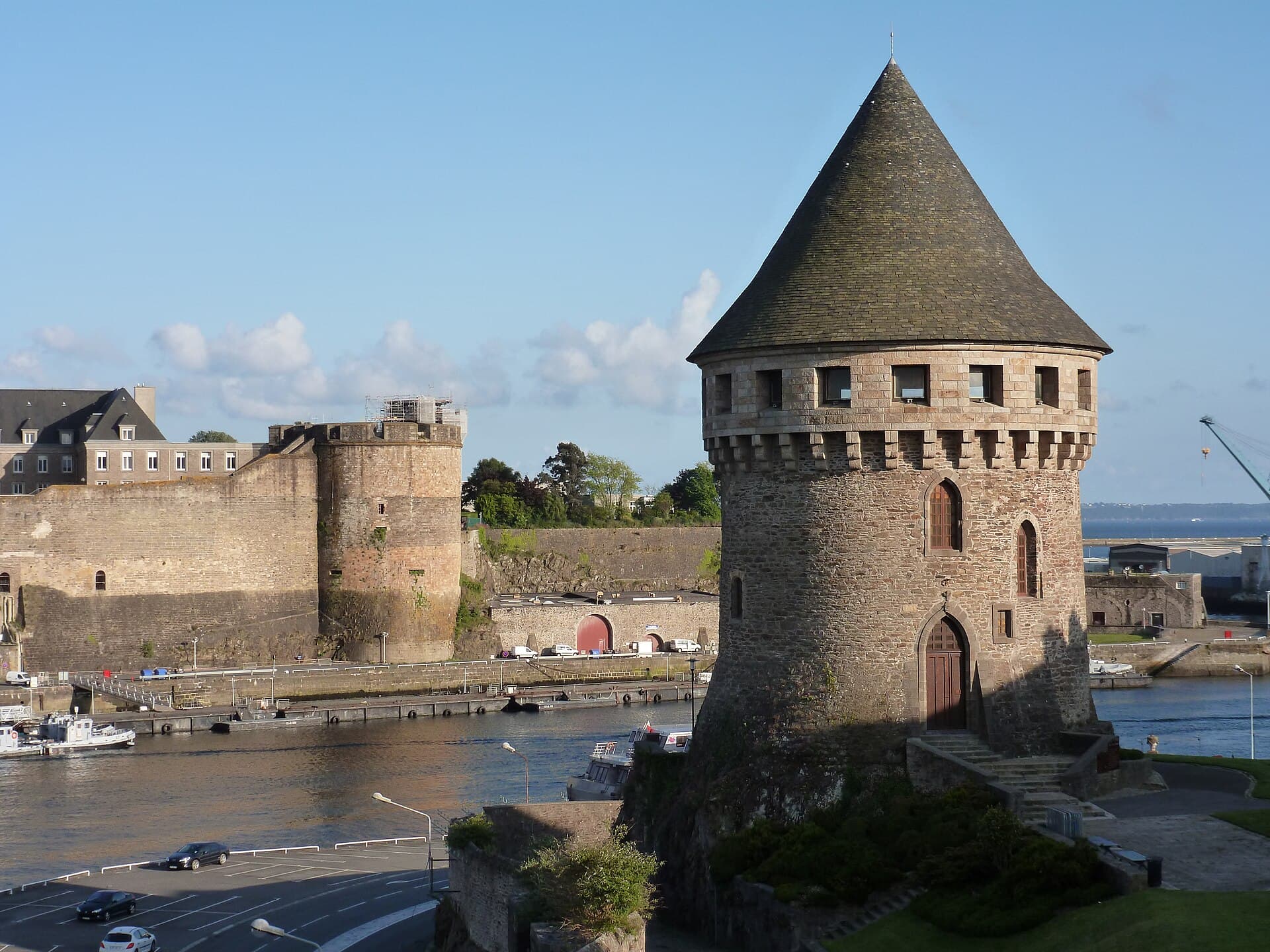
This medieval tower, one of the few structures to survive the devastation of WWII, holds a unique window into a lost city.
Connecting two sides of the city, this isn't just a mode of transport, but a significant first for France.
Discover every secret of Brest
Every address, every reveal in full — in your ear, right where it happened.
You pick your stops. You walk. The voice reveals what the others miss.
No tours available yet. Check back soon — we're preparing them.
Brest, a city deeply intertwined with the sea, stands on the western edge of continental France in Brittany. It's a place of enduring strength, having been almost entirely rebuilt after the extensive damage of World War II. Today, Brest is a thriving port city, a major naval base, and a significant center for ocean research and higher education.
While much of its historic architecture was lost, Brest has embraced a modern identity, characterized by innovative urban planning and a flourishing cultural scene. From its formidable castle, guarding the harbor for over 1700 years, to its cutting-edge ocean discovery center, Océanopolis, Brest offers a unique blend of maritime heritage and contemporary life.
The history of Brest stretches back to the Gallo-Roman era, when it was known as Gesocribate. Around the end of the 3rd century AD, the Romans established a fortified camp here, recognizing its strategic importance for protecting the Armorican coast from Saxon pirates. The powerful walls of this Roman fortification became the foundation for the Château de Brest. In the 4th century AD, it was known as Osismis, a name linked to the ancient Osismii tribe.
Brest's significance as a seaport was truly cemented in the 17th century. In 1631, Cardinal Richelieu ordered the construction of a harbor with wooden wharves, which quickly became a base for the French Navy. Jean-Baptiste Colbert, finance minister under Louis XIV, further developed the wharves in masonry, and fortifications by Vauban were added between 1680 and 1688. The Académie de Marine (Naval Academy) was founded in Brest in 1752, solidifying its status as a center for maritime education.
During World War I, Brest served as a crucial disembarking port for many American troops. The city's strategic importance continued into World War II, when the Germans established a large U-boat submarine base in its harbor. This made Brest a target for Allied bombing raids, which almost completely destroyed the city center during the Battle for Brest in 1944. Only a few buildings, such as the Château de Brest and the Tour Tanguy, remained standing.
After the war, Brest underwent extensive reconstruction, with the city center rebuilt using granite and concrete in the 1950s. The post-war effort gave rise to a modern city with innovative urban planning. Today, Brest is a major university town, with the University of Western Brittany and several prestigious French elite schools, and a hub for oceanography and marine biology research. Every four years, Brest hosts a renowned international festival of the sea, boats, and sailors, a testament to its enduring connection to the ocean.
Begin your exploration at the Château de Brest, a medieval fortress that has guarded the harbor for over 1700 years. It now houses the Musée National de la Marine, offering insights into France's naval history with ship models, paintings, and sculptures. Across the Penfeld River, the 14th-century Tour Tanguy stands as another of the few surviving pre-WWII structures, containing dioramas that illustrate old Brest.
For a unique perspective, ride the Brest Cable Car, France's first urban cable car, connecting the two banks of the Penfeld and offering aerial views of the naval base. The Ateliers des Capucins, a former naval workshop, is now a vast cultural and social hub with exhibitions, a media library, and cafes. Dive into marine life at Océanopolis, a world-class ocean discovery center with three pavilions (tropical, temperate, and polar) showcasing over 1,000 marine species.
Take a stroll along the Cours Dajot, a promenade offering expansive views of Brest harbor. Seek out the Conservatoire botanique national de Brest, a botanical garden specializing in endangered plant species from around the world. For a glimpse of historic Brest, walk down Rue Saint-Malo in the Recouvrance district, one of the few streets to have survived the wartime bombings.
The most pleasant time to visit Brest is from mid-May to mid-September, when the weather is mildest and sunniest. Summers are comfortable, with average daily high temperatures above 18°C (65°F) from late June to early September. While rainfall occurs year-round, July typically sees the least amount of rain. Even in summer, evenings can be cool, so a light sweater is advisable. The city experiences an oceanic climate, characterized by mild winters and cool summers.
Brest is generally a safe city for visitors, with a relatively low crime rate. However, as in any port city, it's wise to be aware of your surroundings, especially at night and in less busy areas like parts of the commercial port or shipyard. The local currency is the Euro (€), and credit and debit cards are widely accepted. While many tourism workers and younger people speak English, French is the official language, so a few basic phrases can be helpful.
Brest Bretagne Airport (BES) is located about 10 kilometers northeast of the city center. A shuttle bus connects the airport to the Porte de Guipavas tram stop, from which you can reach the city center by tram in about 30-40 minutes. Taxis are also available from the airport. Within the city, public transportation, including buses and trams, is reliable.