Brescia Castle
This medieval fortress holds more than just ancient defenses.
Full story unlocks in the tour
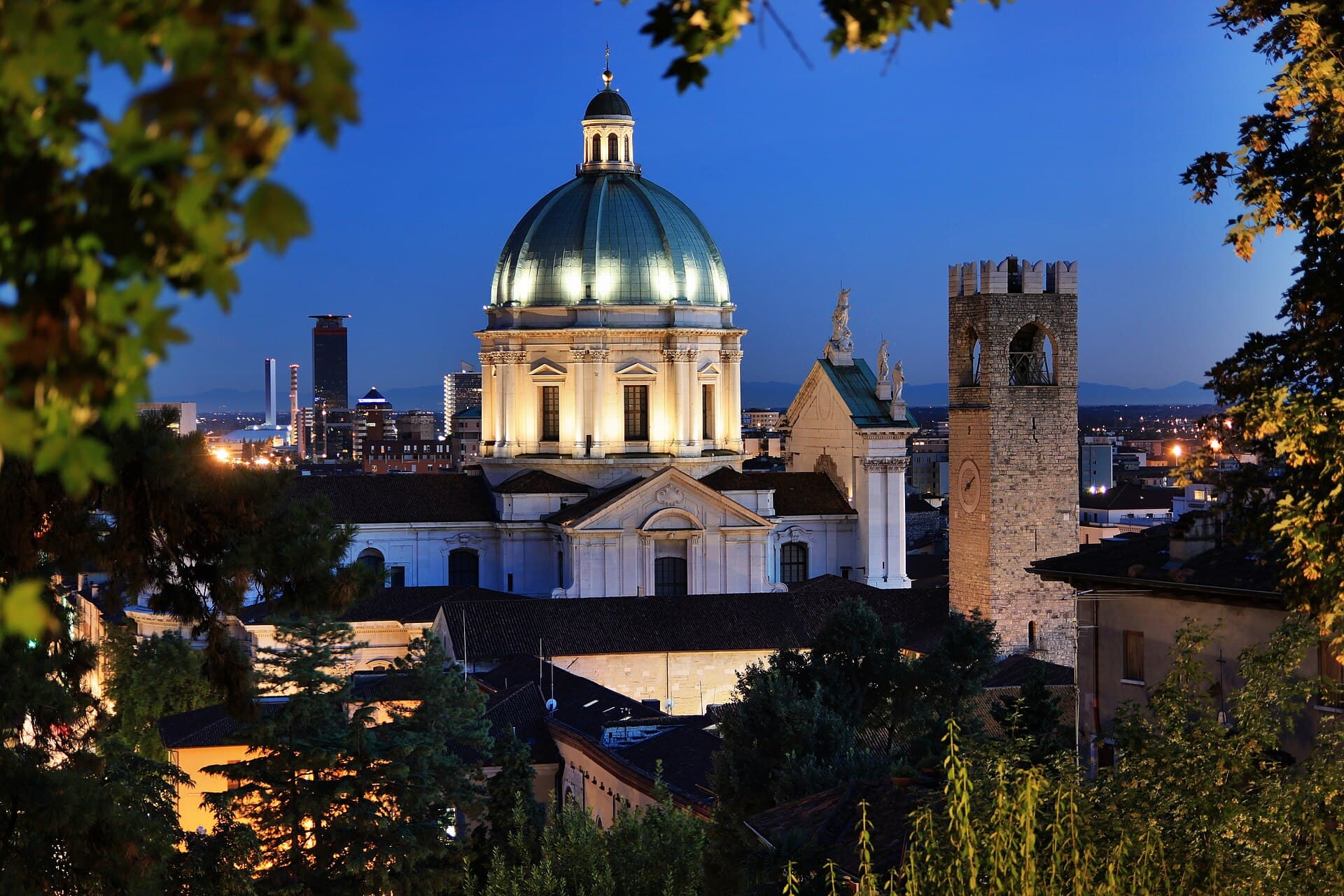 Pedritosway / CC BY 3.0, via Wikimedia Commons
“Brescia: Where Roman Grandeur Meets Lombard Allure.”
Not the postcards. The stories even locals don't know — whispered in your ear, right where they happened.
This medieval fortress holds more than just ancient defenses.
This rationalist square harbors a temporary, yet striking, resident.
Beneath the monastic complex, a glimpse into Roman daily life awaits.
Discover every secret of Brescia
Every address, every reveal in full — in your ear, right where it happened.
You pick your stops. You walk. The voice reveals what the others miss.
No tours available yet. Check back soon — we're preparing them.
Brescia, a city often overshadowed by its more celebrated Lombard neighbors like Milan and Verona, reveals itself as a compelling destination for those seeking a deeper immersion into Italian history and culture. Situated at the foot of the Alps and a short distance from both Lake Garda and Lake Iseo, Brescia offers a singular blend of ancient Roman ruins, medieval architecture, and Renaissance artistry. Designated the Italian Capital of Culture in 2023 alongside Bergamo, the city has been steadily gaining recognition for its well-preserved historical sites, authentic local atmosphere, and thriving cultural scene.
Known as Brixia in antiquity, Brescia has been an important regional center for over 3,200 years, with its origins tracing back to a Celtic stronghold. Today, its historic core is a UNESCO World Heritage site, displaying some of the best-preserved Roman public buildings in northern Italy. Beyond its archaeological treasures, Brescia is also celebrated for its contribution to the world of motor racing as the birthplace of the iconic Mille Miglia, a classic car rally that continues to captivate enthusiasts.
## From Celtic Roots to Roman Grandeur Brescia's story begins around 1200 BC with a settlement on Cidneo Hill, likely by the Liguri tribe. By the 4th century BC, the Celtic Cenomani tribe had established themselves at the foot of the hill, making Brixia their capital. The city gradually became Romanized, becoming an ally of Rome in 194 BC and later a Roman colony in 89 BC. Under Emperor Augustus in 27 BC, it was granted the title Colonia Civica Augusta, solidifying its importance as a trading and manufacturing hub in northern Italy.
## Medieval Transitions and Venetian Influence The early Middle Ages brought a period of upheaval, with Brescia enduring invasions by Attila the Hun in 452, and later by the Goths and Byzantines. In 568 AD, the Lombards took control, establishing Brescia as the capital of one of their duchies. The city's Lombard heritage is significantly preserved in the monastic complex of San Salvatore-Santa Giulia, a UNESCO World Heritage site. By the 11th century, Brescia emerged as an independent commune, actively participating in the Lombard League against Frederick Barbarossa. The 14th and 15th centuries saw Brescia contested by various Italian lordships, including the Scaliger and Visconti families, before it ultimately came under Venetian rule in 1426, a dominion that largely lasted for four centuries.
## The Lioness of Italy and Modern Development The early 16th century marked a period of prosperity, though Brescia suffered a devastating sack by the French in 1512, from which it never fully recovered. After Napoleonic rule, it passed to Austrian control in 1814. Brescia earned the nickname "Lioness of Italy" for its fierce rebellion against the Austrians during the "Ten Days" of 1849, eventually becoming part of the Kingdom of Italy in 1859. The 20th century saw Brescia develop into an important industrial city, notably in metallurgy and automotive engineering. The city also pioneered district heating in Italy in 1972. Its enduring spirit and deep layers of history continue to make Brescia a captivating city to explore.
Begin your exploration at the Brixia Archaeological Park, a UNESCO World Heritage site that features some of the best-preserved Roman ruins in northern Italy. Here, you'll find the majestic Capitolium (Capitoline Temple), built by Emperor Vespasian in 73 AD, and the remains of a Roman theater that once accommodated 15,000 spectators. Adjacent to the Roman Forum, this area offers a direct link to the ancient city of Brixia.
Next, immerse yourself in the Santa Giulia Museum, housed within a former Lombard Benedictine monastery. This expansive museum complex, also a UNESCO site, chronicles Brescia's history from pre-history to the 18th century, showcasing Roman mosaics, medieval jewels, and 18th-century paintings. Highlights include the Basilica of San Salvatore and the Chorale of the Nuns.
Ascend to Brescia Castle, a medieval fortress atop Cidneo Hill, offering sweeping views of the city. The castle grounds house two museums: the Museo delle Armi Antiche (Museum of Ancient Arms) and the Museo Civico del Risorgimento.
Explore Brescia's lively squares: Piazza della Loggia, with its Venetian-influenced architecture and 16th-century clock tower; Piazza Paolo VI, home to both the Old and New Cathedrals; and Piazza della Vittoria, a rationalist square from the 1930s.
Car enthusiasts should visit the Museo Mille Miglia, which tells the story of the legendary classic car race that originated in Brescia.
The most favorable times to visit Brescia are during the spring (April to June) and early autumn (September to October). During these months, the weather is mild and pleasant, with temperatures typically ranging from 60-75°F (15-24°C), ideal for exploring the city's outdoor attractions and nearby lakes. Spring offers blooming landscapes and fewer tourists, while autumn brings harvest festivals and vivid fall colors. Summers can be warm to hot, though acceptable in June, and may experience afternoon thunderstorms. Winter offers lower rates but can be cold and foggy.
Brescia is easily accessible by train, with frequent connections from Milan (around 30-45 minutes), Verona (about an hour), and Venice (under two hours). For those flying, Brescia is conveniently located near four airports, including Bergamo Orio al Serio, which offers a bus service to the city. Once in Brescia, the historic center is highly walkable, allowing easy access to most major sights. The city also has a metro line and public transportation, including buses and taxis, for getting around and reaching areas further afield. If driving, be aware that many streets in the center are pedestrian-only, and parking can be challenging; consider leaving your car in designated parking areas, such as the free lot near the castle. Planning a stay of two to three days is recommended to experience Brescia's core attractions, with an extended stay of four to five days allowing for day trips to Lake Garda or the Franciacorta wine region.