Bremen Town Hall Cellar
Beneath Bremen's grand Town Hall lies a centuries-old secret, a liquid treasure that has outlasted empires.
Full story unlocks in the tour
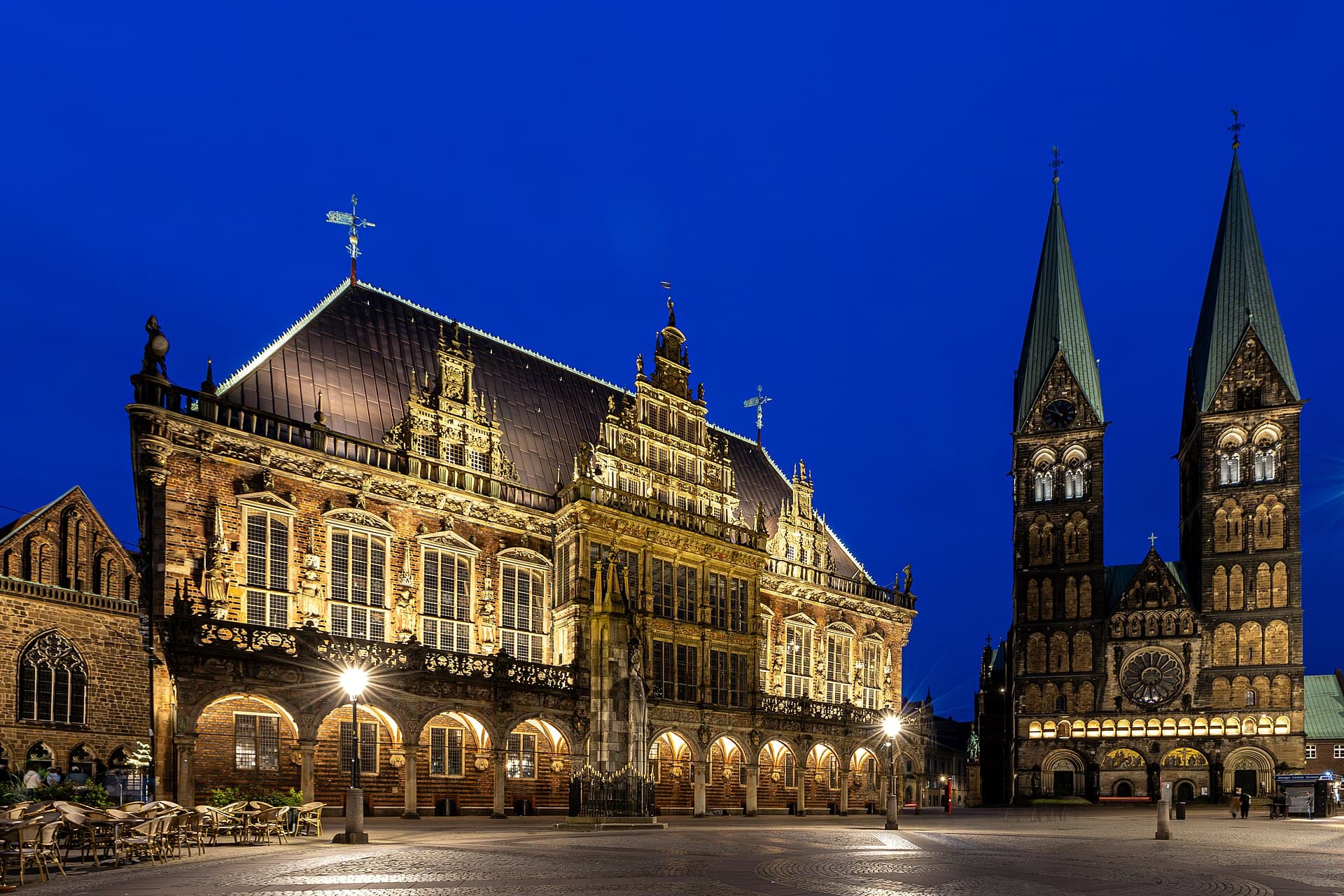 Matthias Süßen / CC BY-SA 4.0, via Wikimedia Commons
“Where ancient trade routes meet the whimsical spirit of a beloved fairy tale.”
Not the postcards. The stories even locals don't know — whispered in your ear, right where they happened.
Beneath Bremen's grand Town Hall lies a centuries-old secret, a liquid treasure that has outlasted empires.
The formidable Roland statue, a symbol of Bremen's freedoms, incorporates a surprising practical function within its very form.
This distinctive brick street, a fusion of art and commerce, once drew sharp criticism from an unexpected source.
Discover every secret of Brême
Every address, every reveal in full — in your ear, right where it happened.
You pick your stops. You walk. The voice reveals what the others miss.
No tours available yet. Check back soon — we're preparing them.
Bremen, a city where the echoes of ancient trade routes mingle with the whimsical spirit of a beloved fairy tale, offers a distinctive German experience. As one of Germany's oldest cities, with over 1,200 years of recorded time, it maintains a comfortable, intimate atmosphere despite its significant cultural and economic standing. Situated on the Weser River, approximately 60 kilometers upstream from its mouth at Bremerhaven, Bremen is the capital of the Free Hanseatic City of Bremen, a two-city state.
The city's compact historic core invites exploration on foot, revealing impressive architecture, playful public art, and lively riverside promenades. From its UNESCO-listed Market Square to the enchanting Schnoor Quarter, Bremen seamlessly blends its enduring past with a lively present. It's a place where you can trace the footsteps of medieval merchants, encounter characters from the Brothers Grimm, and discover a city that has consistently championed its independence and unique identity.
Bremen's origins trace back to an early medieval settlement, becoming the seat of a bishopric in 787 AD under Charlemagne. By the High Middle Ages, it had blossomed into a thriving trading hub, joining the influential Hanseatic League in the 13th century. This powerful confederation of merchant guilds sought to monopolize North Sea and Baltic Sea trade, and Bremen's merchants were at its core. The city's strategic location on the Weser River, one of Germany's main waterways flowing into the North Sea, was crucial to its commercial success.
Throughout much of its history, Bremen maintained a fierce independence within the Holy Roman Empire, a status it proudly symbolized with the erection of the Roland statue in 1404. This period saw the construction of iconic landmarks like the Bremen City Hall, built between 1405 and 1410. However, the city's autonomy was not without its challenges, as it contended with the territorial claims of the Prince-Archbishop and later with the Swedes after the Thirty Years' War.
In the late 19th century, Bremen was integrated into the German Empire by Prussia. Despite this, it continued to flourish as a vital port city. Thanks to new sea wharves and anchorages at Bremerhaven, Bremen became Germany's primary port for emigration to the Americas and a key center for colonial trade. The Norddeutscher Lloyd (NDL) shipping company, founded in Bremen in 1857, grew into one of the world's leading maritime enterprises.
The 20th century brought significant upheaval. Bremen, a city with strong liberal and social-democratic leanings, lost its autonomy under the Nazi regime. World War II inflicted severe damage, destroying almost two-thirds of the city's infrastructure. However, its autonomy was restored after the war, and Bremen became one of the founding states of the Federal Republic of Germany. The post-war economic boom, known as the Wirtschaftswunder, drew workers from across Europe, contributing to Bremen's diverse modern population. Today, Bremen stands as a major cultural and economic hub in Northern Germany, a testament to its enduring resilience and layered heritage.
Bremen's compact historic center offers a wealth of sights, many within easy walking distance. Begin at the Marktplatz, the city's central square and a UNESCO World Heritage site. Here, you'll find the impressive Bremen City Hall, a masterpiece of Weser Renaissance architecture, and the formidable Roland Statue, a symbol of civic liberty since 1404.
Adjacent to the City Hall stands the bronze statue of the Bremen Town Musicians, depicting the donkey, dog, cat, and rooster from the Brothers Grimm fairy tale. Rubbing the donkey's legs with both hands is said to bring good luck. Explore the enchanting Schnoor Quarter (Schnoorviertel), the city's oldest neighborhood, with its narrow, winding alleys and houses dating back to the 15th and 16th centuries. This area is filled with small shops, artisan studios, cafes, and restaurants.
Connecting the Marktplatz to the Weser River is Böttcherstraße, a unique 108-meter-long street known for its Expressionist brick architecture. Don't miss the Haus des Glockenspiels, where 30 Meissen porcelain bells chime hourly, accompanied by rotating carved wooden panels depicting ocean conquerors. For a stroll along the water, head to the Schlachte, the Weser River promenade, offering views and a lively atmosphere with beer gardens and cafes. The St. Peter's Cathedral (St. Petri Dom) is also a prominent landmark, built on the city's highest point.
Bremen experiences an oceanic climate, with average temperatures ranging from 2°C in winter to 18°C in summer. The peak tourist season is July and August, offering the warmest weather (20–25°C) and extended daylight, ideal for outdoor activities and festivals. However, this period also sees larger crowds and higher prices.
For a more relaxed visit with pleasant weather and fewer crowds, consider May, June, September, and October. Spring (March to May) brings blooming parks like the Rhododendron Park, with temperatures rising to a comfortable 10–20°C. Autumn (September to November) offers mild temperatures (12–20°C) and scenic fall foliage, perfect for leisurely walks. While winter (November to March) is colder with more rain, it's a popular time for the festive Christmas market along the Schlachte Embankment. Pack an umbrella, as rainfall is distributed throughout the year.
Bremen Airport (Flughafen Bremen) is a regional airport with connections to several European cities. From the airport, you can reach the city center in about 15-20 minutes via tram line 6 or bus line 52. Taxis are also available. Bremen Hauptbahnhof (main railway station) is centrally located just north of the Old Town and offers excellent connections. The city's main attractions are largely walkable, especially within the compact Old Town, Schnoor Quarter, and along the Schlachte. Public trams and buses provide a well-developed network for longer journeys.
The local currency is the Euro (€), and plug types are C and F, with electricity at 220-240 V. German is the primary language, though English is widely spoken in tourist areas. For a basic town map and information, visit the tourist information office at the main train station. Tap water in Bremen is safe to drink, so consider bringing a refillable bottle.