Bourges Cathedral
Inside the soaring Gothic cathedral, among the biblical narratives in stained glass, one small detail might make you look twice.
Full story unlocks in the tour
 KoS / Public domain, via Wikimedia Commons
“Where medieval grandeur meets secret gardens and unexpected history.”
Not the postcards. The stories even locals don't know — whispered in your ear, right where they happened.
Inside the soaring Gothic cathedral, among the biblical narratives in stained glass, one small detail might make you look twice.
The opulent palace of a 15th-century financier, built to impress, holds a secret about its owner's fate.
These tranquil marshlands, now a patchwork of gardens, once played a surprising role in the city's defense.
Discover every secret of Bourges
Every address, every reveal in full — in your ear, right where it happened.
You pick your stops. You walk. The voice reveals what the others miss.
No tours available yet. Check back soon — we're preparing them.
Bourges, a 'City of Art and History' in the heart of France, offers a journey through time, from its Gallo-Roman origins to its medieval prominence. This compact city, the capital of the Cher department, is defined by its architectural treasures and a peaceful rhythm. It's a place where cobbled lanes lead to grand Gothic structures, and lush marshlands provide a serene escape just steps from the historic center.
The city's most iconic landmark, the UNESCO-listed Saint-Étienne Cathedral, anchors a charming old town filled with over 400 half-timbered houses. Beyond the cathedral, Bourges reveals layers of history, from the grand Palais Jacques Coeur, a testament to 15th-century prosperity, to the unique marshlands that hint at its ancient defenses.
Bourges invites exploration on foot, with pedestrianized streets that weave through picturesque squares and past historic mansions. It's an excellent base for discovering the surrounding Berry province, known for its vineyards and châteaux.
## From Celtic Settlement to Royal City Bourges possesses a long and dramatic history, first inhabited by Celtic tribes around 1000 BC. The area, defined by the confluence of the Yèvre and Auron rivers, shows archaeological evidence of early Iron Age settlements and commercial links with Mediterranean regions.
In 52 BC, Julius Caesar laid siege to the town, then known as Avaricum. The marshy lands surrounding the city initially slowed his progress. After a prolonged siege, Caesar conquered Avaricum, reportedly killing 40,000 townspeople. However, impressed by its wealth and beauty, the Romans chose to preserve the city rather than destroy it, transforming it into a favored stronghold with a defensive wall and 50 round towers. Vestiges of these Gallo-Roman remains, including impressive towers and walls, can still be seen today.
During the Carolingian period, early attempts were made to domesticate the marshlands, and suburban villages began to develop around religious establishments. In 1100, Bourges became part of the French royal domain when its last Viscount, Eudes Arpin, sold his possessions to King Philip I.
## Medieval Grandeur and the Hundred Years' War Bourges rose to significant prominence in the Middle Ages. In 1137, Louis VII was crowned in the Romanesque Cathedral of Bourges. The city became a royal city, and its importance grew further during the Hundred Years' War. From 1370, under Jean, Duke of Berry, Bourges flourished as a major artistic and cultural center, even serving as the capital of a France devastated by the war. The Duke of Berry, a wealthy patron of the arts, commissioned lavish works, including the famous illuminated manuscript, Les Très Riches Heures du Duc de Berry.
The construction of the current Saint-Étienne Cathedral began in 1195, replacing an earlier Romanesque church. This Gothic masterpiece, unique for its lack of a transept, was largely completed by 1230. The 15th century saw Bourges become a bustling commercial center, largely due to figures like Jacques Coeur. Coeur, born around 1400, rapidly ascended to become King Charles VII's finance minister and a nobleman, constructing the magnificent Palais Jacques Coeur between 1443 and 1451. This palace, a precursor to Renaissance mansions, showcases a blend of flamboyant Gothic and early Renaissance architectural styles.
## Modern Bourges Bourges continued to evolve, with the marshlands being drained and cultivated for market gardening from the 17th century. Today, Bourges is recognized as a 'City of Art and History,' celebrated for its preserved medieval center, cultural events like the Printemps de Bourges music festival, and its commitment to green spaces.
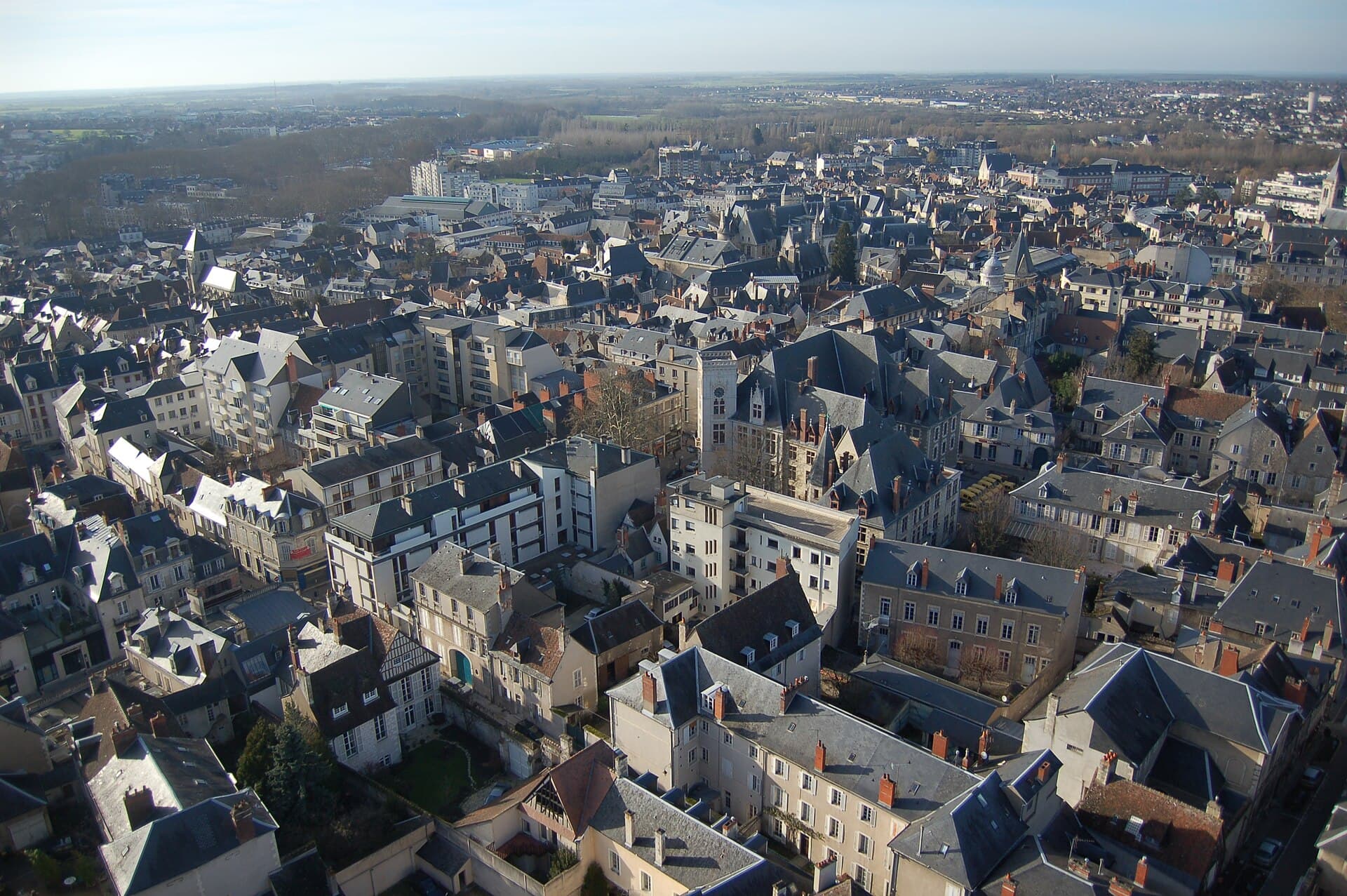
The undisputed highlight of Bourges is the Cathédrale Saint-Étienne, a UNESCO World Heritage site and a masterpiece of Gothic architecture. Its distinctive design lacks a transept, creating a unified interior space, and features remarkable 13th-century stained glass windows that depict biblical stories in evocative detail. Do not miss the astronomical clock from 1424 and the Romanesque crypt, which houses the tomb of Jean, Duke of Berry. Climb the 396 steps of the North Tower (known as the Butter Tower) for expansive city views.
Just a short walk from the cathedral is the Palais Jacques Coeur, a grand 15th-century mansion built by the wealthy merchant Jacques Coeur. This civil Gothic residence showcases intricate carvings and innovative design for its time.
Stroll through the Old Town, a maze of cobbled streets lined with over 400 well-preserved half-timbered houses from the 15th and 16th centuries. Explore picturesque streets like Rue Bourbonnoux and Rue Coursalon.
For a natural escape, visit Les Marais de Bourges, expansive marshlands transformed into idyllic fruit and vegetable gardens, crisscrossed by canals and footpaths. This peaceful area offers a surprising nature walk minutes from the city center.
The Jardin de l'Archêveché, designed by André Le Nôtre, offers formal lawns and flowerbeds directly outside the Cathedral.
Bourges experiences a temperate, mild climate with four distinct seasons. Summers are warm and partly cloudy, with average daytime temperatures around 24–26°C (75–79°F), making July and August ideal for walking and sightseeing. The chance of rain is lowest in July and August. The 'warm season' typically lasts from mid-June to mid-September. Winters are cold and often cloudy, with average lows around 1-5°C (34-41°F), though severe frosts are rare. Spring and autumn bring changeable weather with more frequent precipitation.
For warm-weather activities and the best chance of clear skies, plan your visit between mid-June and mid-September. Consider visiting between May and September to experience Les Nuits Lumière, a free evening festival where city buildings are illuminated.
Bourges is easily accessible by train, with regular services connecting from Paris (Gare d'Austerlitz, Gare de Bercy, Gare de Montparnasse), Orléans, and other major cities. The journey from Paris takes approximately two hours. While there are no major international airports directly in Bourges, travelers can fly into Paris Orly (ORY), Tours Val de Loire (TUF), or Clermont-Ferrand Auvergne (CFE) airports, with onward connections by car or bus.
Once in Bourges, the compact city center is highly walkable, with many attractions easily reached on foot. The city also has a public bus system, AggloBus, serving various parts of Bourges with 18 bus lines. Taxis and ride-sharing services like Uber are also available. If you plan to explore the surrounding Berry region or Loire Valley châteaux, renting a car offers flexibility. Comfortable walking shoes are recommended for navigating the cobbled streets.