The Sink
Before directing iconic films, a future Hollywood luminary honed his craft in an unexpected role at a Boulder establishment.
Full story unlocks in the tour
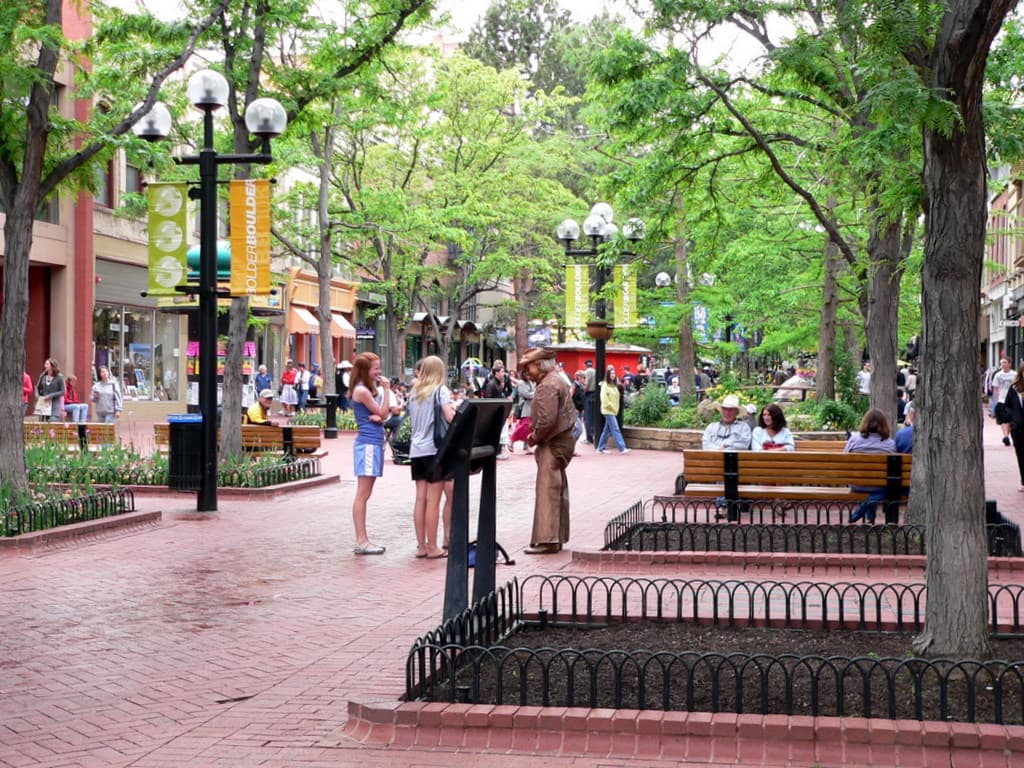 Lee Coursey / CC BY 2.0, via Wikimedia Commons
“Where mountain peaks meet ingenuity, and exploration defines daily life.”
Not the postcards. The stories even locals don't know — whispered in your ear, right where they happened.
Before directing iconic films, a future Hollywood luminary honed his craft in an unexpected role at a Boulder establishment.
A university dining hall in Boulder serves a menu bearing a rather… disquieting name, an homage to a grim chapter in Colorado's past.
Boulder possesses its own version of a famed red rock expanse, offering expansive views without the clamor of concertgoers.
Discover every secret of Boulder
Every address, every reveal in full — in your ear, right where it happened.
You pick your stops. You walk. The voice reveals what the others miss.
No tours available yet. Check back soon — we're preparing them.
Boulder, Colorado, is a city at the foot of the Rocky Mountains, recognized for its fusion of outdoor pursuits, inventive spirit, and a lively cultural landscape. Elevated at 5,430 feet, it provides immediate access to the Front Range, creating a dramatic backdrop for everyday existence. The city frequently appears on lists of desirable places to reside, owing to its relaxed atmosphere, natural splendor, and abundant recreational avenues.
Boulder serves as a center for education and inquiry, housing the University of Colorado Boulder, the flagship and largest campus of the University of Colorado system, alongside numerous research institutions. The city has also cultivated a reputation for its progressive initiatives, including being the first city in the U.S. to impose a tax on itself for funds solely dedicated to acquiring and safeguarding open space. This dedication to its environment, coupled with a thriving technology sector and a bustling downtown, forges a distinctive and inviting destination.
## From Ancient Lands to Gold Rush Town Boulder Valley has been continuously inhabited by Native American tribes for over 13,000 years, with archaeological evidence extending back to the late Pleistocene era. Indigenous peoples, including the Ute and later the Arapaho, moved seasonally between the mountains and plains, seeking winter refuge in the Front Range trough where Boulder now stands.
European American settlement commenced in late 1858 when prospectors arrived at Boulder Canyon during the Colorado Gold Rush. They initially made camp in an area historically connected with Arapaho leader Chief Niwot, despite earlier treaty obligations displacing the Arapaho. The Treaty of Fort Wise in 1861 formally compelled the Arapaho to relocate. Gold discoveries along Boulder Creek in early 1859 attracted more miners and merchants, leading to the formation of the Boulder City Town Company in February 1859 to establish a settlement at the canyon's mouth.
Boulder was incorporated on November 4, 1871, with a population just over 340 residents. The city's founders, recognizing the importance of education, successfully advocated for the University of Colorado to be situated in Boulder, with the first cornerstone laid in 1875 and the university officially opening in 1877. By 1900, Boulder's population exceeded 6,000, and the town began to evolve from a mining supply center into a more refined university community.
In the early 20th century, Boulder solidified its identity as a forward-thinking community. In 1907, an anti-saloon ordinance was adopted. A significant commitment to environmental preservation emerged in 1959 with the 'Blue Line' initiative, a ballot measure that prohibited city water services above 5,750 feet, effectively discouraging mountain housing developments and preserving scenic views. This foresight in land preservation, alongside the growth of the University and a burgeoning tourism industry, shaped Boulder into the distinctive city it is today.
Begin your exploration at the Pearl Street Mall, a four-block pedestrian area lined with shops, eateries, art galleries, and street performers. West of the downtown area, Chautauqua Park offers expansive views of the iconic Flatirons, with numerous walking paths for all skill levels. The Boulder Creek Path provides miles of paved routes through the heart of the city, ideal for walking, cycling, or even tubing in the warmer months.
For a measure of culture, visit the University of Colorado Boulder campus, known for its distinctive red sandstone buildings and the Fiske Planetarium. The Boulder Museum of Contemporary Art (BMoCA) presents diverse visual art exhibits. A singular cultural experience awaits at the Boulder Dushanbe Teahouse, an intricately designed structure gifted to Boulder by its sister city in Tajikistan.
Nature enthusiasts can venture to Eldorado Canyon State Park, a short drive from Boulder, offering impressive sandstone formations, rock climbing routes, walking paths, and picnicking opportunities. For sweeping views of the city and surrounding mountains, drive or walk up Flagstaff Mountain, with various vantage points like Panorama Point and Artist's Point.
Boulder enjoys over 300 days of sunshine annually and experiences four distinct seasons. The most favorable times to visit for pleasant weather and outdoor activities are late spring (May to June) and early fall (September to November). During these periods, temperatures are typically in the 60s and 70s Fahrenheit (16-23 Celsius), ideal for walking and exploring. Fall also brings brilliant foliage as aspen forests turn golden. Summer (June to August) is peak season, with warmer temperatures in the mid-80s to low 90s Fahrenheit (29-35 Celsius) and numerous festivals. While winters can be cold with snowfall, sunny days are common, and lodging prices are generally lower.
Boulder is situated at an elevation of 5,430 feet (1,655 meters). Acclimatization to the altitude is recommended upon arrival, especially for vigorous activities. The city is approximately 25 miles northwest of Denver, with Denver International Airport (DIA) located 33 miles east-southeast. Navigating Boulder is convenient, with over 300 miles of bike and multi-use paths and frequent public transit. The city also offers carshare options. Parking is available, but utilizing alternative transportation is encouraged.
Boulder is recognized for its health-conscious culture and a higher cost of living, though residents generally earn above the national average. The city is committed to increasing affordable housing options. Visitors will find a range of accommodations, from full-service hotels to historic suites.