Biella's Baptistery of San Giovanni Battista
This Romanesque marvel, a symbol of Biella, holds a secret within its ancient walls that hints at a much older, perhaps even pagan, past.
Full story unlocks in the tour
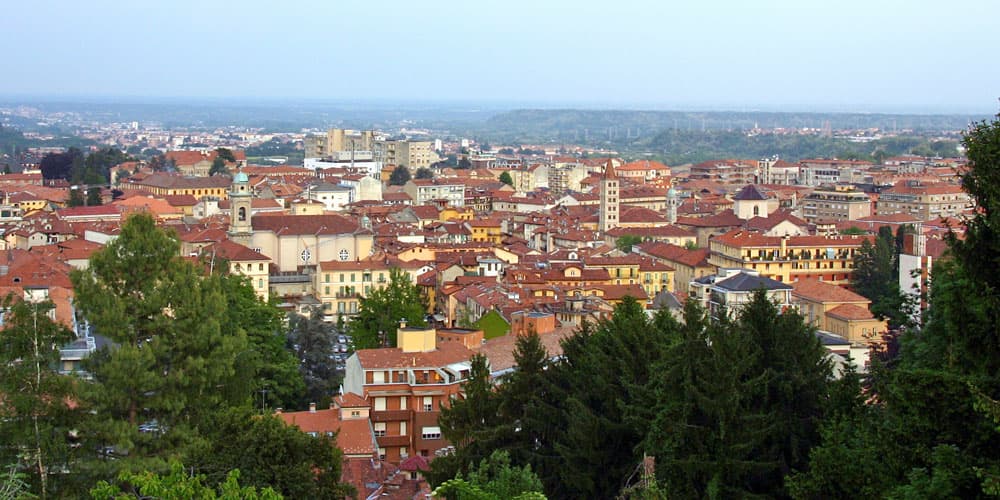 Alessandro Vecchi / CC BY-SA 3.0, via Wikimedia Commons
“Where alpine streams meet ancient looms, weaving a quiet elegance.”
Not the postcards. The stories even locals don't know — whispered in your ear, right where they happened.
This Romanesque marvel, a symbol of Biella, holds a secret within its ancient walls that hints at a much older, perhaps even pagan, past.
Beyond its grand facade, a fresco within the Cathedral offers a unique, almost forgotten, moral lesson from the 15th century.
The charming funicular connecting Biella Piano to the medieval Piazzo offers more than just scenic views; its history is a testament to persistent innovation and a touch of local determination.
Discover every secret of Biella
Every address, every reveal in full — in your ear, right where it happened.
You pick your stops. You walk. The voice reveals what the others miss.
No tours available yet. Check back soon — we're preparing them.
Biella, a city in Italy's Piedmont region, rests at the foot of the Alps, where the Cervo River flows. It's a place where industrial heritage, particularly in textiles, intertwines with a serene natural environment. The city is broadly divided into two main areas: Biella Piano, the lower, more modern part, and Biella Piazzo, the elevated medieval quarter.
Often overlooked by those rushing between Milan and Turin, Biella offers a quieter, more authentic Italian experience. It's a city that has earned recognition for its craftsmanship, being designated a UNESCO Creative City in 2019 for its textile know-how. From ancient Roman settlements to medieval strongholds and 19th-century urban development, Biella's layers of history are visible in its architecture and streetscapes.
## From Bronze Age to Wool Capital Biella's origins stretch back to the Bronze Age, with early settlements found in the lower part of the city, around what is now Via Italia. Archaeological finds, including tools and necklaces, attest to its antiquity, with evidence of Ligurian and Celtic inhabitants who were initially fishermen and hunters, later becoming herders. The area was also a Gallic and Roman center, with two Roman necropolises discovered near Via Italia and on Piazzo hill.
The Christian core of Biella developed around the parish church of Santo Stefano in the 5th century. In 882, Biella was donated to the Church of Vercelli. The medieval period saw the construction of the first defensive walls in the 10th century. A pivotal moment occurred on April 12, 1160, when Bishop Uguccione of Vercelli granted trade privileges to those settling on Piazzo hill, fostering the creation of the Borgo del Piazzo as a refuge during local conflicts. This upper town, with its medieval buildings and arcaded Piazza Cisterna, still retains its ancient character.
Biella passed to the House of Savoy in 1379, a significant shift after being a medieval possession of the counts of Vercelli. The 14th and 15th centuries saw competition between the Visconti family and Savoy for control of the region. By the Middle Ages, wool workers and weavers' guilds were already established, laying the groundwork for Biella's future. The abundance of high mountain pastures for sheep and the plentiful alpine streams, ideal for washing fleece and powering mills, were key to this development.
The 17th century brought further conflicts, with French and Spanish forces vying for control. In 1706, Biellese soldier Pietro Micca became a national hero for his sacrifice in defending Turin from a French siege, which would have also led to Biella's invasion. The 19th century marked a boom in the wool industry, with the introduction of mechanical looms in 1816 by Pietro Sella, leading to a more organized business model. Biella became a major center for the Italian woolen industry, earning it the moniker 'Italian Manchester' from Camillo Benso, Count of Cavour. Today, Biella continues its legacy as a hub for high-quality textile manufacturing, specializing in fine wool, cashmere, and vicuña.
Biella offers a compelling blend of history, industry, and natural beauty. Begin in Biella Piano, the lower city, with the Cathedral of Santo Stefano. Built after a vow during the 1399 plague, its neo-Gothic facade and interior artworks are notable. Nearby, the Baptistery of San Giovanni Battista, an 11th-century Romanesque structure, is one of Piedmont's oldest monuments. The San Sebastiano complex, a 16th-century Renaissance basilica, houses the Museo del Territorio Biellese, showcasing local history from paleontology to modern art.
To reach the medieval Biella Piazzo, take the historic funicular for panoramic views, or walk the cobbled alley. Here, explore Piazza della Cisterna, the heart of the ancient district, surrounded by medieval buildings like Palazzo Dal Pozzo della Cisterna and Palazzo La Marmora. Wander the narrow streets, discovering the Parish Church of San Giacomo and ancient gates.
Beyond the city, the Santuario di Oropa, a UNESCO World Heritage site dedicated to the Black Madonna, is a significant pilgrimage destination. For nature, the Oasi Zegna, a vast nature reserve, offers scenic drives and hiking. The Ricetto di Candelo, a perfectly preserved 14th-century fortified village, is a short drive away and a journey back in time.
The best time to visit Biella for warm-weather activities is from mid-June to mid-September, when temperatures are comfortable, averaging between 23°C and 26°C. Spring (mid-May to mid-June) and autumn (September) also offer pleasant weather, though thunderstorms can be more frequent in late spring and summer afternoons. Winter, from December to February, is cold with average highs of 6°C and lows of -2°C, and snowfall is common.
Biella is a walkable city, with many sights in the main areas easily accessible on foot. The city is divided into Biella Piano (lower) and Biella Piazzo (upper), connected by a funicular railway, though it has faced temporary closures. Local buses operated by ATAP serve the city and connect to nearby towns and villages.
To reach Biella, trains run from Santhià and Novara (on the Turin-Milan line), with services approximately every hour. Biella San Paolo is the main station. If driving, Biella is roughly halfway between Milan and Turin; take the Carisio exit from the A4 highway. An extra suitcase is recommended for those interested in shopping at the luxury factory outlets for wool and cashmere. Booking factory and museum visits in advance is advisable.