Takegawara Onsen
This distinguished bathhouse offers a distinctive take on the traditional hot spring experience.
Full story unlocks in the tour
 水だらけのプール / CC BY-SA 4.0, via Wikimedia Commons
“Where the Earth Exhales Steam: Beppu's Geothermal Heart”
Not the postcards. The stories even locals don't know — whispered in your ear, right where they happened.
This distinguished bathhouse offers a distinctive take on the traditional hot spring experience.
One of Beppu's 'Hells' conceals an unexpected, scaly secret.
The steam rising from Beppu is not merely for show; it is also a time-honored cooking method.
Discover every secret of Beppu
Every address, every reveal in full — in your ear, right where it happened.
You pick your stops. You walk. The voice reveals what the others miss.
No tours available yet. Check back soon — we're preparing them.
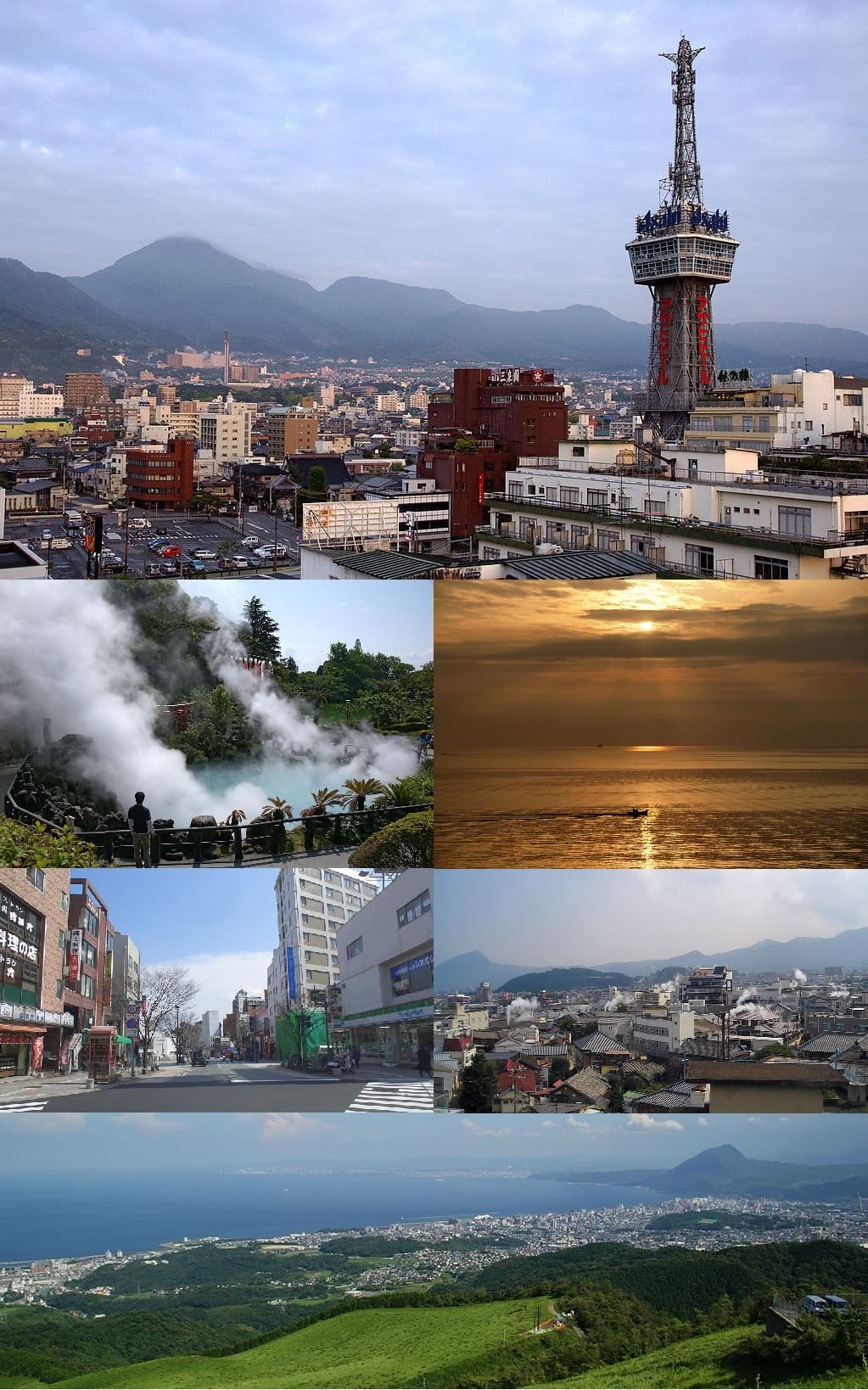
Beppu, on the island of Kyushu, stands as Japan's most celebrated hot spring resort, a city where the earth itself seems to breathe in plumes of steam. With over 2,500 hot springs and the second-largest volume of hot spring water discharge in the world, surpassed only by Yellowstone National Park, Beppu offers an unparalleled array of geothermal encounters. The city divides into eight distinct hot spring areas, collectively known as Beppu Hatto, each possessing its own character and bathing styles, ranging from traditional hot water baths to sand and mud baths.
Beyond the therapeutic waters, Beppu presents a captivating landscape where steam ascends from streets, rooftops, and hillsides, crafting a surreal and atmospheric environment. This geothermal activity is not merely a natural wonder; it is deeply woven into the city's culture and daily life, influencing everything from local cuisine to traditional crafts. Beppu invites visitors to immerse themselves not only in its healing waters but also in its singular blend of natural power and cultural heritage.
## Ancient Origins and Mythological Connections Beppu's history reaches back to antiquity, with its hot springs mentioned in 8th-century chronicles like the "Iyo-no-kuni Fudoki" and "Bungo-no-kuni Fudoki." According to legend, the god Sukunahikonanomikoto found a cure for an illness by bathing in Beppu's thermal waters, conveyed via a long pipe from the seabed. During the Kamakura period (1185-1333 CE), sanatoriums were established in Beppu, Kannawa, and Hamawaki to treat wounded samurai, underscoring the long-standing recognition of the springs' healing properties.
## The Emergence of a Hot Spring Resort The development of Beppu as a significant settlement was spurred by its abundant geothermal resources and the expansion of its port. In the Meiji era (late 19th century), the inauguration of regular steamship service to Osaka transformed Beppu into an accessible resort. Entrepreneur Kumahachi Aburaya, often called the "Father of Beppu Tourism," played a pivotal role in the city's tourism development, devising the famous "Hells of Beppu" tour route and establishing hospitality standards. In 1928, Japan's first regular sightseeing bus with female guides was launched in Beppu, marking the inception of organized mass tourism.
## Modern Development and Cultural Recognition Beppu officially attained city status on April 1, 1924, following the merger of several towns and villages. The city continued to expand, with the construction of Beppu Tower in 1957, designed by Tachu Naito (who also designed Tokyo Tower), becoming an icon of Japanese high-rise construction. In 1950, the Japanese Parliament granted Beppu the status of an "International City of Culture and Tourism." Today, Beppu is also recognized for its traditional bamboo weaving, a craft said to have originated around the 1st century when Emperor Keikō's attendant discovered high-quality bamboo in the area.
Beppu's primary appeal lies in its diverse array of hot springs. The city encompasses eight distinct hot spring areas, known as Beppu Hatto, each presenting unique bathing experiences. Do not miss the opportunity to visit the "Hells of Beppu" (Jigoku Meguri), a collection of seven spectacular hot springs intended for viewing rather than bathing due to their extreme temperatures, often reaching 100°C. Highlights include Umi Jigoku (Sea Hell) with its cobalt-blue waters, and Chinoike Jigoku (Blood Pond Hell), Japan's oldest natural hell, recognized for its striking red pond.
For a singular bathing experience, consider a sand bath at places like Takegawara Onsen, where you are covered in naturally heated sand. The Kannawa district is also a vital destination for its traditional steam-cooking (jigoku mushi) experiences, where you can prepare your own meal using the natural geothermal steam. For sweeping views of the steaming city and Beppu Bay, ascend Mount Tsurumi via the Kintetsu Beppu Ropeway. Beppu Park, a generous urban green space, offers a quiet respite. You can also explore the Beppu City Traditional Bamboo Centre to learn about the city's ancient craft of bamboo weaving.
The most favorable times to visit Beppu for pleasant weather are spring (March-May) and autumn (October-November). These seasons offer mild temperatures, ideal for exploring the outdoor attractions and onsen. Spring brings cherry blossoms, typically reaching their peak in early April, while autumn offers spectacular foliage, particularly at Mount Tsurumi in mid-November. Winter (December-February) is also a good time to visit, as the cool air enhances the atmospheric experience of soaking in the hot springs, with thick steam rising from the city. Summers (June-September) are warm and humid, with the most rainfall in June. The Beppu Fireworks Festival takes place in late July or early August.
Beppu is readily accessible by various modes of transport. From major cities like Tokyo, you can fly to Oita Airport (a 90-minute flight), then take a 40-45 minute bus ride to Beppu. Alternatively, direct train services connect Beppu with cities like Fukuoka (around 1.5-2 hours) and Osaka (under 4 hours). Once in Beppu, the local bus system is dependable and straightforward to navigate, with day and multi-day passes available. Many attractions, especially the Hells of Beppu, are concentrated in the Kannawa district and can be explored on foot or by bus from Beppu Station. The currency is the Japanese Yen, and electrical outlets are Type A or B (same as the United States) with 100 volts at 50/60 Hz. For emergencies, dial 110 for police and 119 for fire or ambulance.