Bayeux Tapestry Museum
The Bayeux Tapestry isn't actually a tapestry.
Full story unlocks in the tour
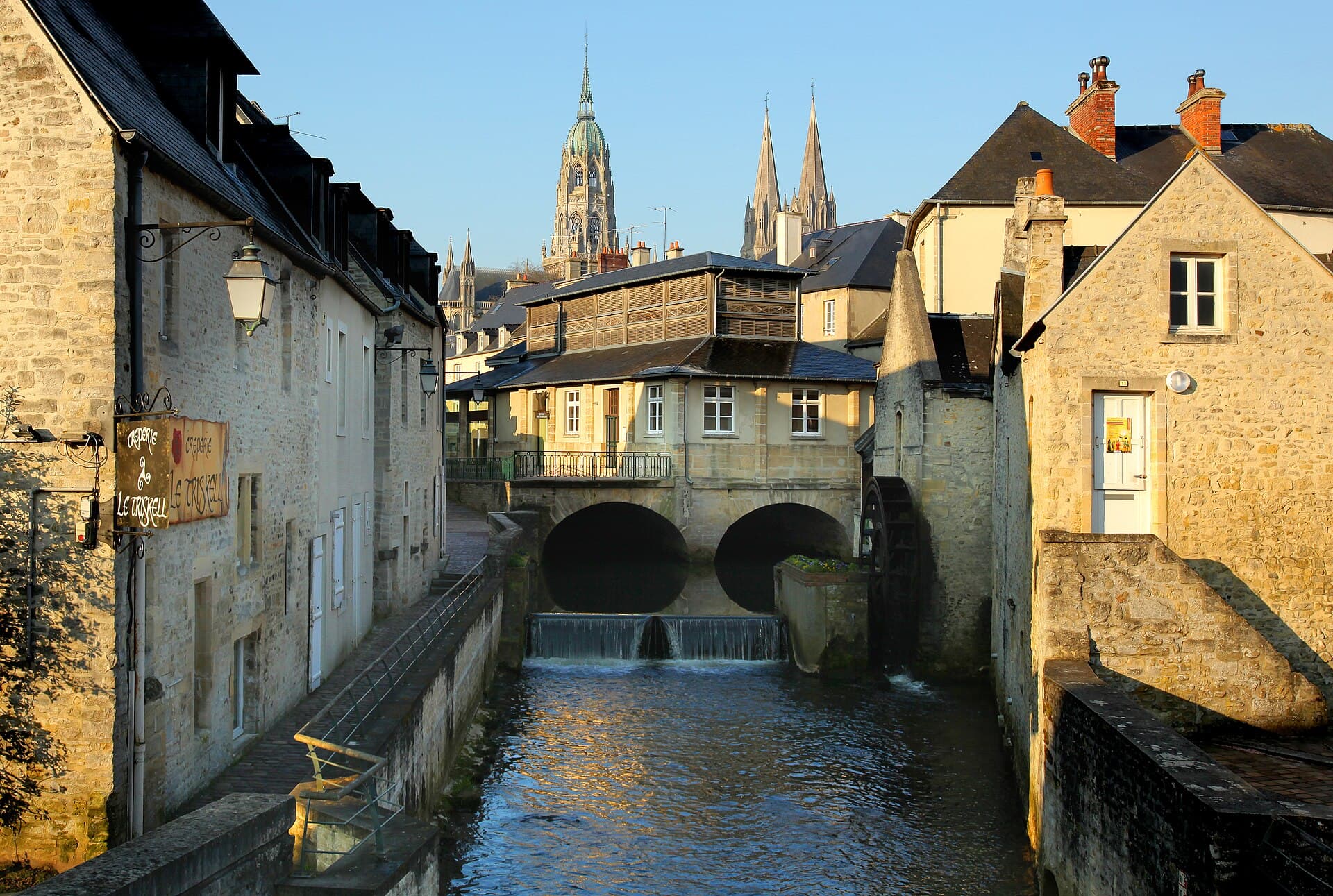 Mairie de Bayeux / CC BY-SA 4.0, via Wikimedia Commons
“Where ancient narratives and modern history converge.”
Not the postcards. The stories even locals don't know — whispered in your ear, right where they happened.
The Bayeux Tapestry isn't actually a tapestry.
Look closely at the Bayeux Cathedral's stained glass, and you'll see a surprising modern touch.
When you park at Place aux Pommes, you're closer to ancient history than you might realize.
Discover every secret of Bayeux
Every address, every reveal in full — in your ear, right where it happened.
You pick your stops. You walk. The voice reveals what the others miss.
No tours available yet. Check back soon — we're preparing them.
Bayeux, a city in Normandy, France, offers a journey through centuries of history, from its Roman origins to its pivotal role in World War II. It’s a place where medieval architecture stands remarkably preserved, a testament to its fortunate liberation in 1944 that spared it from widespread destruction.
At the heart of Bayeux's allure is its dual identity: a medieval city with a compelling past, and a gateway to the poignant D-Day landing beaches. The city’s inviting streets, half-timbered houses, and the majestic Bayeux Cathedral invite exploration, while its museums provide deep dives into both ancient and modern conflicts.
Bayeux manages to feel both historically significant and intimately welcoming, avoiding the impression of a mere tourist trap despite its global recognition. It serves as an ideal base for those looking to explore the wider Normandy region, offering a blend of cultural immersion and historical reflection.
## From Roman Settlement to Norman Stronghold Bayeux, originally known as Augustodurum, was established as a Gallo-Roman settlement in the 1st century BC, built on a crossroads and developing along the Aure River. By the late 3rd century, a walled enclosure protected the city, a layout that can still be traced today. It was an important Roman city and a bishopric by the 4th century. The city's name comes from the Gallic Baiocasses people.
In 880, Bayeux was captured by Rollo the Viking, becoming a significant Norman stronghold. Unlike Rouen, Bayeux maintained its Norse-speaking heritage. The city's prominence grew in the Middle Ages, particularly under William the Conqueror, Duke of Normandy. His half-brother, Bishop Odo de Conteville, was instrumental in enlarging the Bayeux Cathedral, which was consecrated in 1077 in William's presence. It was likely to adorn this new cathedral that the famed Bayeux Tapestry, depicting William's 1066 conquest of England, was commissioned.
Despite its early importance, Bayeux faced periods of decline. After William made Caen his capital, Bayeux suffered, including being burned by Henry I of England in 1106. The city endured further hardship during the Hundred Years' War and the 16th-century Wars of Religion. Stability returned around 1450, and some half-timbered houses from this period still stand.
## World War II and Liberation Bayeux holds a unique place in modern history as the first French city liberated by the Allies on June 7, 1944, the day after the D-Day landings. Miraculously, the city was largely spared from the destruction that befell many other Normandy towns, as German forces were preoccupied defending Caen. Just a week later, on June 14, 1944, General Charles de Gaulle delivered his first major speech on liberated French soil in Bayeux, briefly declaring it the capital of Free France until Paris was liberated.
Today, Bayeux serves as a powerful reminder of these events, with its war museum and British cemetery honoring the sacrifices made during the Battle of Normandy. Its preservation allows visitors to experience a city where ancient narratives and crucial modern history are both vividly present.
The Bayeux Tapestry Museum houses the famed 11th-century embroidery depicting the Norman conquest of England. This UNESCO-listed artwork is nearly 70 meters long and provides a unique visual narrative of the events leading up to the Battle of Hastings. An audio guide enhances the experience, guiding visitors through its 58 scenes.
Dominating the city's skyline is the Bayeux Cathedral (Cathédrale Notre-Dame de Bayeux), a masterpiece of Norman-Romanesque and Gothic architecture consecrated in 1077. Its interior features impressive Romanesque arcades, Gothic vaulting, and striking stained glass. Visitors can also explore its crypt, which was walled up for centuries and rediscovered in 1412.
The Memorial Museum of the Battle of Normandy offers a comprehensive look at the 100 days of fighting following D-Day, from June 7 to August 29, 1944. The museum displays military equipment, uniforms, and personal items from both Allied and German forces, providing a chronological journey through the campaign. Adjacent to the museum is the Bayeux War Cemetery, the largest British and Commonwealth cemetery in Normandy, where over 4,000 Commonwealth soldiers are buried.
Beyond these major sites, take time to stroll through Bayeux's historic center, with its narrow, paved streets and medieval architecture. The Baron Gérard Museum (MAHB), located in the former bishop's palace, showcases local art and artifacts, including examples of Bayeux lace and porcelain.
Bayeux is appealing year-round, but for comfortable weather and fewer crowds, consider visiting in late spring (May–June) or early autumn (September–October). Temperatures during these periods are mild, making it ideal for exploring the city and surrounding D-Day sites. Summer (July–August) brings the warmest weather, with average highs around 70°F (21°C), but also the largest influx of tourists, especially around D-Day anniversary events in early June. Winter is quieter and offers a more atmospheric experience with festive lights, though temperatures are colder.
Bayeux is easily accessible. If traveling from Paris, direct regional trains run from Paris Saint-Lazare station to Bayeux, a journey of about 2.5 hours. For those driving, Bayeux is approximately four hours from Paris.
Once in Bayeux, the city's main attractions are within walking distance of each other. The Bayeux Tapestry Museum, the Memorial Museum of the Battle of Normandy, and the Baron Gérard Museum are all a short stroll apart. The local tourist office can provide maps and information for self-guided walking tours.
Accommodation options in Bayeux include hotels and guesthouses, many within the historic center. Parking is available, with a long-term car park at the train station offering free parking for the first 24 hours. Note that the Bayeux Tapestry Museum will be closed for renovation from September 2025 until October 2027.
For exploring the D-Day beaches, Bayeux serves as an excellent base. During July and August, the Nomad Car D-Day Line offers unlimited travel between historic D-Day sites, including Omaha Beach and Arromanches. Alternatively, many guided tours depart from Bayeux to the landing beaches.