Basilica di San Nicola crypt
Beneath a grand basilica, a crypt holds a puzzle that has puzzled experts for centuries.
Full story unlocks in the tour
 Benjamin Smith / CC BY-SA 4.0, via Wikimedia Commons
“Beyond the obvious, Bari unfolds in layers of unexpected history and authentic daily life.”
Not the postcards. The stories even locals don't know — whispered in your ear, right where they happened.
Beneath a grand basilica, a crypt holds a puzzle that has puzzled experts for centuries.
In the heart of Bari Vecchia, one can walk through a church that lacks a roof and complete walls.
For centuries, unmarried women in Bari followed a specific ritual to find a partner within the year.
Discover every secret of Bari
Every address, every reveal in full — in your ear, right where it happened.
You pick your stops. You walk. The voice reveals what the others miss.
No tours available yet. Check back soon — we're preparing them.
Bari, the capital of Puglia, is a city that often defies initial perceptions. While many consider it a transit point for ferries to Greece or Croatia, a deeper exploration reveals a dynamic, lived-in city with a deep and intricate past. Its historic core, Bari Vecchia, is a maze of narrow streets where daily life unfolds openly, from grandmothers crafting pasta by hand to families gathering in sun-dappled courtyards.
This Adriatic port city has served as a crossroads of cultures for millennia, a fact evident in its architecture, cuisine, and traditions. It is a place where ancient history is not confined to museums but is woven into the very fabric of the streets, offering an authentic Italian experience distinct from more polished tourist destinations.
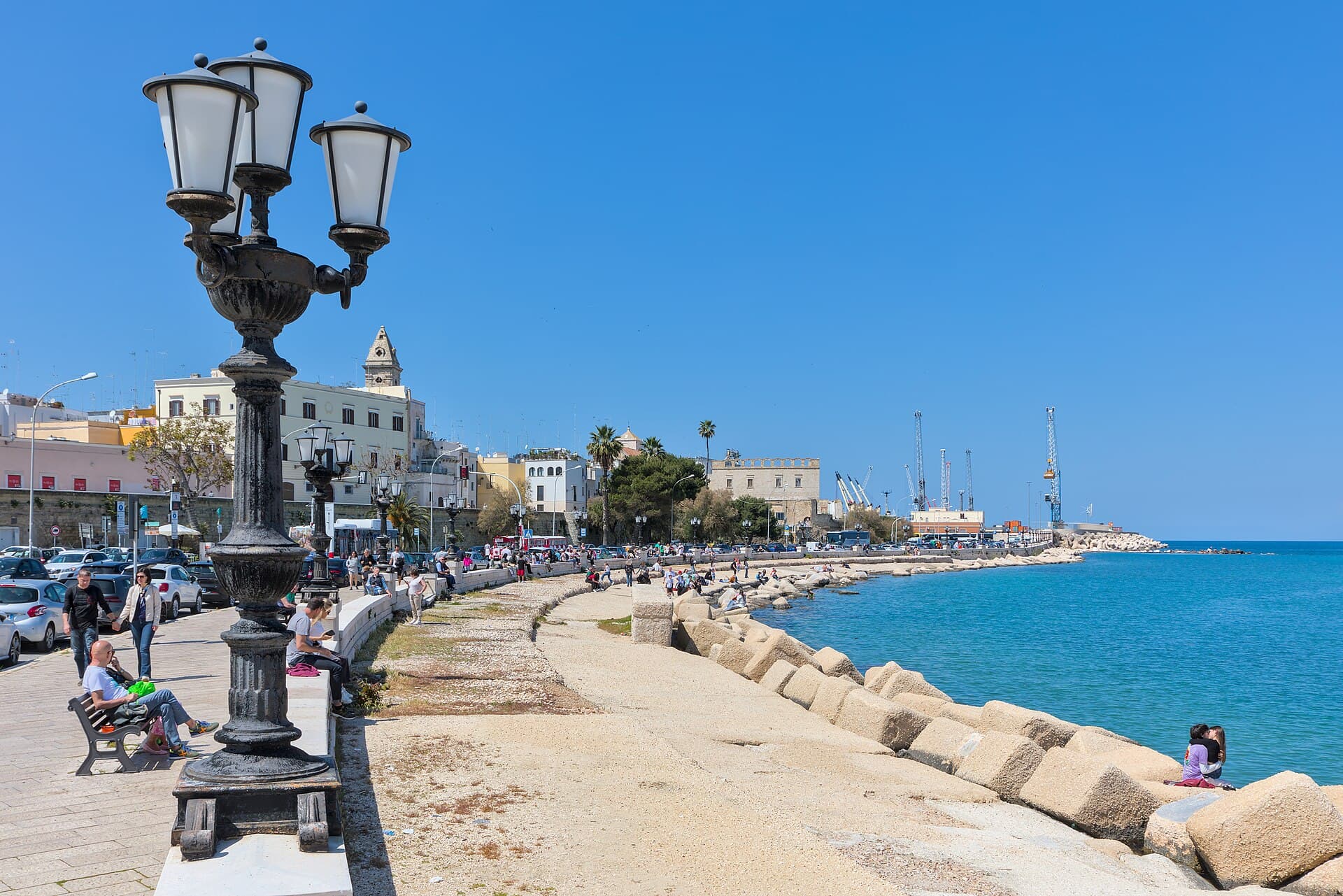
Beyond its medieval allure, Bari also presents a modern aspect with wide boulevards, shopping districts, and Europe's longest seafront promenade, the Lungomare Nazario Sauro, providing a balance of old-world charm and contemporary urban life.
## From Ancient Port to Byzantine Center Bari's story extends back to the 4th millennium BC, with prehistoric settlements flourishing due to its strategic location on the Adriatic coast. By the 8th century BC, Greek settlers established the prominent settlement of Barion, which later became Barium under Roman conquest in the 3rd century BC. Under Roman governance, it thrived as a vital port and military stronghold, particularly after the construction of the Via Traiana connecting it to Rome.
## A Confluence of Empires Following the decline of the Roman Empire, Bari became a contested city, passing between Goths, Lombards, and Saracens. In the 6th century AD, it came under Byzantine rule, transforming into a crucial maritime center and flourishing culturally and economically. During this period, many Byzantine structures were erected. Uniquely, Bari served as the capital of an independent Islamic emirate from 847 to 871 AD, the sole one on the Italian peninsula. It returned to Byzantine control in 875 AD, marking the last Byzantine domination in Italy.
## Norman Conquest and Crusader Gateway In 1071, Bari was conquered by the Normans under Robert Guiscard, integrating it into the newly established Kingdom of Sicily. This era saw Bari flourish as a pivotal hub for commerce and cultural exchange between Europe and the East. A significant moment arrived in 1087 with the transfer of Saint Nicholas' relics from Myra (modern-day Turkey) to Bari, transforming the city into a major Christian pilgrimage site for both Catholics and Orthodox Christians. The grand Basilica di San Nicola was constructed to house these relics, consecrated in 1197. Bari also functioned as a significant port for crusaders and pilgrims journeying to the Holy Land.
## Medieval and Modern Transformations Bari reached a zenith during the Swabian domination of Frederick II, who rebuilt the Castello Svevo in the 12th century. The city later experienced periods of decline and rule by the Republic of Venice, which expanded its harbor, making it an important exchange point in the Mediterranean. In the 19th century, Bari grew substantially, with Gioacchino Murat encouraging expansion outside the medieval walls, leading to the development of the modern Murat quarter with its wide streets and cultural institutions. Despite considerable damage from bombings during World War II, Bari underwent swift reconstruction and post-war advancement, evolving into the bustling metropolis it is today, a city that honors its diverse and distinguished past.
Bari's allure resides in its contrasts, best explored by meandering through its distinct districts. Begin in Bari Vecchia, the Old Town, a maze of narrow, winding streets where daily life extends onto sun-warmed stones. Here, you will discover the iconic Strada delle Orecchiette, where local women skillfully craft fresh pasta by hand outside their homes.
The Basilica di San Nicola stands as a masterpiece of Apulian Romanesque architecture, sheltering the relics of Saint Nicholas, the inspiration for Santa Claus. Nearby, the Cattedrale di San Sabino (Bari Cathedral) displays Romanesque design with a crypt containing relics of Saint Sabinus and excavated ruins of earlier structures beneath.
Guarding the edge of the Old Town is the imposing Castello Normanno-Svevo, a 12th-century Norman castle expanded by Frederick II, offering a glimpse into Bari's turbulent past. For a taste of modern Bari, stroll along the Lungomare Nazario Sauro, Europe's longest seafront promenade, providing expansive views of the Adriatic. The lively squares of Piazza del Ferrarese and Piazza Mercantile serve as dynamic centers for observing daily life and enjoying an aperitivo.
The most pleasant times to visit Bari are during the spring (April to June) and autumn (September to October). These shoulder seasons offer agreeable weather with mild temperatures, fewer crowds, and more comfortable conditions for exploration. Spring brings blossoming landscapes, while autumn provides similar temperatures with the added benefit of local festivals like the Fiera del Levante in September. Summers (July and August) are warm, with temperatures reaching up to 35°C (95°F), and represent the peak tourist season, leading to more visitors and higher prices, especially at the beaches. Winters (December to February) are generally mild but can be cool and damp, with fewer tourist activities.
Bari is a city easily explored on foot, particularly its historic center, Bari Vecchia. Public transportation, including trains and buses, is affordable and efficient for navigating the city and surrounding region. If planning day trips, a car rental can be useful for reaching smaller, less accessible towns, though local transport is often sufficient.
Accommodation options vary, but staying in the city center or Bari Vecchia provides convenient access to most attractions. Many small shops and street food vendors in the Old Town operate on a cash-only basis, so it is wise to carry euros. Be aware that many shops and smaller eateries observe an afternoon riposo, closing between approximately 2 PM and 5 PM. When dining, a coperto (cover charge) is standard in most sit-down restaurants and is not a gratuity; tipping is appreciated but not obligatory. Tap water in Bari is safe to drink.