Old Town Hall
The Old Town Hall of Bamberg stands defiantly in the middle of the Regnitz River, a testament to civic ambition.
Full story unlocks in the tour
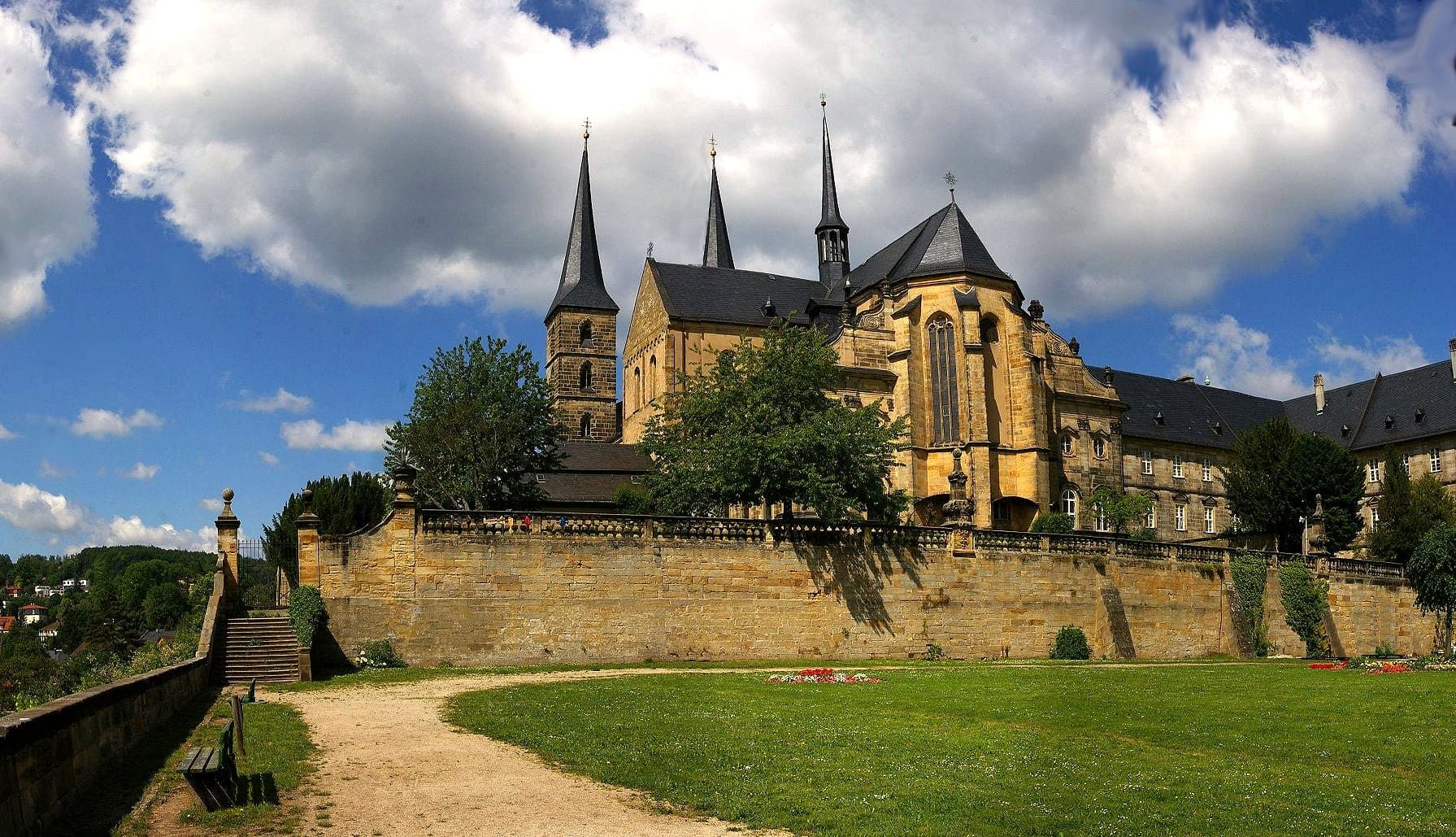 Reinhard Kirchner / CC BY-SA 3.0, via Wikimedia Commons
“Where medieval grandeur meets the unexpected, on seven hills and a river.”
Not the postcards. The stories even locals don't know — whispered in your ear, right where they happened.
The Old Town Hall of Bamberg stands defiantly in the middle of the Regnitz River, a testament to civic ambition.
Within the Bamberg Cathedral, a unique papal tomb lies far from Rome.
Bamberg's famous smoked beer, Rauchbier, has a history rooted in tradition, though one popular origin story is a charming fabrication.
Discover every secret of Bamberg
Every address, every reveal in full — in your ear, right where it happened.
You pick your stops. You walk. The voice reveals what the others miss.
No tours available yet. Check back soon — we're preparing them.
Bamberg, a UNESCO World Heritage site since 1993, is a city in Upper Franconia, Bavaria, Germany, that feels like stepping into a storybook. It is often called the "Franconian Rome" because it is built on seven hills, each crowned with a church. The city is bisected by the Regnitz River, creating a distinctive landscape of bridges, canals, and riverside houses.
Bamberg's Old Town, with its approximately 2,400 timber-framed houses, survived World War II largely unscathed, preserving a medieval cityscape rarely encountered in Germany. This Bavarian city offers a captivating blend of historical grandeur and local culture. From its imposing cathedral to the unique Old Town Hall situated in the middle of the river, Bamberg presents a wealth of architectural and historical treasures. Beyond its visual appeal, Bamberg is renowned for its distinctive Rauchbier, or smoked beer, a tradition that dates back centuries.
Bamberg's origins trace back to the 9th century, its name derived from the nearby Babenberch castle. The city's prominence began in 1007 when Henry II, Duke of Bavaria and later Holy Roman Emperor, made Bamberg the seat of a bishopric. His vision was to create a "second Rome," a significant religious and political center. This period marked the construction of many monumental buildings, including the first cathedral, consecrated in 1012. Bamberg played a crucial role as a link between the Germanic and Slavic peoples of Eastern Europe, particularly Poland and Pomerania.
The city experienced a period of great prosperity from the 12th century onwards, briefly serving as a center of the Holy Roman Empire. The lavish restoration of the cathedral in the early 13th century, after earlier structures were destroyed by fire, reflects this era of wealth. From the mid-13th century, the bishops of Bamberg became powerful Prince-Bishops, overseeing further architectural development. The city's architectural styles from this period notably influenced urban forms in central Europe, including northern Germany and Hungary.
Bamberg's independence ended in 1802 with the secularization of church lands, and it became part of Bavaria in 1803. The 19th century brought new transport links, including a connection to the German rail system in 1844 and a canal linking the Rhine and Danube rivers, leading to rapid growth. Uniquely, Bamberg largely escaped the widespread destruction of German cities during World War II, preserving its medieval and Baroque townscape. Today, it remains a university city, celebrated for its long history and cultural traditions.
Begin your exploration in the Old Town (Altstadt), a UNESCO World Heritage site, where streets paved with stone weave through medieval and Baroque architecture. The iconic Old Town Hall (Altes Rathaus), adorned with elaborate frescoes, is dramatically situated on an artificial island in the Regnitz River. Nearby, the picturesque "Little Venice" (Klein Venedig) district, a former fishing village, features charming half-timbered houses lining the eastern bank of the Regnitz.
Ascend to the Domberg (Cathedral Hill) to visit the imposing Bamberg Cathedral (Bamberger Dom), a masterpiece of Romanesque and Gothic architecture. Inside, you will find the tombs of Emperor Henry II and his wife Cunigunde, as well as the unique papal tomb of Clement II, and the mysterious Bamberg Rider statue. Adjacent to the cathedral are the Neue Residenz (New Residence), a sprawling Baroque palace with over 40 opulent rooms and a beautiful Rose Garden (Rosengarten) offering panoramic city views, and the Alte Hofhaltung (Old Court), a Gothic and Renaissance complex. For a taste of local culture, explore Bamberg's renowned breweries and sample its distinctive smoked beer, Rauchbier.
Bamberg is enjoyable year-round, but the warmer months offer the mildest weather and a lively atmosphere. Late June to early September is ideal for warm-weather activities. Spring (March-May) brings blooming gardens and fewer crowds, with temperatures ranging from 8–22 °C (46–72 °F). Autumn (September-November) offers mild weather, colorful foliage, and various cultural events, with temperatures between 15–20 °C (59–68 °F) in September. December is magical for its Christmas markets and festive decorations.
Bamberg's Old Town is best explored on foot, though comfortable shoes are essential due to stone-paved streets and some steep inclines, particularly around the cathedral and castle hills. Public transportation includes a reliable bus network connecting the town center with outer neighborhoods. The nearest airport is Nuremberg (NUE), approximately an hour away by train. Bamberg is well-connected to other major German cities by train, with frequent regional and high-speed ICE services. The main train station (Bamberg HBF) is about a 15-minute walk from the historic center. Taxis and ride-share apps are also available. Many shops maintain traditional opening hours, sometimes closing for lunch.