Ballarat New Cemetery Gatehouse
A cafe operates within the grounds of a Ballarat cemetery.
Full story unlocks in the tour
 Mattinbgn (talk · contribs) / CC BY 3.0, via Wikimedia Commons
“Where the echoes of gold rush fortunes meet a thriving cultural present.”
Not the postcards. The stories even locals don't know — whispered in your ear, right where they happened.
A cafe operates within the grounds of a Ballarat cemetery.
Observe closely in a central Ballarat laneway for some unexpected faces.
The bluestone walls of Ballarat's Old Gaol carry more than just historical weight.
Discover every secret of Ballarat
Every address, every reveal in full — in your ear, right where it happened.
You pick your stops. You walk. The voice reveals what the others miss.
No tours available yet. Check back soon — we're preparing them.
Ballarat, a grand regional city in Victoria, Australia, is a place where the legacy of the 1850s gold rush still gleams. Just 75 minutes west of Melbourne, its streets are lined with impressive 19th-century architecture, a testament to the immense wealth unearthed by fortune seekers. Today, Ballarat is recognized for its local produce, diverse restaurants, vineyards, and historic villages, all alive with creative energy. The city's name itself, derived from the Aboriginal words "Balla" and "Arat" meaning 'resting place', hints at its long history as a gathering ground.
Beyond its golden past, Ballarat offers a dynamic contemporary arts scene, acclaimed festivals, and a strong culinary identity. From exploring open-air museums that recreate the goldfields era to encountering native Australian wildlife, Ballarat provides a unique blend of historical immersion and modern experiences. It stands as a testament to resilience and transformation, evolving from a boomtown into a cultural center.
Before European settlement in 1837, the Ballarat region was inhabited by the Wadawurrung people, an Indigenous Australian group whose land extended along the Yarrowee River. The name "Ballarat" itself is believed to come from the Wadawurrung words "Balla" and "Arat," meaning 'resting place' or 'elbow resting place', and was first recorded by squatter Archibald Yuille in 1837 for his sheep run.
The discovery of gold near Ballarat in August 1851 by Thomas Hiscock sparked the Victorian gold rush, rapidly transforming the area into a flourishing boomtown. Within days of further discoveries at Poverty Point on August 19, 1851, thousands of prospectors flocked to the Yarrowee Valley, soon known as the Ballarat diggings. Between 1852 and 1853, Ballarat became the richest goldfield in the world. This influx of people from across the globe brought new skills, ideas, and cultures, and for a time, Ballarat rivaled Melbourne in wealth and cultural influence.
The immense wealth generated by gold also brought significant social and political tensions. Miners faced hardships, including a disliked government gold license fee. Opposition to this system culminated in the Eureka Rebellion, also known as the Eureka Stockade, on December 3, 1854. This armed uprising saw miners, disgruntled with colonial government policies, swear allegiance to the Southern Cross flag and construct a stockade at the Eureka diggings. Government troops attacked the lightly guarded stockade, resulting in the deaths of approximately 22 miners. The Eureka Rebellion is considered a pivotal moment in Australian history, leading to the introduction of white male suffrage and interpreted as an origin of Australian democracy. The Eureka Flag has since become a national symbol.
Ballarat's prosperity continued well into the late 19th century, unlike many other gold boomtowns, due to sustained high gold yields. Proclaimed a city on September 9, 1870, Ballarat developed impressive bluestone buildings, many of which survive today. The city's official spelling, "Ballaarat" with a double 'a', was used for 143 years until 1994, when it was changed to "Ballarat" to reflect the amalgamation of surrounding districts. By 1858, the gold rush population peaked at nearly 60,000, though many were itinerant. By 1859, a more stable population of around 23,000 remained, many of whom had become wealthy and established a strong economy based on deep underground gold mining. The railway arrived in 1862, further solidifying Ballarat's role as an important regional center.
Begin your exploration at Sovereign Hill, an outdoor museum that vividly recreates Ballarat during the 1850s gold rush. Here, you can pan for gold, explore a recreated township, and interact with costumed characters from the era. For a deeper understanding of the gold rush and the Eureka Stockade, visit the Eureka Centre, located at the memorial park considered the site of the 1854 rebellion. The Art Gallery of Ballarat, Australia's oldest and largest regional art gallery, hosts a range of exhibitions from contemporary art to historical pieces.
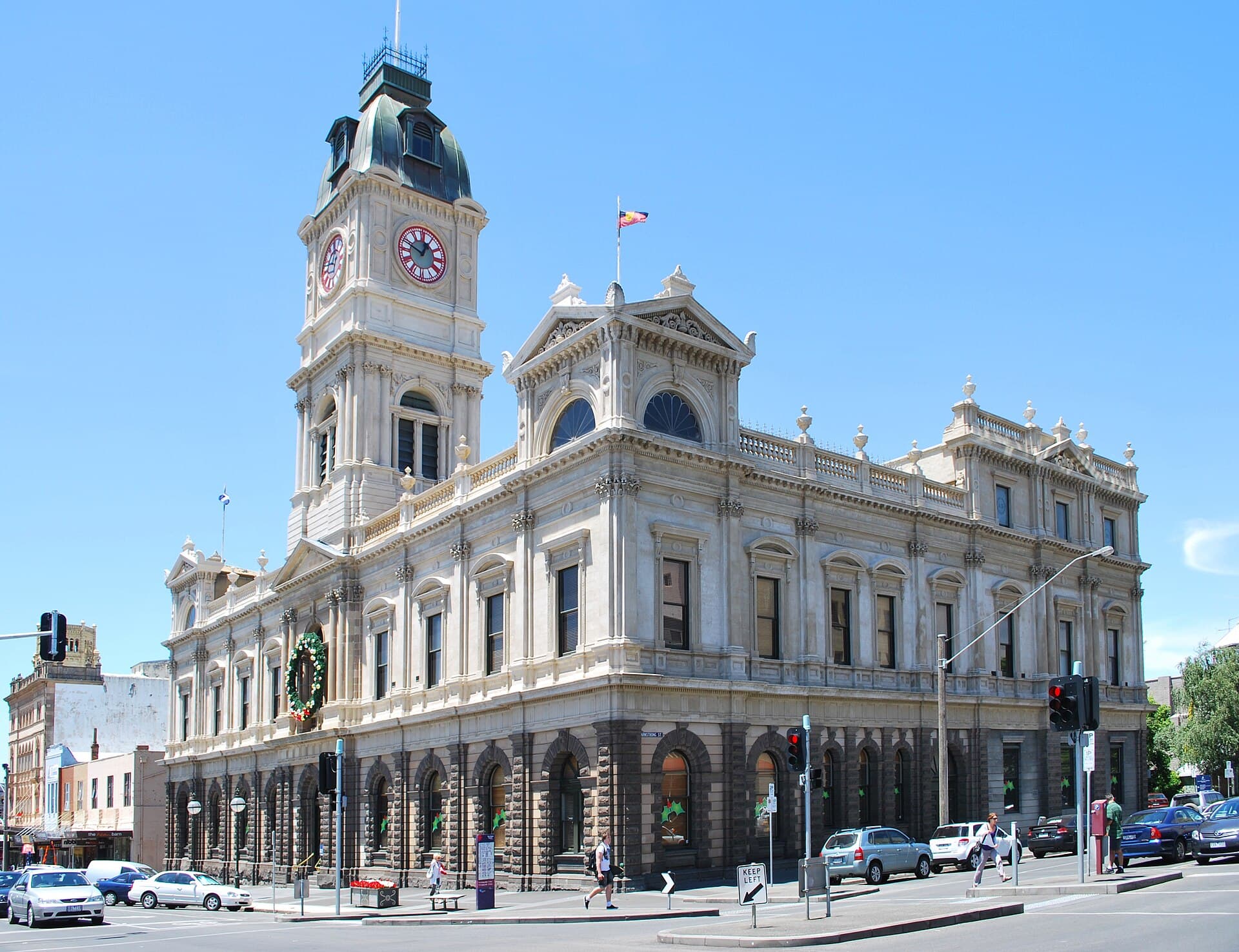
Stroll through the Ballarat Botanical Gardens, covering 40 hectares and featuring formal gardens, a fernery, and a floral conservatory, particularly known for its begonia display. Adjacent to the gardens is Lake Wendouree, a popular spot for birdwatching and scenic walks, which even hosted rowing events during the 1956 Olympic Games. For a unique family experience, Ballarat Wildlife Park offers close encounters with native Australian animals, including the chance to hand-feed kangaroos. If you're looking for something different, Kryal Castle is a replica medieval castle with a moat, drawbridge, maze, and live shows. Take time to explore Ballarat's grand 19th-century architecture along its historic main streets, including notable buildings like the Ballarat Town Hall and Her Majesty's Theatre.
The best times to visit Ballarat are during spring (September to November) and autumn (March to May) when the weather is mild and pleasant, and crowds are typically smaller. Spring brings blooming flowers, adding a fresh feel to the city. While January and February are the warmest months with daytime temperatures peaking around 26°C (79°F), winter (June to August) is colder, with July daytime averages around 10°C (50°F) and overnight lows around 3°C (37°F). However, winter can be good for outdoor activities without intense heat, though it is also the rainiest season.
Ballarat is approximately a 1.5-hour drive northwest of Melbourne. The city is well-connected by road, with the Western Highway linking it to Melbourne and points west, and the Midland Highway connecting it north to Bendigo and south to Geelong. For those preferring public transport, V/Line operates frequent passenger trains between Ballarat Station and Melbourne's Southern Cross Station. Within Ballarat, a bus network, branded as Public Transport Victoria (PTV), provides local routes radiating from the city center and railway station to various suburbs and attractions. A Myki pass is required for bus travel. Additionally, a hop-on hop-off bus service connects many of Ballarat's iconic attractions, offering a flexible way to explore. Ballarat also has a range of accommodation options, including heritage hotels and vacation cottages.