Bahla Fort
The massive mud-brick walls of Bahla Fort hold more than just historical significance.
Full story unlocks in the tour
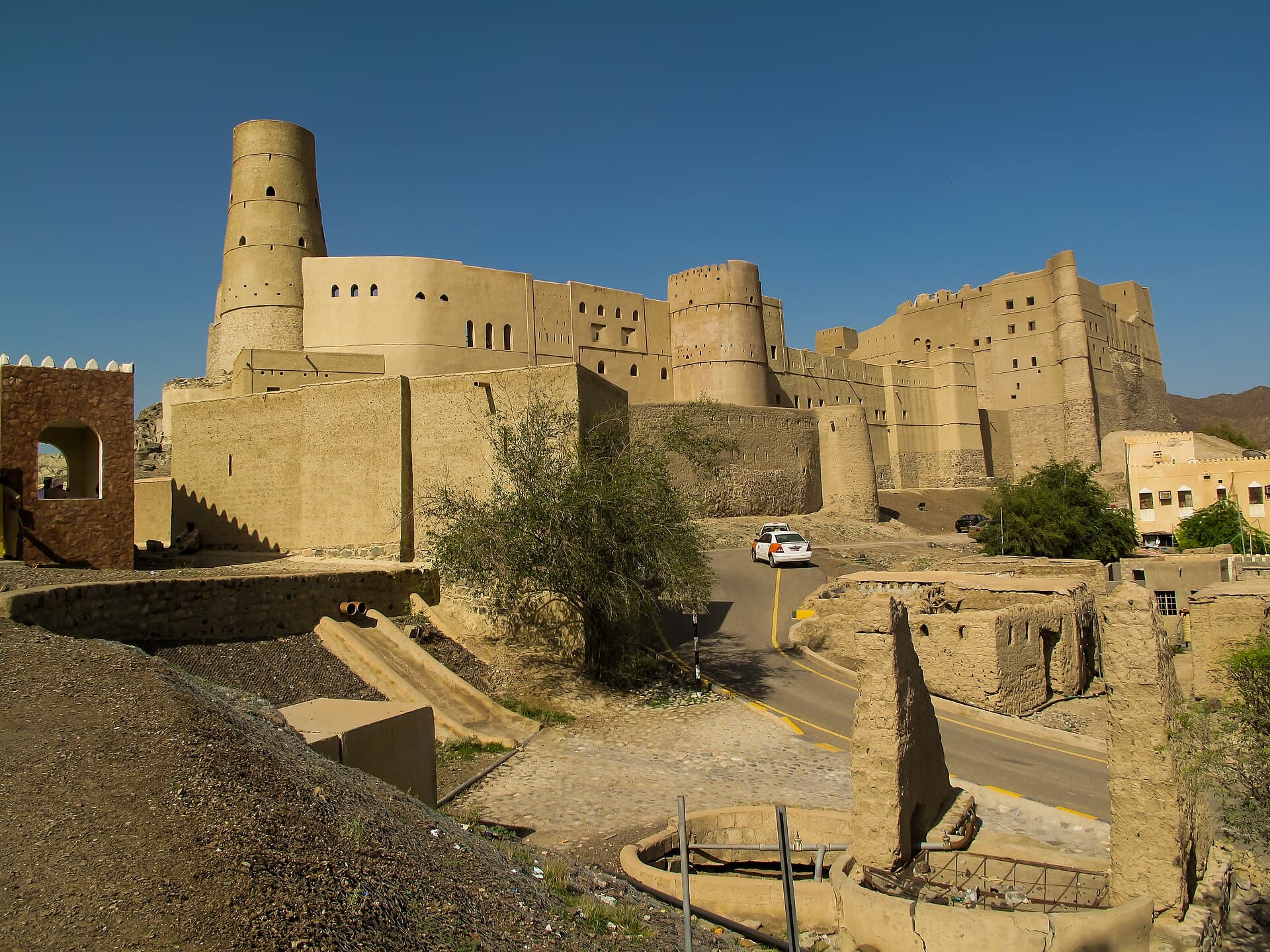 Francisco Anzola / CC BY 2.0, via Wikimedia Commons
“Where ancient mud-brick walls guard tales of magic and enduring craft.”
Not the postcards. The stories even locals don't know — whispered in your ear, right where they happened.
The massive mud-brick walls of Bahla Fort hold more than just historical significance.
The distinct red and brown clay pots of Bahla are renowned throughout Oman and beyond.
A 12-kilometer mud-brick wall encircles the Bahla oasis, a formidable defense from centuries past.
Discover every secret of Bahla
Every address, every reveal in full — in your ear, right where it happened.
You pick your stops. You walk. The voice reveals what the others miss.
No tours available yet. Check back soon — we're preparing them.
Bahla, an ancient oasis town in Oman's Ad Dakhiliyah Governorate, offers a captivating journey into the country's past and enduring traditions. Approximately 200 kilometers southwest of Muscat and 40 kilometers from Nizwa, Bahla is defined by its impressive UNESCO World Heritage-listed fort and a sprawling palm oasis sustained by an ingenious ancient irrigation system.
Often described as the 'City of Magic' due to its intriguing folklore, Bahla presents a less polished, more authentic experience than some of Oman's more heavily touristed sites. Its mud-brick architecture, traditional souq, and active pottery workshops provide a tangible connection to Omani life as it has been for centuries. This is a place where history is not merely preserved but actively lived, offering a unique glimpse into a fortified oasis settlement that thrived in the medieval Islamic period.
Bahla's history stretches back to the third millennium BCE, making it one of Oman's oldest continuously inhabited cities. Its strategic location in a fertile oasis, coupled with a sophisticated falaj (irrigation) system, allowed for the development of agriculture and date palm cultivation, laying the groundwork for its prosperity.
The city reached its zenith during the medieval period, particularly under the rule of the Banu Nebhan tribe. This influential dynasty, which dominated central Oman from the 12th to the end of the 15th century, established Bahla as their capital. During this time, the monumental core of Bahla Fort, known as Hisn Tamah, was constructed and expanded. The fort, with its massive mud-brick walls and defensive towers, served as both a stronghold and a symbol of the Banu Nebhan's power, playing a crucial role in protecting trade routes, including the lucrative frankincense trade.
In 1987, Bahla Fort was recognized as Oman's first UNESCO World Heritage Site, a testament to its exceptional mud-brick architecture and its significance as a medieval Islamic fortification. However, by the time of its inscription, the fort was in a delicate state, threatened by erosion and previous restoration efforts that had not respected its authenticity. This led to its inclusion on the List of World Heritage in Danger in 1988. A large-scale restoration program, initiated by the Omani government in the 1990s and costing $9 million, successfully preserved the fort using traditional methods and materials. Bahla Fort was removed from the endangered list in 2004 and reopened to the public in 2012, allowing visitors to explore its labyrinthine passages and towering walls.
Beyond its military and political importance, Bahla has also been a renowned center for traditional pottery for centuries. Archaeological evidence suggests pottery production here dates back to as early as 2500 BC. The local clay from the wadi floors and surrounding mountains, combined with generations of artisanal skill, has made Bahla pottery famous throughout Oman and beyond.
The main draw in Bahla is the imposing Bahla Fort, a UNESCO World Heritage Site. Allow 1.5 to 2 hours to explore its massive mud-brick walls, defensive towers, and maze of rooms. Climb to the top for expansive views of the surrounding palm oasis and the distant Hajar Mountains. The fort is divided into three main sections: Al-Qasabah (the oldest part), Bait al-Jabal (the mountain house), and Al-Bait al-Hadith (the new house).
Just across the main road from the fort is the Old Bahla Souq, a traditional Omani market. Here, you can find local pottery, silver artifacts, and other handcrafted goods. The souq is particularly lively in the mornings and late afternoons, and on Fridays, it hosts a special livestock market. Nearby, you can visit pottery workshops to see artisans at work, using ancient techniques to create ceramics from local clay.
While in the area, consider a short drive (5 km) to Jabreen Castle, another architectural masterpiece from the mid-17th century. Known for its ornate ceilings, intricate carvings, and secret passageways, it offers a different perspective on Omani defensive and residential architecture.
The ideal time to visit Bahla is during the cooler months, from October to April. Temperatures during this period are more comfortable for exploring the fort and other outdoor attractions, ranging from 20°C to 30°C (68-86°F) during the day. The months of January, February, and March are particularly inviting. Summers, from May to September, can be very hot, with temperatures often exceeding 40°C (104°F), making midday exploration less pleasant.
Bahla is approximately 200 km from Muscat and 40 km from Nizwa. The easiest way to reach Bahla is by rental car, with well-paved roads from Muscat taking about 1 hour 45 minutes. Buses are also available from Muscat to Bahla.
Bahla Fort is open daily, typically from 9:00 AM to 4:00 PM (Friday 8:00 AM to 11:00 AM), with an entrance fee of 5 OMR. It's advisable to wear comfortable shoes for exploring the fort's uneven steps and extensive grounds. As Bahla is a conservative town, modest dress is recommended for both men and women, covering shoulders and knees. Carrying Omani Rials, especially in smaller denominations, is recommended for purchases at the souq.