Valley of the Golden Mummies
Beneath the Bahariya sands, a late 20th-century excavation revealed a burial ground far more extensive than anyone imagined.
Full story unlocks in the tour
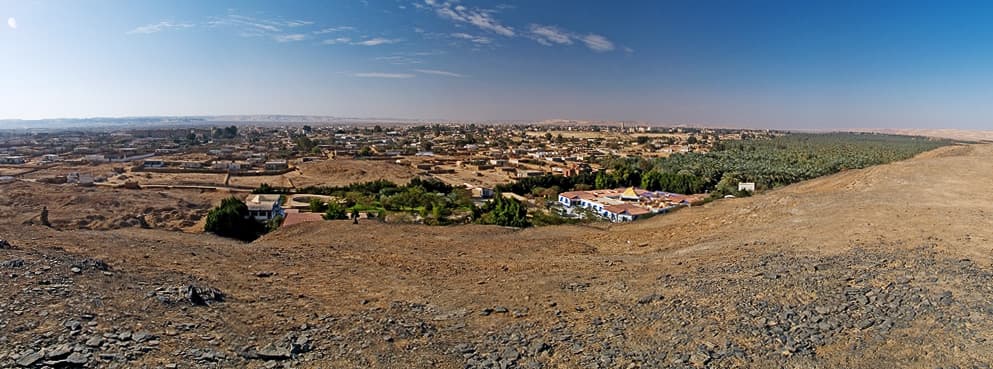 Nomo michael hoefner / http://www.zwo5.de / CC BY-SA 2.5, via Wikimedia Commons
“Where ancient legacies emerge from the embrace of the desert.”
Not the postcards. The stories even locals don't know — whispered in your ear, right where they happened.
Beneath the Bahariya sands, a late 20th-century excavation revealed a burial ground far more extensive than anyone imagined.
This landscape tells a dramatic geological story, a striking contrast to the golden dunes typically found across the Sahara.
Within the desert's vastness, a natural formation gleams with an unexpected brilliance.
Discover every secret of Bahariya
Every address, every reveal in full — in your ear, right where it happened.
You pick your stops. You walk. The voice reveals what the others miss.
No tours available yet. Check back soon — we're preparing them.
Bahariya Oasis, approximately 370 kilometers southwest of Cairo in Egypt's Western Desert, presents a compelling fusion of natural grandeur, ancient narratives, and enduring cultural heritage. This verdant depression, stretching across roughly 2000 square kilometers, offers a striking counterpoint to the surrounding arid expanse with its abundant date palms, olive groves, and fruit orchards. Known historically as "Deses" by the ancient Egyptians and "Parva" by the Romans, Bahariya has held a crucial role throughout Egypt's long story, serving as a vital connection between the Nile Valley and distant African kingdoms.
Today, Bahariya Oasis stands as a center for adventure tourism, inviting visitors to embark on desert safaris, spend nights under clear, star-filled skies, and explore distinctive geological formations. Beyond its dramatic landscapes, the oasis is also recognized for its archaeological treasures, including the celebrated Valley of the Golden Mummies and ancient temples. Travelers can also find solace and restoration in the area's natural hot springs, believed to possess therapeutic qualities.
## From Ancient Settlements to Roman Flourishing Bahariya Oasis carries a deep lineage of human habitation stretching back to the Neolithic period, with evidence of communities from at least the Third Millennium BCE. During ancient Egypt's Middle Kingdom (1975–1640 BC), significant settlements took root, and the oasis became known for exporting agricultural products, particularly wine, to the Nile Valley. Rock inscriptions from the Middle Kingdom and later eras have been discovered in areas like el-Harrah, underscoring this long continuum of life.
The oasis experienced a period of remarkable flourishing during the Greco-Roman era (332 BC–395 AD). It grew into a celebrated center for producing wine, olive oil, dates, and cereals. Notable structures from this period include a temple at Qasr el-Miqisba, dedicated to the god Ammon by Alexander the Great, standing as one of the few Egyptian temples honoring the Macedonian conqueror. The Romans also left their imprint with the construction of a substantial military fort at Qarat el-Toub. In 1996, the extraordinary Valley of the Golden Mummies came to light, revealing hundreds of mummies adorned with elaborate golden masks and decorations, reflecting the oasis's prosperity and a fascinating blend of Egyptian and Roman burial customs.
Bahariya was once a significant center for Coptic Christians, though most of the population embraced Islam centuries ago. The oasis's connection to the wider region of Egypt improved considerably in the early 1970s with the construction of an asphalt road linking it to Cairo, bringing modern infrastructure and influencing the local Waḥātī language. Today, the economy relies on agriculture, iron ore mining, and the welcoming of travelers.
Begin your journey in Bawiti, the main town of Bahariya Oasis, which preserves a charming core of old homes overlooking groves of palms. The Valley of the Golden Mummies offers a compelling view, displaying hundreds of Greco-Roman mummies with gilded faces and intricate burial artifacts, many of which are exhibited in the Golden Mummies Museum in Bawiti. Nearby, the Temple of Ain El Muftella provides insight into 26th Dynasty religious practices with its well-preserved chapels honoring deities like Amun and Horus. Another historical location is the Temple of Alexander the Great, one of the few temples in Egypt dedicated to him.
For natural wonders, venture into the Black Desert, a unique expanse of volcanic hills covered with dark stones and iron-rich rocks, offering sweeping, dramatic vistas. A short drive away, the White Desert National Park presents surreal chalk-white rock formations sculpted by wind and sand into shapes resembling colossal mushrooms and abstract figures. Be sure to see Crystal Mountain, a ridge sparkling with quartz and calcite crystals. Conclude your days by unwinding in one of Bahariya's natural hot springs, such as Bir Sigam, known for its restorative qualities.
The ideal period to visit Bahariya Oasis and the surrounding deserts spans from October to April. During these months, daytime temperatures are comfortably warm, ranging from 20–30°C (68–86°F), making outdoor pursuits like hiking and safaris enjoyable. Evenings bring cool to cold air, typically between 5–15°C (41–59°F), perfect for observing the night sky and enjoying campfires. Summers, from May to September, are intensely hot, with temperatures often surpassing 40°C (104°F), rendering exploration less comfortable.
Bahariya Oasis lies approximately 370 kilometers from Cairo. The most common route to reach it is by bus from Cairo's Turgoman Station, with the trip lasting 4-5 hours. Private cars or taxis are also an option, taking around 4-4.5 hours on a paved highway. Many safari operators offer packages that include transportation from Cairo.
While in Bahariya, securing a local guide is essential for desert excursions and highly advisable for visiting archaeological sites, particularly for navigating the Black and White Deserts. The main town of Bawiti provides basic medical facilities, fuel stations, and ATMs, though carrying sufficient cash is prudent. Lightweight, breathable fabrics like cotton and linen are recommended for daytime, with warm layers crucial for the cool desert nights.