Beethovenhaus
Ludwig van Beethoven found more than just lodging in Baden; he found inspiration for one of his most monumental works.
Full story unlocks in the tour
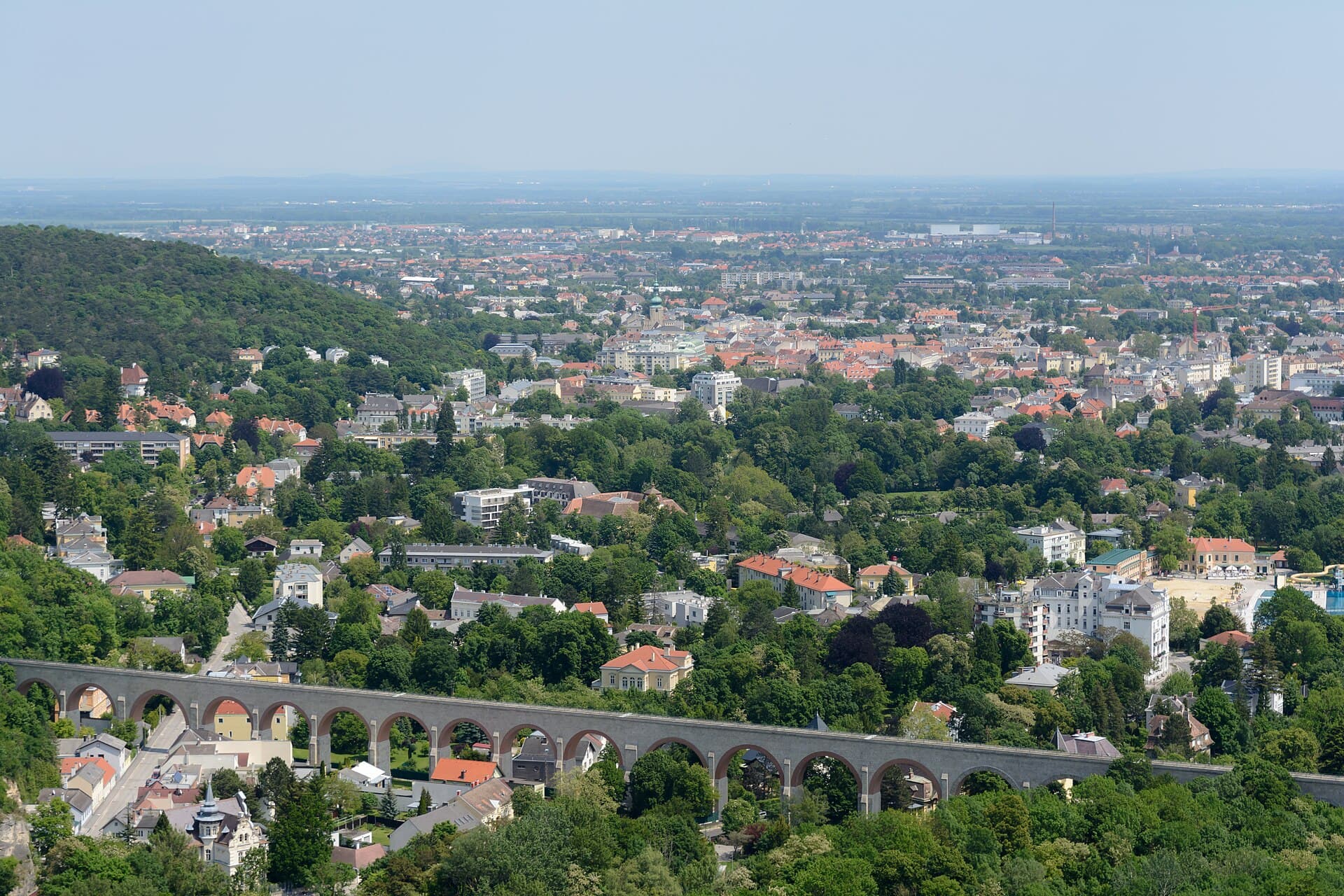 Uoaei1 / CC BY-SA 4.0, via Wikimedia Commons
“Where imperial elegance meets healing waters and artistic whispers.”
Not the postcards. The stories even locals don't know — whispered in your ear, right where they happened.
Ludwig van Beethoven found more than just lodging in Baden; he found inspiration for one of his most monumental works.
Beneath the glittering facade of Austria's largest casino lies a secret that predates its opulent gaming halls by centuries.
The expansive Kurpark, a tranquil green space, once hosted an emperor with a peculiar habit that saved him money.
Discover every secret of Baden
Every address, every reveal in full — in your ear, right where it happened.
You pick your stops. You walk. The voice reveals what the others miss.
No tours available yet. Check back soon — we're preparing them.
Baden bei Wien, often simply called Baden, is a historic spa town in Lower Austria, situated approximately 25 kilometers south of Vienna. Recognized as a UNESCO World Heritage Site in 2021 as part of the 'Great Spa Towns of Europe,' Baden has drawn visitors for its therapeutic sulfur springs for millennia. The town's name itself, 'Baden,' meaning 'baths,' speaks to its long-standing association with these restorative waters.
Beyond its reputation as a spa destination, Baden offers a blend of imperial elegance and cultural richness. The town's architecture displays a mix of early 19th-century Biedermeier style and early 20th-century infrastructure, reflecting its evolution as a world-class resort. Surrounded by vineyards and the Vienna Woods, Baden provides a picturesque setting for relaxation and exploration.
With a population of around 26,000, Baden retains the charm of a smaller European town while offering a diverse range of attractions, from grand old buildings and expansive parks to modern thermal spas and a lively cultural scene. It served as a favored summer retreat for the Habsburg emperors and a workplace for renowned composers like Mozart, Beethoven, and Strauss, solidifying its place in Austrian history and culture.
The story of Baden stretches back to Roman times, when the settlement was known as 'Aquae Cetiae' or 'Thermae Pannonicae,' indicating its early use as a Roman watering place. The warm, mineral-rich sulfur springs were a key draw, leading to the construction of early baths. The town was first mentioned as 'Padun' in a deed from 869 AD.
Baden received its municipal status in 1480. However, its early history was marked by significant challenges, including destruction during Turkish invasions in 1529 and 1683, the Thirty Years' War, a plague in 1713, and a major fire in 1714. Despite these setbacks, the town consistently recovered and flourished.
The 18th and 19th centuries saw Baden rise to prominence as a premier spa destination. Emperor Franz II (later Franz I of Austria) established his summer residence here, spending nearly every summer from 1811 to 1834. This imperial patronage transformed Baden into a social and cultural center, attracting high aristocracy, the upper middle class, and notable figures from the arts. A fire in 1812 led to a significant rebuilding effort in the Biedermeier style, with Joseph Kornhäusel becoming a leading architect in shaping the town's appearance.
Baden's musical heritage is particularly rich. Composers such as Wolfgang Amadeus Mozart, Ludwig van Beethoven, Franz Schubert, and Johann Strauss all spent time in Baden, drawing inspiration from its serene atmosphere. Beethoven, in particular, composed significant parts of his Ninth Symphony during his stays in the town between 1821 and 1823.
By 1870, Baden was recognized as a world-leading spa, attracting fashionable guests from across the globe. During World War I, it served as the temporary seat of the Austro-Hungarian high command. Following World War II, Baden was the headquarters for Soviet forces in occupied Austria until 1955. In 2021, Baden's historical significance and its architectural testimony to 18th and 19th-century international spa culture were formally recognized with its inscription as a UNESCO World Heritage Site.
Begin your exploration in the Kurpark Baden, one of Europe's largest spa parks, offering serene walking paths, historic pavilions, and monuments to famous visitors like Beethoven and Mozart. Within the Kurpark, you will find the Beethoven Temple, offering views over the city, and the music pavilion, where concerts are held.
Adjacent to the Kurpark is the Doblhoffpark, home to the Rosarium, Austria's largest rose garden, displaying over 800 varieties. The main bloom in May and June transforms the park with thousands of colorful blossoms.
Visit the Beethovenhaus on Rathausgasse 10, a museum dedicated to Ludwig van Beethoven's time in Baden, where he worked on his Ninth Symphony. For contemporary art enthusiasts, the Arnulf Rainer Museum is housed in a former bathing temple, showcasing the artist's work within a unique historical setting.
The Hauptplatz (Main Square) is a central point, featuring the Trinity Column, erected in 1714 to commemorate the end of the plague. Nearby is the Kaiserhaus, Emperor Franz II's former summer residence. The Stadtpfarrkirche St. Stephan (parish church of St. Stephen), dating from the 15th century, holds a plaque commemorating Mozart, who is believed to have composed his Ave Verum Corpus here.
Consider a visit to the Casino Baden, one of Europe's oldest and most beautiful casinos, housed in the historic Trinkhalle. For a unique swimming experience, the Thermalstrandbad Baden, also known as the 'Baden Sea,' is an open-air thermal complex with a wave pool and a beach made from Danube sand.
The best time to visit Baden for general outdoor activities and warm weather is from mid-June to early September, with a peak in the second week of August. July is typically the clearest month, with comfortable temperatures. For hot-weather activities like swimming, early July to mid-August is ideal. Spring (April-June) and autumn (September-November) offer mild weather, fewer crowds, and are excellent for enjoying blooming gardens or fall colors. While winters are cold and snowy, Baden still offers attractions like the Römertherme and cultural events, making it a viable option for a cozy getaway.
Baden is easily accessible, situated approximately 25-30 kilometers south of Vienna. The most convenient way to reach Baden by air is via Vienna International Airport (VIE), with taxi or bus transfers taking about an hour. Regular train services from Vienna, including S-Bahn or REX lines, arrive at Baden Bahnhof in about 25-30 minutes. The town itself is walkable, and public transportation is available.
For those interested in exploring multiple attractions, the Niederösterreich Card can provide access to several museums and sites, including the Beethovenhaus and Arnulf Rainer Museum. Most shops in Austria are closed on Sundays, so plan your shopping accordingly. The official currency is the Euro (EUR). While German is the primary language, English is often understood in tourist areas.