Wat Mahathat
The iconic Buddha head, embraced by the roots of a banyan tree, carries a double narrative of destruction and nature's slow embrace.
Full story unlocks in the tour
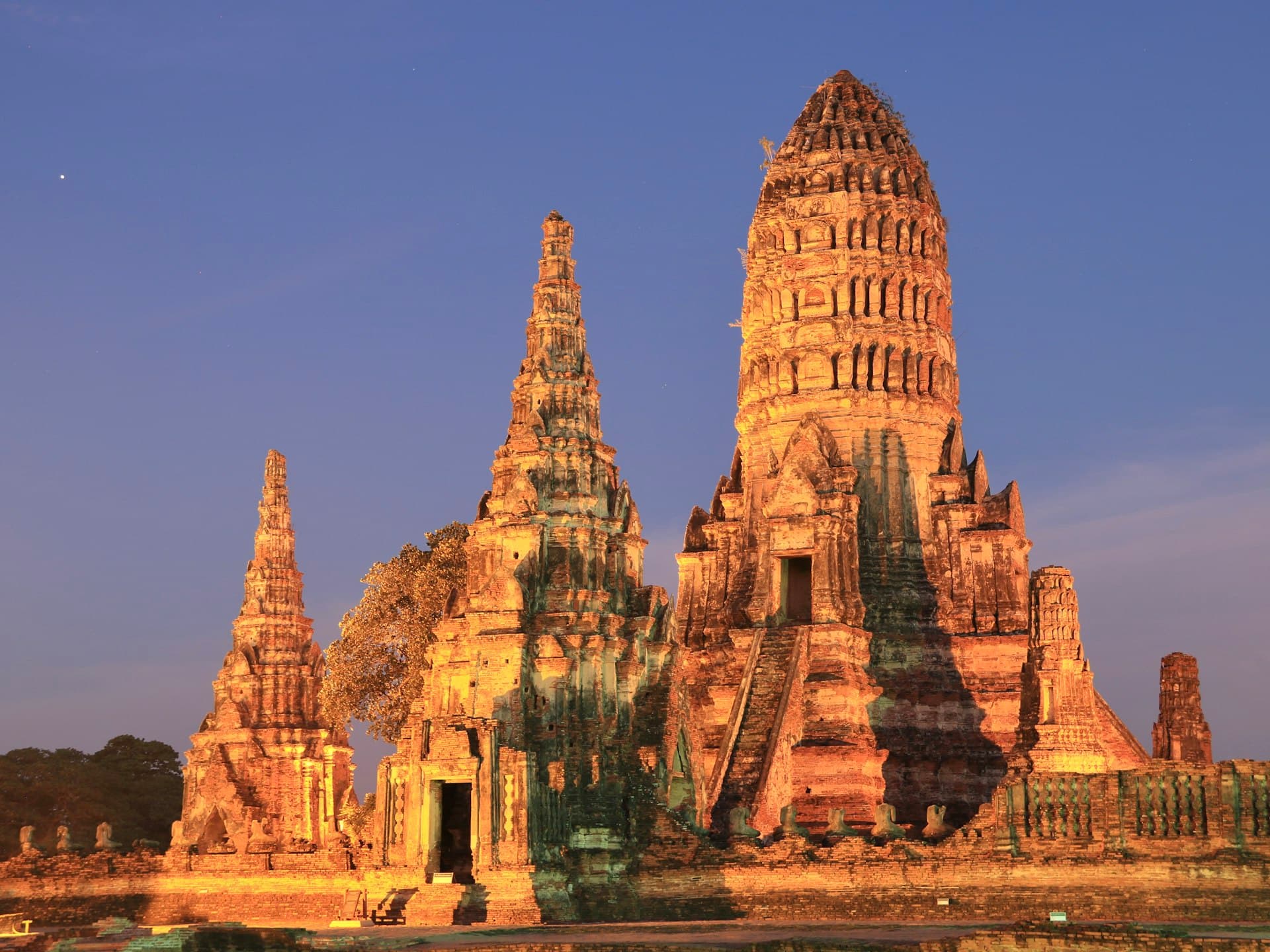 Photo: Hongbin / Unsplash
“Where the stones of a fallen empire speak of grandeur and loss.”
Not the postcards. The stories even locals don't know — whispered in your ear, right where they happened.
The iconic Buddha head, embraced by the roots of a banyan tree, carries a double narrative of destruction and nature's slow embrace.
Though it evokes the spirit of a bygone era, the lively Ayutthaya Floating Market is a more recent creation than the city's ancient temples.
This temple stands as a monument to a dramatic and tragic royal succession, built upon the site of a fatal sibling rivalry.
Discover every secret of Ayutthaya
Every address, every reveal in full — in your ear, right where it happened.
You pick your stops. You walk. The voice reveals what the others miss.
No tours available yet. Check back soon — we're preparing them.
Ayutthaya, a UNESCO World Heritage Site, invites visitors on a profound journey into Thailand's past. Situated a mere 80 kilometers north of Bangkok, this former capital of the Kingdom of Siam flourished from 1350 to 1767, evolving into one of the world's largest and most cosmopolitan cities. Its strategic location, where the Chao Phraya, Lop Buri, and Pa Sak rivers converge, offered both natural defenses and facilitated extensive trade with merchants from both Eastern and Western lands.
Today, the sprawling Ayutthaya Historical Park safeguards the evocative remnants of its grand temples, palaces, and Buddha statues, displaying a synthesis of Khmer, Sukhothai, and Sri Lankan architectural styles. While many travelers experience Ayutthaya as a day trip from Bangkok, an overnight stay allows for a more leisurely exploration, revealing the ruins' magic at sunrise and sunset, and fostering a deeper connection to this storied city.
Ayutthaya was founded in 1350 by King Uthong, also recognized as King Ramathibodi I. Bearing the name of Ayodhya, the fabled city from the Hindu epic Ramayana, it swiftly eclipsed the former capital of Sukhothai in both power and influence. For over four centuries, Ayutthaya served as the heart of the Siamese Kingdom, growing into a significant international trading hub. Merchants and dignitaries from across Asia and Europe, including the Portuguese, Dutch, and French, made Ayutthaya their home, contributing to its diverse and flourishing culture.
At its zenith in the 17th and 18th centuries, Ayutthaya exceeded the combined size of London and Paris, with a population surpassing one million inhabitants. The city was celebrated for its impressive temples, royal palaces, and an intricate network of canals, earning it the moniker 'Venice of the East.' Architectural and artistic advancements from this period significantly influenced the urban planning and design of modern-day Bangkok.
Ayutthaya's prosperity was not without conflict. The kingdom endured constant tension with neighboring Burma, engaging in a series of wars over centuries. In 1767, following a 14-month siege, the Burmese Konbaung dynasty invaded and utterly devastated Ayutthaya. The city was reduced to ashes, its temples demolished, treasures plundered, and many inhabitants were killed or enslaved. This catastrophic event marked the conclusion of the 417-year-old Ayutthaya Kingdom.
After the destruction, the capital of Siam relocated south, first to Thonburi and then to Bangkok, where efforts were made to recreate Ayutthaya's architectural and urban blueprints. For nearly two centuries, Ayutthaya lay dormant, its sacred structures remaining as poignant relics. Restoration endeavors commenced in the 1960s, and in 1991, a substantial portion of the Ayutthaya Historical Park received designation as a UNESCO World Heritage Site, acknowledging its profound historical and cultural importance. Today, the ruins stand as a powerful testament to Thailand's enduring history and the resilience of its people.
The Ayutthaya Historical Park, an expansive open-air museum, warrants at least one full day of exploration, or ideally, two. Begin at Wat Mahathat, known for the Buddha head embraced by tree roots—a truly iconic and frequently photographed sight. Directly across stands Wat Ratchaburana, where visitors can ascend partway up its central prang and explore crypts that once held ancient treasures and faded murals.
Wat Phra Si Sanphet, once the royal temple and ceremonial heart, features three iconic chedis that enshrined the ashes of Siamese kings. For a grand riverside tableau, visit Wat Chaiwatthanaram, a Khmer-style temple particularly striking as dusk settles. Do not overlook Wat Yai Chai Mongkhon, with its imposing central stupa encircled by rows of seated Buddhas and a large reclining Buddha statue. For a more serene experience, seek out the massive, 42-meter-long reclining Buddha at Wat Lokayasutharam, situated amidst sparse ruins, offering a distinct contrast.
Consider a boat trip along the Chao Phraya River for an altered perspective of the temples, especially as evening light fades. The Ayutthaya Night Market provides a lively setting for local street food and crafts after the temples close. For a deeper look at artifacts, the Chao Sam Phraya National Museum houses many items recovered from temple crypts.
The most pleasant time to visit Ayutthaya is during Thailand's cool, dry season, from November to February. Temperatures during these months typically range from 22–30°C, providing comfortable conditions for exploring the outdoor ruins. December and January are the busiest tourist months, offering clear skies and pleasant mornings, though popular locations can draw crowds. For slightly fewer visitors with similarly excellent weather, consider November or February. The hot season (March-May) frequently sees temperatures exceeding 35-40°C, making midday sightseeing intense. The rainy season (June-October) brings heavy afternoon downpours but also verdant landscapes and significantly fewer visitors.
Ayutthaya is readily accessible from Bangkok by train, bus, minivan, taxi, or guided tour, with journeys typically lasting 1 to 2 hours. Once in Ayutthaya, you can navigate the historical park on foot, by bicycle (rentals are affordable), or by tuk-tuk, which can be hired for individual trips or by the hour. A combo pass for six major temples costs 220 THB and offers good value, though individual temple entries are usually 50 THB.
Dress with respect when visiting temples by ensuring shoulders and knees are covered. Loose, long clothing is also more comfortable in the heat and humidity. Stay hydrated with ample water, use sunscreen, and carry insect repellent. Comfortable walking shoes are strongly recommended for traversing the uneven temple grounds. While generally safe, observe typical travel precautions such as safeguarding valuables and agreeing on tuk-tuk fares in advance.