Chapel of the Tablet at the Church of Our Lady Mary of Zion
A single monk guards a sacred relic, unseen by any other living soul.
Full story unlocks in the tour
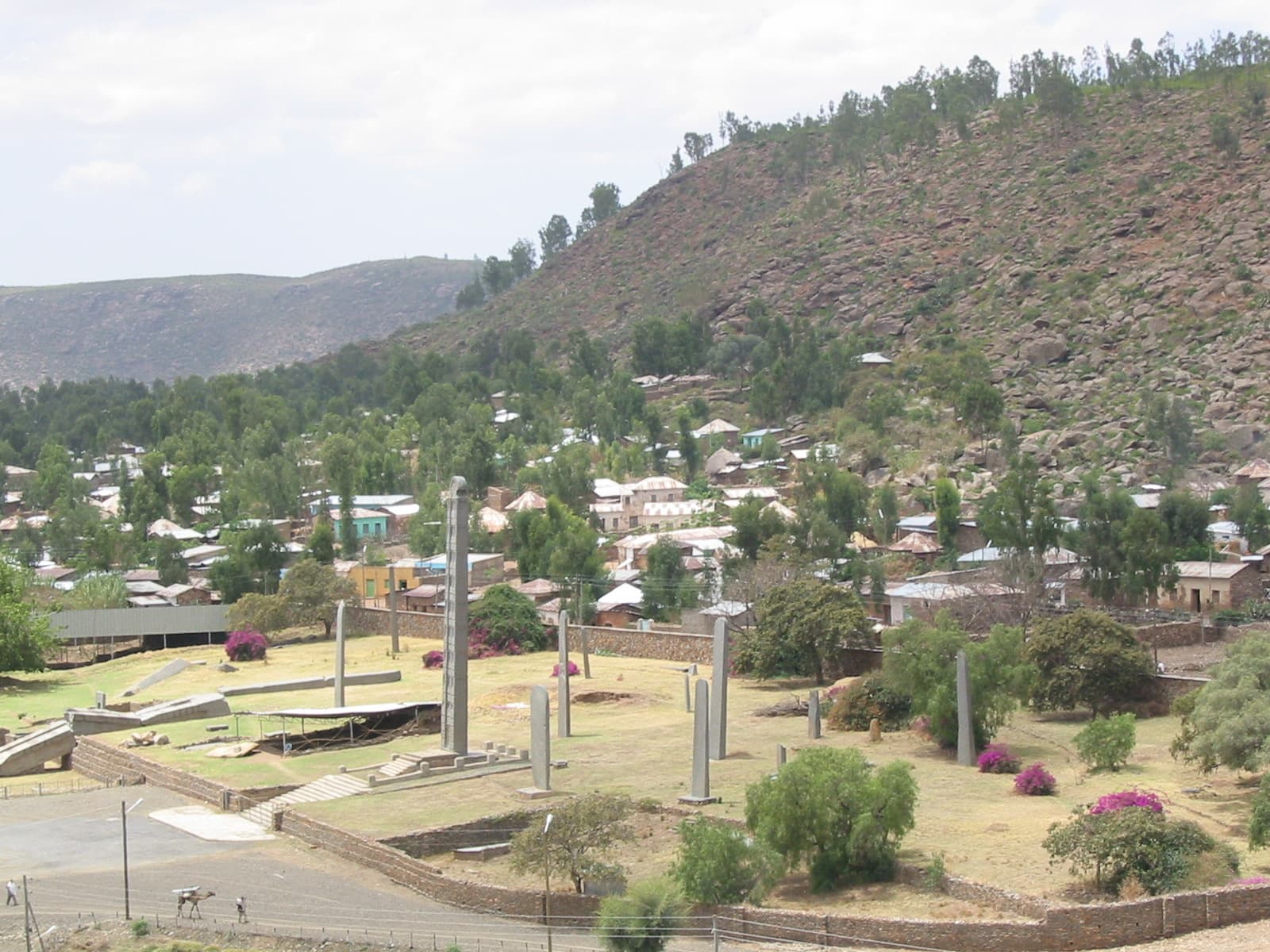 Jim Williams / CC BY-SA 3.0 igo, via Wikimedia Commons
“Where ancient obelisks pierce the sky and legends of queens and covenants echo through time.”
Not the postcards. The stories even locals don't know — whispered in your ear, right where they happened.
A single monk guards a sacred relic, unseen by any other living soul.
One of the largest carved stones ever attempted by ancient humans lies broken on the ground.
This ancient reservoir is still used for a significant ritual each year, though its royal namesake might not have bathed there.
Discover every secret of Axoum
Every address, every reveal in full — in your ear, right where it happened.
You pick your stops. You walk. The voice reveals what the others miss.
No tours available yet. Check back soon — we're preparing them.
Axum, also spelled Aksum, is a city in Ethiopia's northern Tigray Region, a profound link to one of Africa's most influential ancient civilizations. Once the capital of the powerful Axumite Empire, which flourished from approximately 100 CE to 940 CE, Axum was a major trading power that controlled routes across the Red Sea, connecting Africa, Arabia, and the Greco-Roman world.
Today, Axum is a UNESCO World Heritage Site, recognized for its monumental obelisks, ancient ruins, and deep cultural significance. It is considered the cradle of Ethiopian civilization and a foundational center of Ethiopian imperial history. The city's blend of archaeological wonders and enduring legends, including its alleged connection to the Queen of Sheba and the Ark of the Covenant, makes it a compelling destination for those seeking to explore Ethiopia's ancient past.
Axum rests at an elevation of 2,131 meters (6,991 feet) and offers a tangible sense of stepping into history, where the spirit of the past is palpable at every turn.
The origins of Axum trace back to a blend of Cushitic-speaking peoples in Ethiopia and Semitic-speaking peoples from southern Arabia, who settled across the Red Sea around 500 BCE. This cultural fusion was evident in the early kingdom of Yeha, which arose around the mid-fifth century BCE. Following Yeha's collapse, Axum emerged as the dominant regional power in the first century CE.
The Axumite Empire rapidly grew into a significant naval trading power, strategically positioned to control key trade routes between Africa, Arabia, and India. Its major cities, including Adulis, Axum, and Matara, became cosmopolitan centers, hosting Jewish, Nubian, Christian, and even Buddhist minorities. The empire's prosperity was built on exports such as gold, ivory, and incense, and it was the first African empire outside of Egypt to mint its own coinage in gold, silver, and bronze.
A pivotal moment in Axum's history occurred in the 4th century CE when King Ezana converted to Christianity under the guidance of a Syrian bishop. Ezana declared Axum a Christian state, making it one of the first nations in the world to embrace Christianity as a state religion, long before much of Europe. This conversion led to the development of a unique Ethiopian literary tradition and the adoption of the Ge'ez script in liturgy, replacing Greek.
Axum remained a strong empire and trading power until the rise of Islam in the 7th century. While Islamic powers spread through Africa, Axum maintained good relations with its Islamic neighbors due to its earlier sheltering of Muhammad's first followers. However, the empire eventually declined as Arab control of Red Sea trade routes cut off Axum's commerce with Alexandria, Byzantium, and Southern Europe. The power center shifted south, but Axum's cultural, religious, and political legacies continued to shape subsequent Ethiopian societies, solidifying its place as a precursor to the modern Ethiopian state.
Axum offers a concentration of historical and religious sites, many within walking distance of each other. The Northern Stelae Park is a primary draw, featuring around 120 monolithic obelisks, some standing over 23 meters tall, intricately carved to resemble multi-story buildings. These stelae are believed to mark the tombs of ancient kings.
Adjacent to the stelae field is the Axum Museum, which houses artifacts from the pre-Axumite, Axumite, and post-Axumite eras, offering context to the region's history. The Church of St. Mary of Zion complex is a revered religious site, believed by many to house the Ark of the Covenant in its Chapel of the Tablet, though access is restricted to a single guardian monk. The complex includes both the old and new churches of Our Lady Mary of Zion.
Other significant sites include the ruins of Dungur Palace, also known as the Palace of the Queen of Sheba, dating back to the 4th century. The Queen of Sheba's Bath (Mai Shum), an ancient reservoir, is still used for ritual baptisms. Visitors can also explore King Ezana's Park, known for a 4th-century stone tablet inscribed in ancient Greek, Ge'ez, and Sabean, and the Tombs of Kings Kaleb and Gebre Meskal from the 6th century.
The optimal time to visit Axum is during the dry season, which runs from October to March. During these months, the weather is mild with clear skies, making it ideal for exploring the outdoor historical sites. Temperatures are generally comfortable, with peak daytime temperatures around 27°C (80°F). The wet season, from May to September, should generally be avoided as heavy rainfall can make roads muddy and difficult to access. November offers particularly clear skies.
Axum is reachable by domestic flights from Addis Ababa, Ethiopia's capital. While the town is small, a knowledgeable local guide is highly recommended to provide context to the archaeological sites, legends, and imperial history. Most visitors spend one to two nights in Axum to explore the main attractions.
Accommodation options in Axum are generally modest, so be prepared for more basic facilities. Cash is essential, as credit cards are rarely accepted outside of hotels. It's advisable to bring USD or Euros to exchange at banks or hotels, as ATMs can be unreliable. Axum rests at an altitude of approximately 2,100 meters (6,991 feet), so take it slow upon arrival to adjust to the elevation and stay hydrated. When visiting religious sites, dress modestly and respectfully, covering shoulders and legs, and always ask permission before photographing local people.